MLIT and CFAIC Announce Investigation Findings
Rainwater Infiltrating Wall, Poor Drainage Increased Water Pressure
"Deficiencies and Improper Responses at Every Stage... Multiple Complaints Before Accident"
Nationwide Full-Scale Inspection and Special Checks Followed by Reinforcement Measures
According to an investigation, the overpass retaining wall collapse in Osan, Gyeonggi Province last July resulted from poor or inappropriate responses at every stage, from design and construction to maintenance.
The same construction company had already experienced two separate collapses of other retaining walls it built, and there were clear warning signs that this wall might fail even before the accident. However, no meaningful action was taken, which greatly worsened the damage. Because this was an accident that could have been prevented, it is hard to avoid criticism that it was a man-made disaster. The government has decided to inspect all similar types of retaining walls nationwide and carry out repairs and reinforcement where necessary.
On the 26th, the Ministry of Land, Infrastructure and Transport and the Central Facility Accident Investigation Committee (CFAIC) announced the investigation findings and measures to prevent a recurrence. In July last year, a 10-meter-high reinforced earth retaining wall at the Gajang Intersection overpass in Osan collapsed, burying two vehicles. One person was killed and one person was injured in the accident. Over seven months following the incident, the CFAIC conducted on-site inspections, document reviews, hearings with related parties, and ground investigations and quality tests.
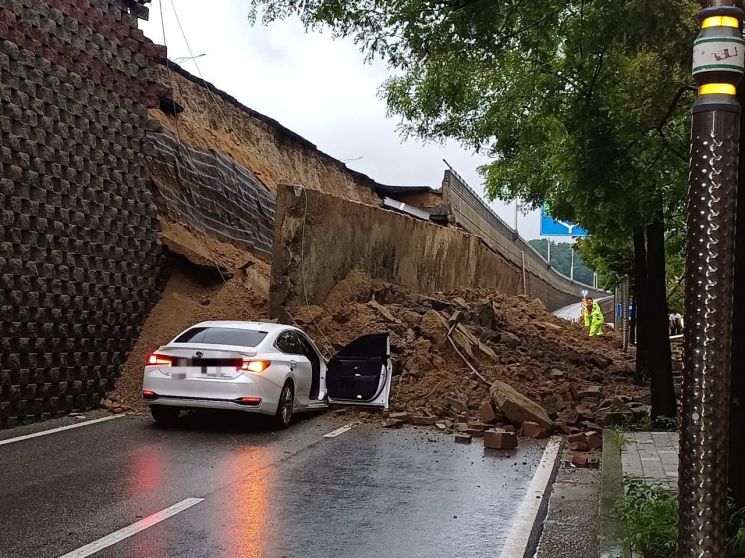 Last July, heavy rains caused the overpass retaining wall at the Gajang Intersection in Osan, Gyeonggi Province to collapse, crushing two vehicles. Yonhap News, Gyeonggi Provincial Fire & Disaster Headquarters
Upper structure settled, rainwater kept flowing in → water pressure increased and caused collapse
The CFAIC concluded that the direct cause of the collapse was that, after heavy rainfall at the time, drainage did not function properly, which increased the pressure acting on the retaining wall. The drainage channel and pavement surface above the wall cracked, allowing rainwater to continuously infiltrate through the gaps. This weakened the backfill material (the soil used to fill the space behind the wall).
The L-shaped retaining wall installed at the top of the structure first subsided, and settlement and cracking occurred in the overpass pavement. As a result, more rainwater flowed in through the cracked areas. At the time, there was a localized downpour of 39.5 mm per hour. Because the rainwater was not drained, the water pressure increased and the wall eventually collapsed.
At the design stage, the risk associated with the composite structure created by the upper L-shaped retaining wall should have been carefully assessed, but this was done poorly. Proper drainage measures should have been designed to prevent excessive water pressure, but the drainage design was inadequate. The quality standards for the backfill material were also not clearly specified.
At the construction stage, soil containing a large amount of fine particles with poor drainage characteristics was used. There were no records indicating whether approval had been obtained for changing materials (reinforced soil blocks) or whether quality tests had been conducted. There were also construction quality issues, such as submitting the original design drawings as-built without reflecting design changes. Supervisors and inspectors likewise failed to properly oversee and correct the construction company’s improper handling of its work.
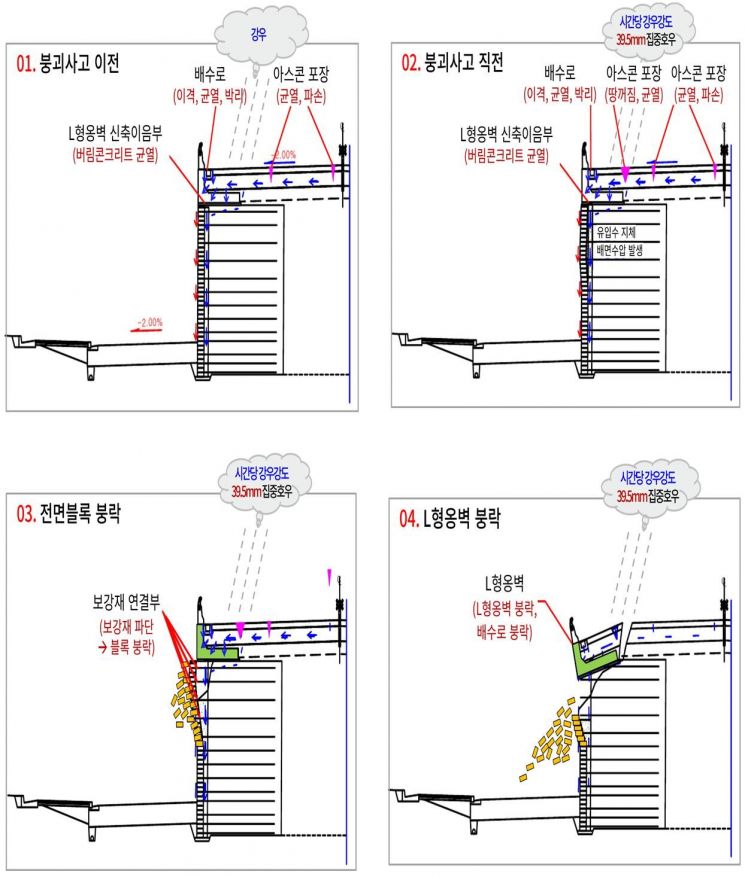 Collapse process of the reinforced earth retaining wall of the overpass at Osan Gajang Intersection. Provided by the Ministry of Land, Infrastructure and Transport
The management entity was also unclear. Although this facility was completed in 2011, it was not handed over to Osan City, the managing authority, until 2017. Until it opened to traffic in 2023, it was not registered in the Facility Management System (FMS), and therefore did not undergo mandatory procedures such as safety inspections.
There were also signs of poor maintenance. Hyundai Engineering & Construction, which built this facility, had previously carried out construction on another retaining wall at a nearby intersection and one in another region, and both walls collapsed in accidents in 2018 and 2020. Even after those accidents, the company did not conduct safety reviews or present measures to prevent recurrence. During a detailed safety inspection in 2023, problems such as poor drainage and bulging were pointed out, but the follow-up measures were reportedly inadequate.
From about 20 days before the Osan collapse until the day of the accident, multiple civil complaints were filed through the national civil complaint portal about settlement of the pavement and concerns over possible collapse in the accident section. Nevertheless, Osan City did not take proactive measures such as cause analysis or safety assessment.
Revision of design standards and stronger management…nationwide full-scale inspection
To prevent similar accidents, the CFAIC proposed improving construction standards, strengthening the maintenance system, and conducting special inspections. For composite structures where an L-shaped retaining wall is installed on top of a reinforced earth retaining wall, it recommended establishing specific design and construction standards, including load application and construction methods, and strengthening design standards for drainage facilities.
It also pointed out the need to strengthen management by periodically checking whether facilities are registered in the FMS and whether design documents have been submitted, and by having the government issue enforcement orders when unregistered facilities are discovered. The Ministry of Land, Infrastructure and Transport plans to revise the Enforcement Decree of the Facility Safety Act.
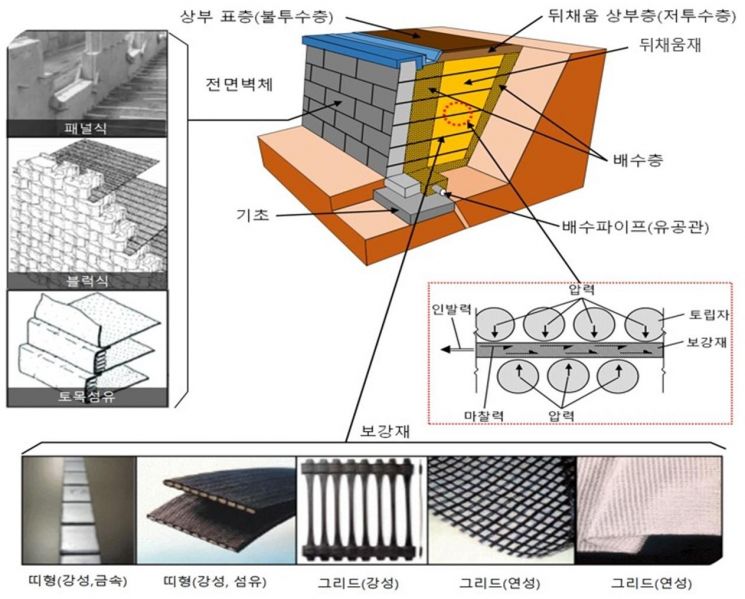 Components of reinforced soil retaining walls. Provided by the Ministry of Land, Infrastructure and Transport.
The committee further proposed a nationwide full-scale inspection of composite reinforced earth retaining walls and their drainage designs. Facilities found to be inadequate through this inspection will be subject to special inspections, and safety assessments or repair and reinforcement measures will be implemented where necessary. Local governments are to complete their surveys by May and carry out special inspections by September.
CFAIC Chairperson Kwon Ohkyun stated, "This accident was the result of comprehensive deficiencies throughout the construction process, including design, construction, and maintenance," and stressed, "Relevant agencies must thoroughly implement countermeasures so that similar accidents do not recur." The Ministry of Land, Infrastructure and Transport plans to revise related laws and standards based on the investigation results. It will also take steps to ensure that administrative sanctions and criminal investigations of those responsible for the accident proceed without delay.
The section where the accident occurred was designed under contract from Osan City by Kunhwa Engineering, Donga Engineering Consultants, and Donglim Consultant. Korea Land and Housing Corporation (LH) commissioned the construction, and Hyundai Engineering & Construction carried out the work from 2007 to 2011, with construction supervision handled by Korea Construction Management Corporation and LH. In 2017, management responsibility was transferred from LH to Osan City, and the road was opened to traffic in 2023.
© The Asia Business Daily(www.asiae.co.kr). All rights reserved.














