After the U.S. Supreme Court invalidated on February 20 the tariffs imposed under the Trump administration based on the International Emergency Economic Powers Act (IEEPA), the Cato Institute, a U.S. libertarian think tank, argued that the 10% tariffs the Trump administration imposed under Section 122 of the Trade Act are also clearly in violation of the law.
The legal basis for invoking Section 122 of the Trade Act is the existence of “large and serious United States balance-of-payments deficits,” but the Trump administration invoked it to address “large trade deficits.” The Cato Institute argues that the balance of payments and the trade balance must be distinguished. The balance of payments consists of the current account, the financial account (including foreign exchange reserves), and the capital account, whereas the trade balance is only one component (the goods balance) of the current account.
Clark Packard and Alfredo Carrillo Obregon, trade policy experts at the Cato Institute, made this argument in an article titled “The New Trump Tariffs Are Also Unlawful,” posted on the institute’s website on February 24.
Section 122 of the Trade Act was enacted in the early 1970s (1974), when the United States was leaving the Bretton Woods fixed exchange rate system. The provision allows the president, in response to “situations of fundamental international payments problems,” to impose temporary import tariffs of up to 15% or other trade-restrictive measures such as quotas for up to 150 days, unless Congress approves an extension.
The situations specified in the statute are either “large and serious United States balance-of-payments deficits” or cases in which the dollar faces an “imminent and significant depreciation.”
Because the Trump administration claimed that Section 122 had to be invoked to resolve the United States’ large trade deficit, it effectively treated the trade balance and the balance of payments as the same thing, which the institute contends is a significant distortion of the statutory language. Another provision of Section 122 authorizes temporary trade-liberalizing measures to address “large and persistent balance-of-trade surpluses.” This shows that Congress understood the balance of payments and the trade balance as distinct concepts. The Senate Finance Committee report also distinguishes between the two.
The institute also offered an economic explanation. The balance of payments consists of the current account, the financial account, and the capital account. Under a fixed exchange rate system, when a balance-of-payments imbalance occurred, a country had to devalue its currency or use its foreign exchange reserves. At that time, a “balance-of-payments deficit” meant a decline in foreign exchange reserves. Today, however, the system is based on floating exchange rates, and a country like the United States, which has ample capital inflows and does not fix its currency, does not need to defend a balance-of-payments deficit with foreign exchange reserves. The currency adjusts freely.
Economist Milton Friedman had already argued in the 1960s that floating exchange rates eliminate balance-of-payments problems. Today, the United States records the world’s largest trade deficit but at the same time the largest financial account surplus. Most economists do not regard the United States as experiencing “large and serious balance-of-payments deficits.” As long as there is sufficient demand for U.S. Treasury securities and equities, the United States is not facing a “balance-of-payments problem.”
The institute noted that the Trump administration’s Department of Justice (DOJ) acknowledged in previous litigation that Section 122 does not apply to the current situation. In a brief submitted to the Court of Appeals, the DOJ stated that “the concerns raised by the President in declaring a national emergency stem from the trade deficit, which is conceptually distinct from a balance-of-payments deficit.” Although this reasoning was withdrawn at the Supreme Court stage, it would now be difficult to argue the opposite.
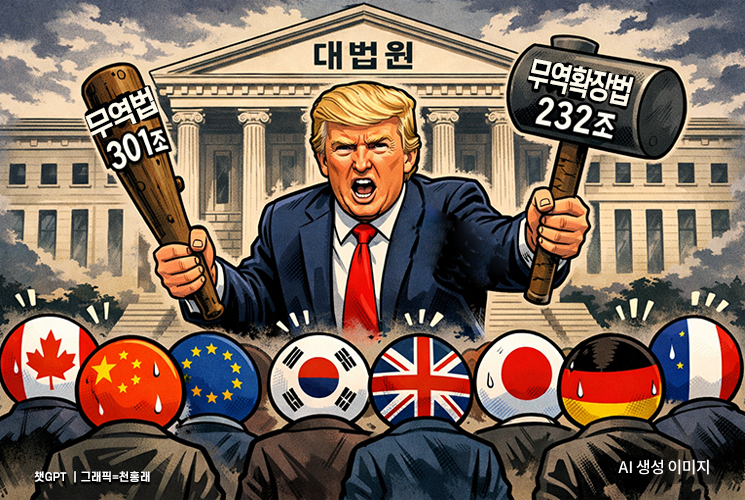
The institute predicted that “the courts should issue an injunction against enforcement of Section 122, but if the litigation drags on, the 150-day period could be exceeded.” It added, “If the president wants such broad tariff authority, the proper course is to ask Congress for it. However, given that 2026 is an election year and tariffs have become highly unpopular, that is unlikely in practice. Instead, the administration is more likely to use the 150-day window to maintain tariffs under Section 122 while attempting, through Sections 301 and 232, to effectively reconstitute the IEEPA regime.”
© The Asia Business Daily(www.asiae.co.kr). All rights reserved.












