Last year, total global debt reached a record high of 348 trillion dollars (approximately 4,970 quadrillion won). The expansion of fiscal deficits in major economies such as China, the United States, and Europe had a significant impact. Debt is expected to increase further going forward due to defense spending and investment in artificial intelligence (AI).
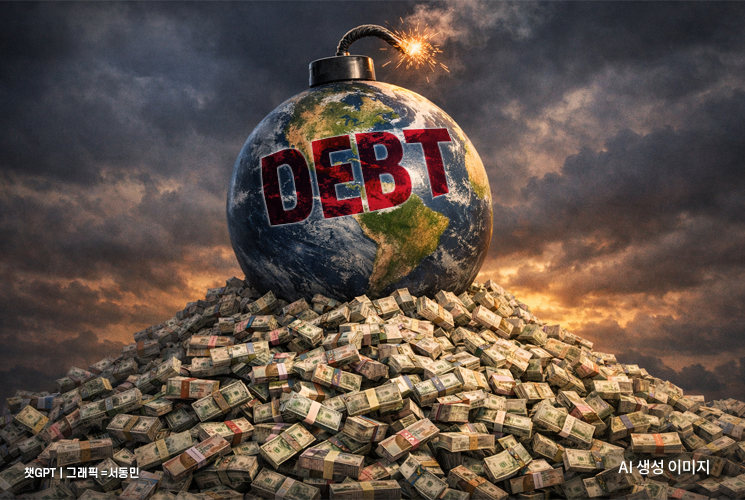
On the 25th (local time), the Institute of International Finance (IIF) reported that total global debt last year stood at 348 trillion dollars, up 28.8 trillion dollars (approximately 410 quadrillion won) from the previous year. This was the largest annual increase since the COVID-19 pandemic. By sector, government debt amounted to 106.7 trillion dollars, non-financial corporate debt to 100.6 trillion dollars, and household debt to 64.6 trillion dollars. By market, advanced economies accounted for 231.7 trillion dollars and emerging economies for 116.6 trillion dollars.
Debt levels rose as government spending increased. In particular, the United States, China, and major European economies accounted for about three-quarters of the total increase. The expansion of defense budgets in major countries and rising investment in advanced technologies also served as key drivers of higher fiscal spending. Gordon Shannon, a fund manager at TwentyFour Asset Management, told the Financial Times (FT) that these figures are "a further wake-up call for markets," adding, "Attention has focused on companies issuing AI-related bonds to finance surging capital expenditure, but in reality it is governments that are driving bond supply."
Although total debt increased, the debt-to-gross-domestic-product (GDP) ratio fell for the fifth consecutive year to 308%. The debt-to-GDP ratio is regarded as an indicator of a borrower’s ability to service its obligations. However, the decline in the ratio was driven by an easing of burdens in the private sector, while the share of government debt in GDP continued to rise. In emerging economies, the debt-to-GDP ratio exceeded 235%, hitting an all-time high.
The IIF projected that global debt could increase much more over the coming years if fiscal expansion driven by higher defense spending coincides with interest-rate cuts and a relaxation of financial-sector regulation. In Europe, where defense spending is rising amid heightened geopolitical tensions, the debt-to-GDP ratio is expected to climb by more than 18 percentage points by 2035. The IIF analyzed that "a powerful global capital-expenditure 'supercycle' centered on large-scale investment in AI-based data centers, energy security and transition, and resilient infrastructure will further reinforce this trend."
Meanwhile, the IIF added that emerging economies are facing an unprecedented refinancing burden, with more than 9 trillion dollars of debt maturing in 2026.
© The Asia Business Daily(www.asiae.co.kr). All rights reserved.












