Ministry of Education Announces Launch of "Sunlight-Connected School" Project on 26th
Choi Kyojin: "Practicing Carbon Neutrality Starting from Schools... Climate Change and Ecological Transition Education"
The government has decided to gradually expand solar power generation facilities to all national and public elementary, middle, and high schools nationwide by 2030. Excluding 2,371 small schools and aging schools where it is difficult to install such facilities, solar facilities are expected to be installed at virtually all schools.
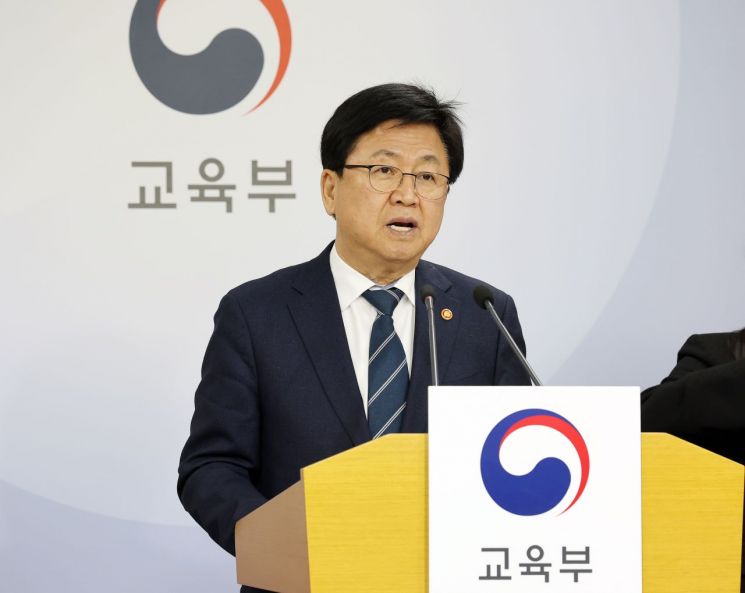
Minister of Education Choi Kyojin held a briefing at the Government Complex Sejong on the 26th and announced the "Sunlight-Connected School Project Implementation Plan," which contains these details.
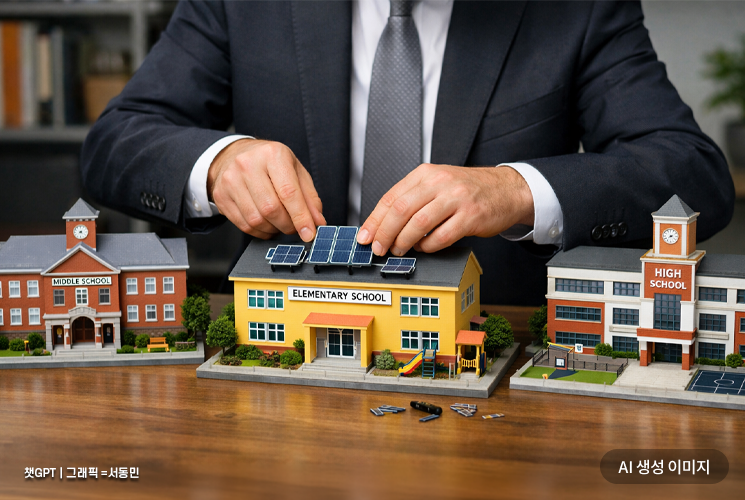
The Sunlight-Connected School project was prepared to respond to the increasing trend in schools' electricity consumption and electricity bills, and to enable schools to play a leading role in reducing greenhouse gas emissions for a nationwide energy transition. As of last year, among 10,315 national and public elementary, middle, and high schools, 3,566 schools (34.6%) were equipped with solar facilities. This year, new solar facilities will be installed at 260 schools, and facilities will be expanded at 140 schools through space restructuring and the completion of school-complex facilities, so that a total of 400 schools will carry out a pilot Sunlight-Connected School project. The pilot project will be funded with 43.3 billion won in special grants. For the remaining 3,978 schools, excluding small schools (2,274 schools) and aging schools (97 schools) where it is difficult to install solar facilities, the government plans to install facilities in stages by 2030. Private schools will be handled separately by the Ministry of Climate and Energy.
The solar panels to be installed at each school will be approximately 4 m by 40 m in size, with an installed capacity of around 50 kW. Each school is expected to generate about 68 MWh of electricity annually. Based on 400 schools, this is equivalent to the annual effect of planting 1.91 million pine trees. In terms of greenhouse gas reduction, this amounts to 12,597 tons per year.
According to the Ministry of Education, electricity consumption and educational electricity tariffs for schools have been rising every year. Electricity consumption at elementary and secondary schools increased from 3.448 billion kWh in 2020 to 4.434 billion kWh in 2024, and during the same period, electricity bills rose from 358.5 billion won to 634.0 billion won. The Ministry of Education expects that, through this project, part of the electricity used in schools will be replaced by self-consumption of solar power, reducing electricity bills by 10 million won per school annually.
The project is also significant as a school-level initiative to help achieve the government's "mid- to long-term national greenhouse gas reduction targets." The government aims to reduce greenhouse gas emissions by 40% by 2030 compared with 2018 levels. Through this project, the Ministry of Education said it will emphasize the role of schools as spaces for climate change and ecological transition education in which students can directly experience and explore carbon neutrality and energy use and production.
Separate measures will also be strengthened to ensure safe management. Using the Integrated Education Facility Information System, the government plans to comprehensively monitor power generation and abnormal signs, and manage the entire process of operating solar facilities at each school based on data. It will make it mandatory to install "arc protection devices," which cut off electricity when an arc occurs in the direct current circuits of solar facilities, and, depending on conditions, will also install fire-prevention systems such as emergency shutoff devices linked to fire detection. In addition, the statutory inspection cycle for solar facilities will be shortened from once every four years to once a year so that safety inspections can be conducted annually.
The installation of solar facilities may cause indirect damage in surrounding areas, such as light reflection. Regarding these concerns, an official from the Ministry of Education said, "We will proceed after considering the installation angle, location, and other factors," adding, "If complaints arise due to light reflection and similar issues, the school in question may be moved to a lower priority in the project schedule."
Minister Choi said, "This is a meaningful project that goes beyond energy savings and greenhouse gas reduction to transform schools into central spaces for climate change and ecological transition education," adding, "We hope that carbon-neutral practices in schools will spread not only to local communities but also throughout society as a whole."
© The Asia Business Daily(www.asiae.co.kr). All rights reserved.













