Ministries of Industry and Labor Hold Roundtable with Heads of Foreign Chambers in Korea
Industry Minister: "We Will Establish Hotlines with Foreign-Invested Companies and Fully Support Businesses"
Labor Minister: "We Will Enhance Predictability on
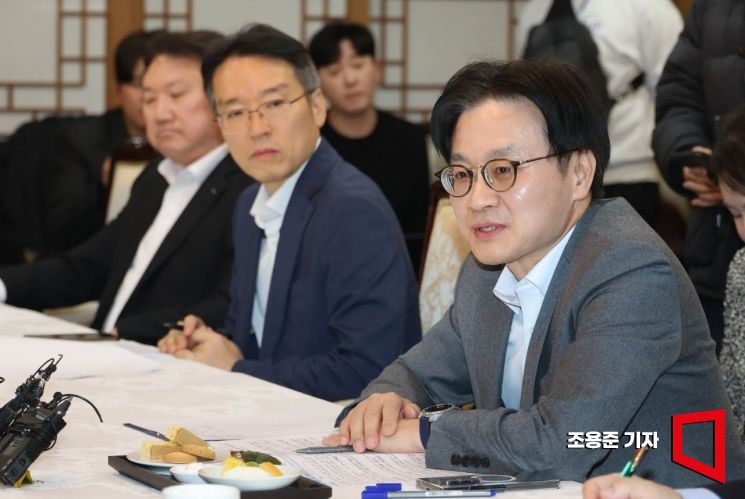 Kim Jeonggwan, Minister of Trade, Industry and Energy, is speaking at an invited roundtable hosted by the American Chamber of Commerce in Korea at the Government Complex Seoul in Jongno-gu, Seoul, on January 9, 2026. Photo by Cho Yongjun
As the enforcement of the revised Trade Union Act, commonly known as the "Yellow Envelope Act," draws near, the government has moved to contain growing concerns among foreign companies over labor-management risks. It announced plans to prepare interpretive guidelines and strengthen on-site communication in order to minimize uncertainty surrounding the expanded scope of "employers" and the provisions limiting claims for damages.
At a roundtable meeting held on the 26th at Korea Electric Power Corporation's South Seoul Office in Seoul with the heads of seven foreign chambers of commerce in Korea from the United States, Europe, Germany, France, the United Kingdom, Japan, and China, Minister of Trade, Industry and Energy Kim Jeonggwan said, "Following the revision of the Trade Union Act, we have worked with the Ministry of Employment and Labor to draw up interpretive guidelines in order to ease uncertainty at labor-management sites and to establish sound labor relations based on dialogue and cooperation," adding, "Together with the Ministry of Employment and Labor, we will do our utmost to support companies by strengthening communication between labor and management and establishing a hotline with foreign-invested companies."
Minister of Employment and Labor Kim Younghoon also said, "The revised Trade Union Act is a law aimed at promoting dialogue between labor and management and strengthening a sustainable industrial ecosystem," adding, "We are preparing for its implementation with top priority on enhancing predictability in the field while remaining faithful to the purpose of the law."
The roundtable was organized to review the opinions of foreign companies investing in Korea regarding the revised Trade Union Act, which is scheduled to take effect on March 10. The aspects that foreign companies are particularly focused on are the expanded scope of employers and the provisions limiting claims for damages. In manufacturing and infrastructure sectors where subcontracting structures are common, there is a possible interpretation that bargaining responsibilities could extend to the primary contractors, which has led to calls to improve predictability regarding the scope of the law's application. In addition, the fact that the scope of damage claims arising from industrial actions will be restricted is also cited as a concern from an investor's perspective, as it could affect corporate risk management systems.
At the roundtable, the American Chamber of Commerce in Korea and the European Chamber of Commerce in Korea (ECCK), among others, conveyed these on-site recommendations related to the law's enforcement. In response, the two Korean ministers stated that they would carefully review and reflect corporate opinions in the course of operating the system.
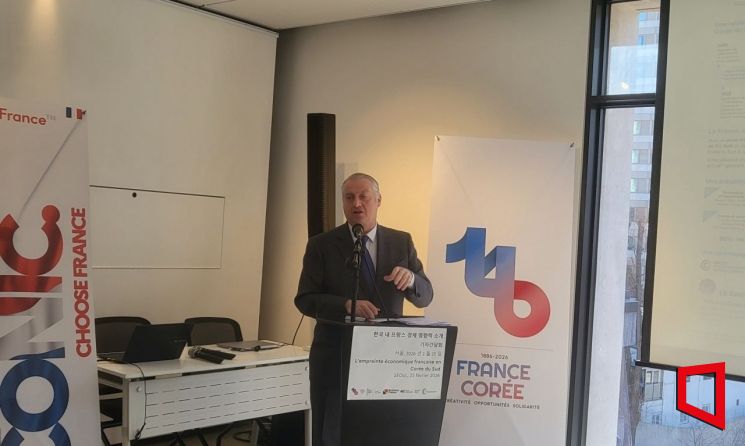 Jallicong Davidpierre, Chairman of the French Chamber of Commerce in Korea, is speaking at a press conference for the "Study Report on France's Economic Influence in Korea" held at the French Embassy in Korea, Seodaemun-gu, Seoul, on the morning of the 25th. Photo by Sim Seonga
Earlier, at an event held the previous day at the French Embassy in Korea in Seodaemun-gu, Seoul, to present the "Study Report on France's Economic Influence in Korea," the French Korean Chamber of Commerce and Industry disclosed that it had formed a task force (TF) with the Ministry of Trade, Industry and Energy to help resolve labor-management conflicts at French companies operating in Korea.
David-Pierre Jallicon, Chairman of the French Korean Chamber of Commerce and Industry, said, "We formed a TF with the Ministry of Trade, Industry and Energy to resolve labor-management conflicts that foreign companies experience in Korea, and officials from the Ministry of Employment and Labor are also taking part," adding, "The five major foreign chambers of commerce in Korea have consulted with senior government officials and submitted recommendations to the Korean government." He continued, "From an investor's perspective, we explained the impact that law enforcement could have on corporate activities and asked for a gradual application of regulations and for efforts to minimize conflicts or misunderstandings in legal interpretation."
Lee Joon, Vice Chairman and Honorary Chairman of the French Korean Chamber of Commerce and Industry, said, "The biggest concern for French companies established in Korea is labor relations," adding, "Many of them hope to be able to operate their businesses more flexibly within the broader social context."
Chairman Jallicon also disclosed that he had recently met with President Lee Jaemyung. He said, "The President also recognized that Korea is a heavily regulated market from a management standpoint, and we discussed the need for deregulation," adding, "Youth employment and balanced regional development were also key agenda items." He went on to say, "It was also mentioned that foreign companies operating in Korea tend to have relatively high youth employment rates."
© The Asia Business Daily(www.asiae.co.kr). All rights reserved.













