"Government Must Build an Investment Ecosystem as a Designer of Markets"
Deputy Finance Ministers and Deputy Central Bank Governors of the Group of 20 (G20) countries agreed on the need to stimulate private investment and advance regulatory reform amid a trend of low global growth, and they resumed discussions on global imbalances, including the widening of current account gaps between countries.
The Ministry of Finance and Economy announced on the 26th the outcome of the “2026 Second G20 Finance and Central Bank Deputies Meeting,” which was held by videoconference on the night of the 25th. In line with the host country United States’ policy of streamlining the finance track and focusing on core agendas, the meeting centered on economic growth and global imbalances. From Korea, Choi Jiyoung, Director General for International Economic Affairs, took part and presented Korea’s policies to revitalize investment and its activities as co-chair of the Study Group on Global Imbalances.
In the economic growth session, member countries assessed that the global economy is generally on a low growth trajectory. They cited regulatory and administrative burdens, insufficient public and private investment, and constraints on labor mobility as major causes. In particular, they concurred that the private sector is the key driver of growth, and they stressed the need to promote innovation through regulatory reform, expand private investment, and pursue labor market reforms. Director General Choi shared Korea’s policies to expand investment in new industries and rationalize regulations preemptively, stating that “the government, as a designer of markets, must build an investment ecosystem, and as a promoter of innovation, it must support the private sector’s autonomous innovation.”
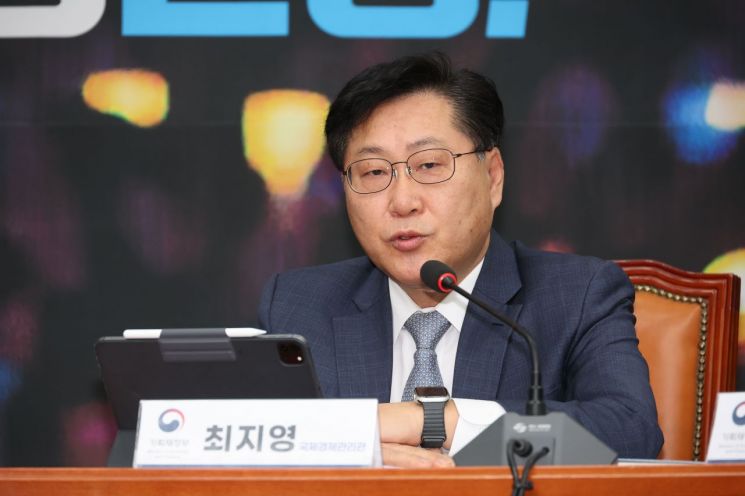 In January last year, Choi Jiyoung, Director-General for International Economic Affairs at the Ministry of Finance and Economy (then the Ministry of Strategy and Finance), was speaking at a foreign exchange market review briefing held at the National Assembly in Yeouido, Seoul. Yonhap News.
In the global imbalances session, Korea and Australia, as co-chairs, presented the outcome of discussions in the Study Group they are jointly leading. The Study Group was established to restart the global imbalance discussions that had been suspended since COVID-19, and, in cooperation with the International Monetary Fund (IMF) and the Organisation for Economic Co-operation and Development (OECD), it is analyzing the structure, causes, and spillover effects of imbalances.
Director General Choi highlighted the following as key outcomes of the discussions: the need to improve the IMF’s country-level imbalance measurement models; the limitations of assessments that focus primarily on current accounts and the need for complementary research; and the need for additional empirical analysis of the impact of industrial policies and non-market policies. Member countries assessed that understanding of imbalances has been substantially organized and expressed expectations that constructive discussions will continue at future ministerial and deputies’ meetings.
The United States also unveiled its plans to advance key agendas ahead of the April meeting of Finance Ministers and Central Bank Governors. To address the debt problems of low-income countries, it plans to prepare and submit a standard memorandum of understanding for the G20 Common Framework, and it will also host a ministerial-level event aimed at improving financial literacy.
Meanwhile, according to this year’s G20 key meeting schedule, the April Finance Ministers’ Meeting will be held in Washington, D.C., the United States, and the May Finance Deputies’ Meeting will take place in Fort Lauderdale. The August Finance Ministers’ Meeting will be held in Asheville, the October Finance Ministers’ Meeting in Bangkok, and the December Leaders’ Summit in Miami.
© The Asia Business Daily(www.asiae.co.kr). All rights reserved.












