Tourist tax hike to curb overtourism
Barcelona, one of Spain's leading tourist cities, plans to introduce one of the highest tourist taxes in Europe in order to curb the number of visitors and address its housing shortage.
Barcelona to double tourist tax from April
According to the UK newspaper The Independent on the 25th (local time), the Parliament of Catalonia, which has jurisdiction over Barcelona, approved a bill on the same day to double the tax on users of holiday accommodation from an average of 6.25 euros (about 10,000 won) per night to up to 12.5 euros (about 20,000 won) per night. As a result, hotel guests will be subject to the higher rate from April, and depending on hotel rating, the current burden of 5 to 7.5 euros (about 8,000 to 12,000 won) per night will rise to 10 to 15 euros (about 16,000 to 25,000 won).
If two people stay for two nights at a four-star hotel, which accounts for nearly half of all hotels in Barcelona, the local authorities will be able to charge up to 11.4 euros (about 19,000 won) per person per night, potentially adding up to 45.6 euros (about 76,000 won) in extra costs. Guests at five-star hotels may be charged up to 15 euros (about 25,000 won) per night.
Hotel industry warns "It could kill the goose that lays the golden eggs"
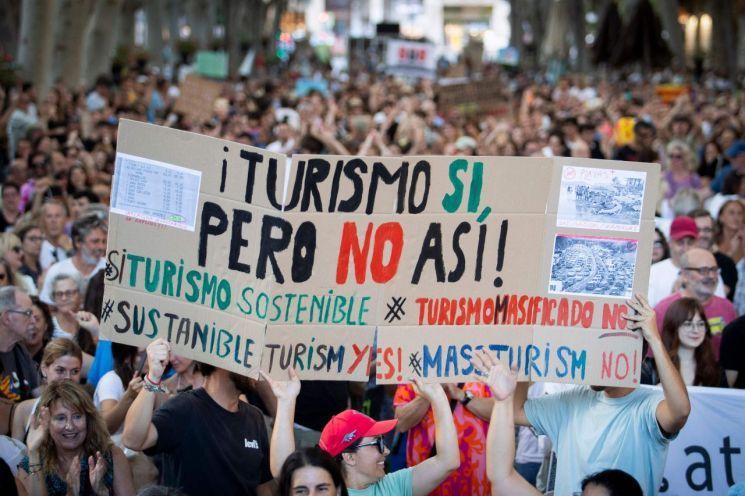 Residents of Palma, on the Spanish island of Mallorca ? one of the country’s major tourist destinations ? are staging protests against overtourism in July 2024. AFP and Yonhap News
According to the Spanish National Statistics Institute, the number of foreign tourists visiting Catalonia, the region where Barcelona is located, reached a record high of 20.1 million last year. As tourist numbers have increased, the burden on housing and urban infrastructure has grown, and locals have been suffering from housing shortages and deteriorating living conditions, creating a serious problem of so-called "overtourism." Under the bill, one quarter of the tax revenue collected will be used to tackle the city's housing problems.
However, there are also negative reactions among tourists to the tax hike. Irene Verazzo (33), a nurse from Italy, said that Barcelona is already an expensive city and that her intention to revisit is likely to decline. She pointed out, "Tourists are already spending enough money through shopping and visits to tourist attractions," adding, "It is not fair to impose additional costs."
By contrast, local resident Ivan Liu (21), who is experiencing housing difficulties, said, "The tax increase will not fundamentally solve the housing crisis, but the increase itself seems reasonable."
The hotel industry is concerned that the tax hike could lead to a decrease in the approximately 15.8 million visitors who come to Barcelona each year. Manel Casals, secretary general of the Barcelona Hotel Association, said that a proposal to raise the rate gradually while monitoring the impact was rejected, warning, "In the end, it could kill the goose that lays the golden eggs."
Meanwhile, the number of Korean tourists visiting Spain is also on the rise. According to the Spanish Tourism Office, about 431,872 Koreans traveled to Spain last year, up 10% from the previous year. This figure represents a recovery to about 68% of the level seen before COVID-19 in 2019 (580,775). In particular, the average daily spending per Korean tourist was 480 euros (about 800,000 won), an increase of 17.6% from the previous year (408 euros, about 680,000 won).
© The Asia Business Daily(www.asiae.co.kr). All rights reserved.













