Publication of the report
"2026 Asia-Pacific PE Investment Trends and Opportunities"
The size of private equity (PE) investment in Korea reached 12 trillion won in the first half of last year. For this year, expectations are emerging that PE activity will expand in business-unit carve-out deals and in the technology space.
According to Samjong KPMG's recently published report, "2026 Asia-Pacific PE Investment Trends and Opportunities," Korea's PE investment volume in the first half of last year stood at 8.5 billion dollars (approximately 12 trillion won. The report stated, "The Korean PE market is assessed to be entering a 'mature stage' on the back of solid industry fundamentals and the potential improvement of the exit market," adding, "Although conservative investment sentiment strengthened as short-term uncertainty increased for export-oriented industries due to U.S. trade tariff issues early last year, this appears to have created buying opportunities for certain undervalued assets and restructuring targets."
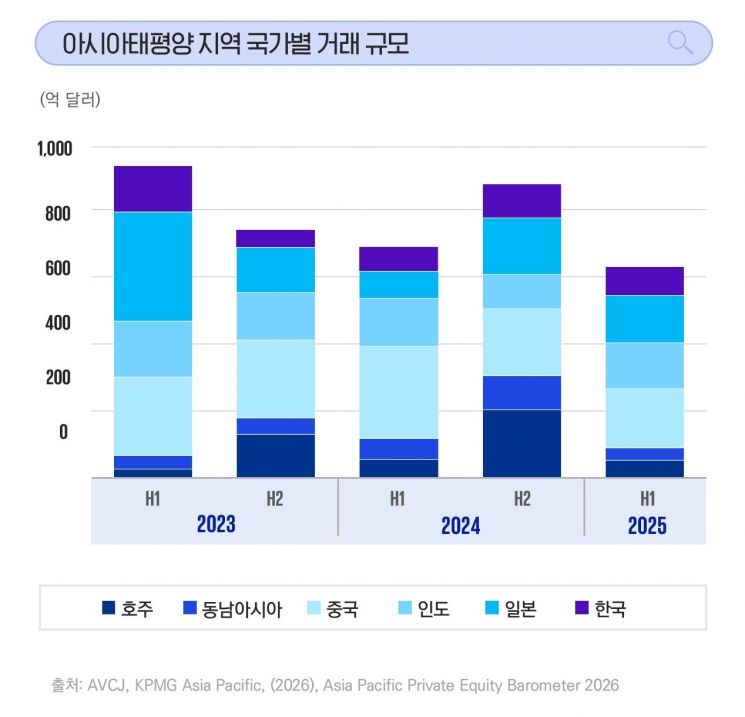
In the first half of 2025, private equity (PE) investment in the Asia-Pacific region amounted to 64.3 billion dollars. This figure represents a 28% decline from the same period a year earlier and is the lowest level since 2019. However, the number of deals increased by 4% compared with the second half of 2024, showing signs of breaking out of a long-term downtrend. On a first-half basis, fund-raising reached 95.4 billion dollars, the second-highest level since 2019. The report interpreted this as indicating that PE managers' investment capacity is expanding and that this will serve as a driving force enabling them to pursue a diverse range of transactions aligned with future market conditions.
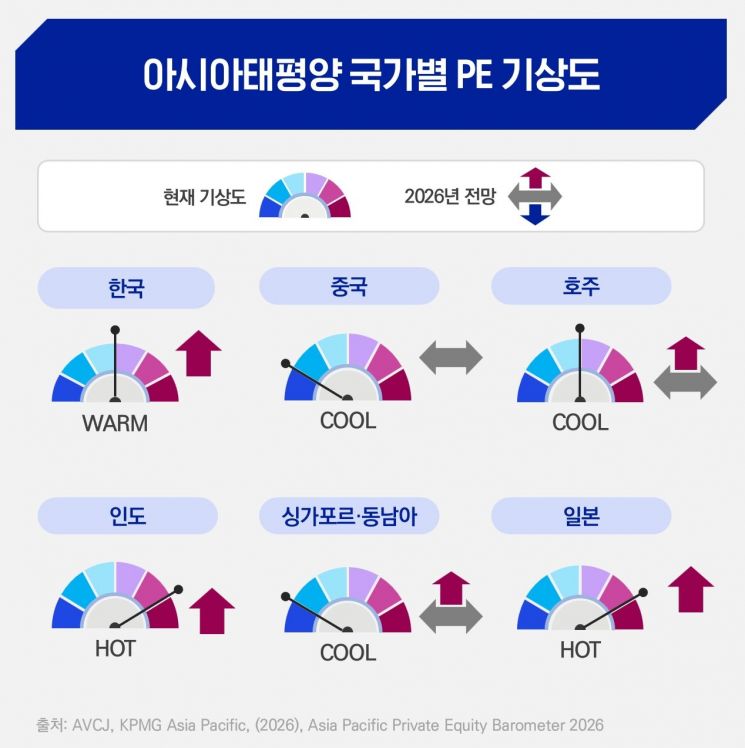
By region, the size of PE investment in China came to 17.7 billion dollars, the lowest level since 2019, due to factors such as geopolitical risks and tighter regulations. Singapore and Southeast Asia also saw a sharp decline in investment volume, to 3.6 billion dollars. In contrast, Japan (14 billion dollars), India (13.7 billion dollars), and Korea maintained relatively stable investment flows and continued to attract investor interest.
By sector, driven by digital transformation and the adoption of artificial intelligence (AI), the TMT (technology, media, and telecommunications) segment emerged as a core investment destination, accounting for 31% of total deal value and 47% of deal count. The healthcare, manufacturing, and transportation sectors also continued to attract investment flows, reflecting structural factors such as demographic shifts and supply-chain restructuring.
The average deal size decreased from 72 million dollars in the second half of 2024 to 50 million dollars in the first half of 2025, indicating a stabilization in valuations. In particular, mid-market deals (ranging from 15 million to 500 million dollars), which are used for entering high-growth segments, regional expansion, and operational improvement, expanded their share to 45%, establishing themselves as a core pillar of PE investment.
Changes are also emerging in PE managers' value-creation strategies. In addition to enhancing operational efficiency through automation and digitalization, artificial intelligence (AI) and environmental, social, and governance (ESG) factors are rising as key pillars.
As overall PE exit activity slowed due to the contraction of the initial public offering (IPO) market, trade sales (disposals to strategic investors) and secondaries were used as alternative exit strategies. Based on exit proceeds in the first half of 2025, trade sales accounted for 59%, followed by PE secondary exits (30%) and IPOs (6%).
Jinwon Kim, Vice CEO of Samjong KPMG, commented, "Despite geopolitical issues, the Asia-Pacific market offers coexisting investment opportunities across a wide range of risk-return profiles, including China's medium- to long-term potential, the stability of Japan, Australia, and Korea, and the growth potential of India and Southeast Asia."
He added, "Korea is a market with a stable consumer base and strong competitiveness in technology-based industries, and global investors continue to show interest, supported by favorable exchange-rate conditions," and went on to say, "The activities of global PE firms are expected to expand in carve-out deals and in technology-driven growth areas."
© The Asia Business Daily(www.asiae.co.kr). All rights reserved.













