A Korean research team has used artificial intelligence (AI) to reveal that zinc (Zn) plays a decisive role in the atomic arrangement of platinum-cobalt. Platinum catalysts are used in fuel cells for hydrogen vehicles. However, they face limitations such as high cost and short lifespan. Their performance degrades over time, and high manufacturing costs have become an obstacle to the popularization of hydrogen cars. In contrast, the "virtual blueprint" completed by AI has improved the drawbacks of platinum catalysts and made it possible to realize high-performance catalysts. The method involves using AI to calculate and predict atomic arrangements and then implementing the results through actual experiments. Expectations are rising that this approach could become a new paradigm for future materials development.
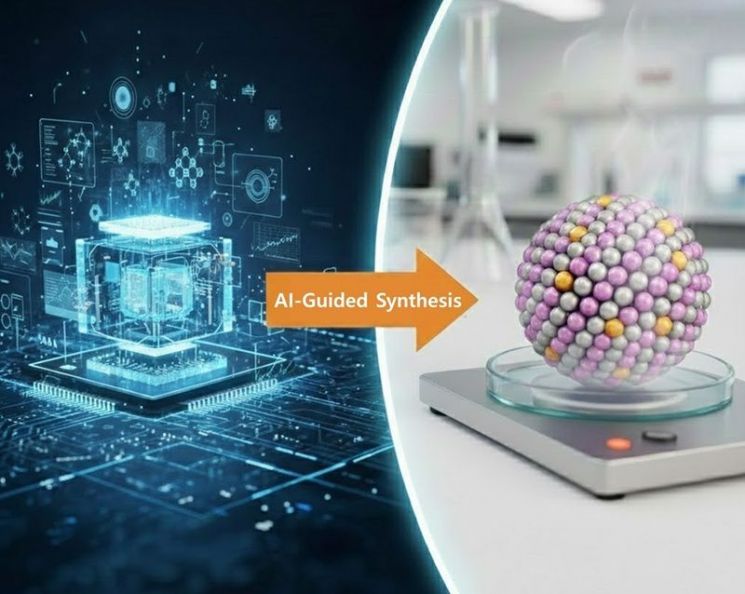 Conceptual diagram of catalyst development based on artificial intelligence (AI-generated image). KAIST
On the 26th, the Korea Advanced Institute of Science and Technology (KAIST) announced that a research team led by Professor Jo Eunae in the Department of Materials Science and Engineering at KAIST and a team led by Professor Lee Wonbo in the School of Chemical and Biological Engineering at Seoul National University have developed a technology that uses AI to predict the "atomic arrangement" tendencies of catalysts.
This technology operates on the same principle as "calculating in advance which combinations are advantageous for completing a puzzle before actually assembling it." By first calculating the ordering rate of metal atoms, AI enables the efficient design of high-performance catalysts.
For example, in conventional platinum-cobalt (Pt-Co) alloy catalysts used in fuel cells for hydrogen vehicles, achieving an ordered intermetallic compound structure, in which atoms are regularly arranged, required heat treatment at very high temperatures. However, under such conditions, particles tend to agglomerate or the structure becomes unstable, which has posed limitations for practical application in fuel cells.
To solve these problems, the joint research team introduced a machine-learning-based quantum chemical simulation. The aim was to precisely predict, using AI, how atoms move and arrange themselves inside the catalyst.
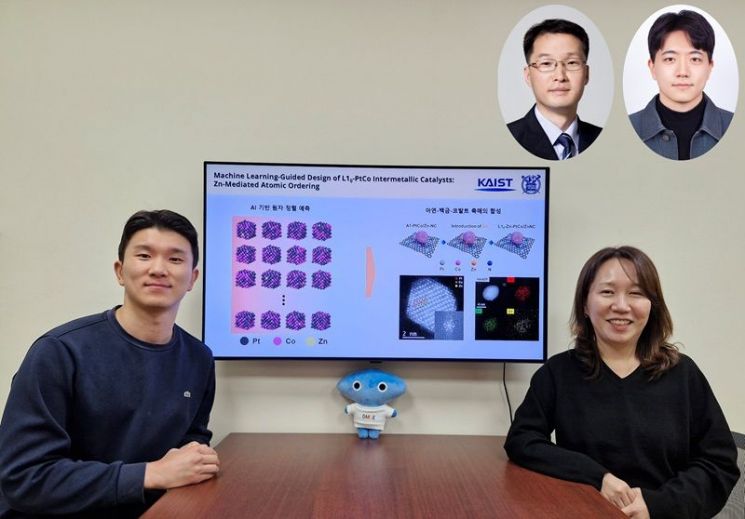 (From left) Jang Hyunwoo, PhD candidate at KAIST; Cho Eunae, Professor at KAIST; (From top left) Lee Wonbo, Professor at Seoul National University; Ryu Jaehyun, PhD. KAIST
In the simulation, the joint research team discovered that zinc acts as a mediating element that accelerates atomic ordering. When zinc is introduced, atoms can more easily find their proper positions, enabling the formation of a more precise and stable structure. In effect, AI has identified the "optimal pathway for atomic ordering."
The zinc-platinum-cobalt catalyst actually synthesized based on AI predictions achieved both higher activity and excellent long-term durability compared with conventional platinum catalysts. This case demonstrates that high-performance catalysts can be realized in the laboratory using the "virtual blueprint" calculated by AI.
In particular, the technology developed by the joint research team is expected to help extend catalyst lifetimes and reduce manufacturing costs across key carbon-neutral industries, including not only hydrogen passenger cars but also hydrogen trucks and hydrogen ships that require long-distance operation, as well as energy storage systems (ESS).
Professor Jo said, "This study is a case in which we used machine learning to predict in advance the atomic arrangement tendencies of catalysts and then realized them through actual synthesis," adding, "We expect AI-based materials design to become a new paradigm for developing next-generation fuel cell catalysts."
Meanwhile, this research was jointly led by Jang Hyunwoo, a PhD candidate in the Department of Materials Science and Engineering at KAIST, and Ryu Jaehyeon, PhD in the School of Chemical and Biological Engineering at Seoul National University, as co-first authors. The research results (paper) were recently published in Advanced Energy Materials, an international journal in the field of energy materials.
© The Asia Business Daily(www.asiae.co.kr). All rights reserved.













