LG Uplus announced on the 26th that it will unveil next-generation security technologies at MWC26, the world's largest mobile communications exhibition to be held in Barcelona, Spain on the 2nd of next month (local time), to respond to growing cyber threats driven by the spread of AI.
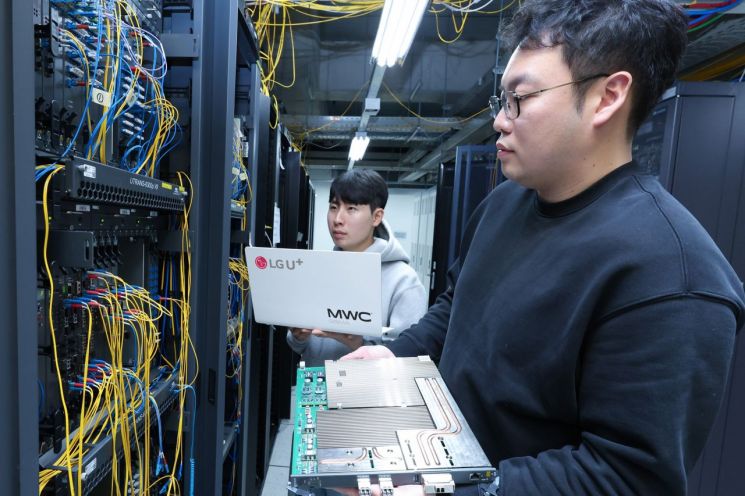 LG Uplus said on the 26th that it will unveil next-generation security technology at MWC26, the world's largest mobile communications exhibition, to be held in Barcelona, Spain on the 2nd of next month (local time). An image shows LG Uplus employees presenting quantum-resistant cryptography (PQC) optical transmission equipment. Provided by LG Uplus.
At MWC26, LG Uplus will showcase security solutions including AlphaKey, homomorphic encryption technology, optical transmission equipment, and U+SASE. The technologies to be unveiled this time are characterized by focusing on preemptive blocking rather than post-incident response.
The cloud-based integrated account management solution AlphaKey uses AI to learn the access and behavior patterns of users and administrators for each client company, and detects abnormal access or attempts to leak internal information in real time. AlphaKey is designed to move detection earlier than existing security systems, enabling analysis and response from the precursor stage of abnormal behavior. Through continuous activity monitoring, if abnormal actions such as large-volume data queries or file downloads in a short period of time are detected, it blocks access and notifies the administrator. It also provides an automatic reporting function that analyzes the scope of abnormal-symptom propagation, thereby supporting post-incident response.
LG Uplus will also introduce homomorphic encryption technology that it plans to apply to its AI calling application ixi-O. Homomorphic encryption is a technology that enables storage, computation, and search while data remains encrypted. Because data can be processed without decryption, it is protected in such a way that its content cannot be interpreted even if it is leaked. By applying homomorphic encryption technology to ixi-O, LG Uplus plans to store and process call data in an encrypted state and fundamentally block information leakage caused by hacking.
Optical transmission equipment based on post-quantum cryptography (PQC), designed for the era of quantum computers, will also be unveiled. Post-quantum cryptography is a next-generation cryptographic technology based on mathematical structures that are difficult to decrypt even with quantum computers. In addition, the company will present U+SASE, a security-as-a-service platform that integrates networks and security. Unlike the conventional method of operating various security solutions separately, U+SASE is configured so that security functions can be managed on a single platform. In particular, U+SASE has enhanced its security functions to respond to generative AI environments. Through AI-based data loss prevention functions and other features, it is designed to block situations in which internal corporate information is leaked externally via generative AI.
Joo Eomgae, Head of Wireline Business at LG Uplus, said, "Our goal is to provide security technologies that allow customers to feel safe at a time when AI-based hacking threats are growing," adding, "We will continue to further develop differentiated security services going forward."
© The Asia Business Daily(www.asiae.co.kr). All rights reserved.












