This Year’s Growth Forecast Raised from 1.8% to 2.0%
Next Year’s Growth Outlook Cut to 1.8%
Inflation Forecast Lifted to 2.2% for This Year...Kept at 2.0% for Next Year
The Bank of Korea has revised its forecast for this year’s economic growth in Korea upward from 1.8% to 2.0%.
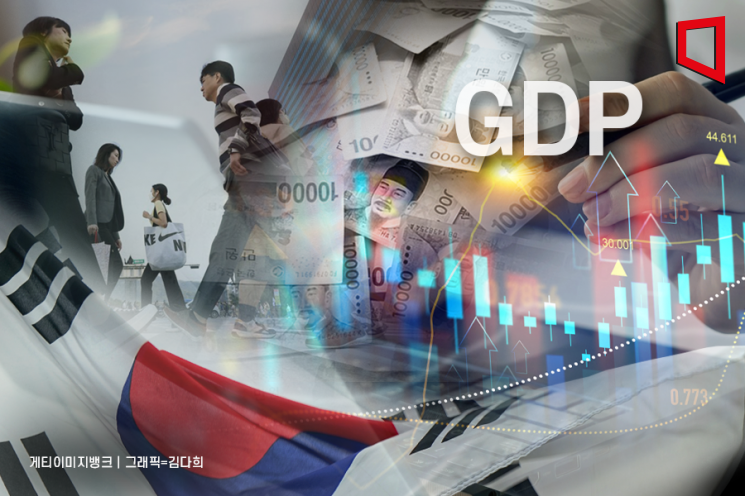
This marks an additional upward revision just three months after it raised the forecast by 0.2 percentage points in its November 2025 outlook. This is seen as reflecting the fact that the upward trend in semiconductor exports is steeper than expected and that consumer sentiment is recovering gradually.
In its revised economic outlook released on February 26, 2026, the Bank of Korea projected that the Korean economy will grow 2.0% this year. However, it lowered next year’s growth forecast from 1.9% to 1.8%.
This year’s 2.0% growth forecast is the same as the projection the government announced last month and is slightly higher than the recent 1.9% forecasts by the International Monetary Fund (IMF) and the Korea Development Institute (KDI). However, the Bank of Korea is broadly in line with the IMF and KDI in that they also took a more optimistic view of the Korean economy and revised their growth forecasts upward.
The Bank of Korea’s decision to raise its growth forecast this time reflects its judgment that both exports and domestic demand now have stronger upside factors than at the time of the November 2025 projection. In its monetary policy decision statement last month, the Monetary Policy Board of the Bank of Korea had already hinted at the possibility of an upward revision, stating that “upside risks appear to have increased somewhat due to the broader upturn in the semiconductor cycle and better-than-expected growth momentum in major economies.”
In particular, the fact that the semiconductor sector is performing better than expected is cited as the biggest factor behind the higher growth forecast. The Bank of Korea expects the rapid improvement in the semiconductor cycle to boost exports and facility investment, thereby strengthening the overall growth engine. In a report to the National Assembly on February 23, 2026, Bank of Korea Governor Rhee Changyong said, “Despite uncertainties related to U.S. tariff policy, this year’s growth rate will be significantly higher than last year as the export growth trend continues on the back of robust semiconductor conditions.”
In fact, Korea’s export performance has continued to improve this year. According to the Korea Customs Service, exports in January 2026 amounted to 65.8 billion dollars, up 33.8% from a year earlier, with semiconductor exports (20.69 billion dollars) surging 102.5% and leading the overall increase. From February 1 to 20, total exports reached 43.5 billion dollars, up 23.5% from the same period a year earlier. During the same period, semiconductor exports jumped 134.1%, with their share of total exports expanding to 34.7%.
Expectations of a domestic demand recovery supported by solid consumer sentiment also contributed to the upward revision of the growth forecast. Robust exports centered on semiconductors and a buoyant stock market have increased optimistic assessments of the economy, which in turn are having a positive impact on the consumption sentiment of economic agents. The Composite Consumer Sentiment Index (CCSI) released by the Bank of Korea stood at 112.1 in February 2026, rising for the second consecutive month. According to the National Data Office (formerly Statistics Korea), retail sales, a key indicator of domestic consumption trends, increased 0.5% last year, rebounding for the first time in four years.
It is thus analyzed that the combination of an improved export outlook driven by semiconductors and a moderate recovery in domestic demand has pushed this year’s growth forecast up to the 2% range.
However, there are still uncertainty factors along the growth path that could weigh on the growth rate. Despite the conclusion of the Korea-U.S. trade negotiations, lingering uncertainty over U.S. tariff policy and the high degree of dependence on semiconductors for growth are cited as key risk factors. Construction investment, which dragged down last year’s growth, is also a downside factor. Construction investment is expected to see some easing of last year’s contraction this year. However, there are also analyses that the pace of recovery in construction investment could be slower than expected, as construction orders are not sufficiently translating into actual ground-breaking and the sluggish property market in regional areas is adding to the drag.
The forecast for consumer price inflation has been revised upward to 2.2%, a slight increase of 0.1 percentage points compared with the November 2025 projection. The forecast for next year remains at 2.0%. Although this year’s forecast has been revised up slightly, the Bank of Korea expects inflation to remain on a stable path near the 2% target level, amid offsetting upward and downward factors such as the downward stabilization of international oil prices and the strong won exchange rate. Consumer price inflation in January 2026 was 2.0%, the lowest rate in five months.
© The Asia Business Daily(www.asiae.co.kr). All rights reserved.












