Consistent conditions, easier turf maintenance
Cost savings, realistic spin and shot feel
TGL launch showcases full-scale use of artificial turf
The area that golf courses in Korea focus on the most is the green. When the greens are in good condition, amateur golfers tend to give generous reviews. Conversely, if maintenance is poor, the course is quickly branded as "a golf course you never want to visit again."
Most golf courses dream of what is often called "glass-plate greens," but reality is far from easy because of the heavy cost burden. Greens at Korean golf courses mainly use bentgrass. It retains its green color even in winter, which is visually excellent, but it is difficult to maintain. Maintenance staff often have to be deployed even during rounds. For worker safety, announcements such as "Ball coming. Please be careful" are repeatedly made.
Recently, climate variability has added to the challenge. Abnormally high temperatures and heat waves have scorched greens, and successive torrential rains have severely damaged cool-season grasses. As a result, more golf courses are gradually switching to Korea-adapted turf varieties.
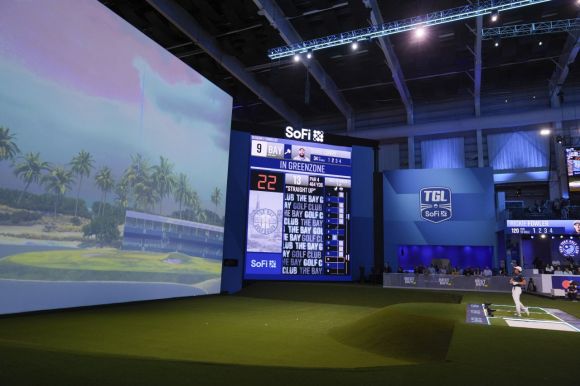 TGL is a new golf league that combines indoor screen golf with cutting-edge artificial turf technology. AP Yonhap News
Against this backdrop, artificial turf greens are emerging as an alternative. They are less affected by weather and can maintain consistent conditions, which is a major advantage. With only basic cleaning and replenishment of infill, they can be used for a long time, reducing maintenance burdens. In the long run, cost savings can also be expected. Thanks to recent technological advances, they can now reproduce ball behavior and roll similar to actual field greens, and many say the feel of shots from the fairway is also natural.
The materials used for artificial turf are also diverse. Polyethylene (PE), the most widely used, is soft and offers an appearance and performance similar to natural grass. Polypropylene (PP) has excellent heat resistance and chemical resistance. Polyvinyl chloride (PVC) and polyamide (nylon) are also used. Recently, products that combine multiple materials to maximize each advantage have been released.
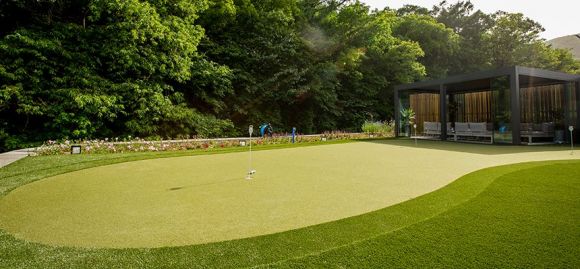 Using artificial turf to create golf greens can reduce costs and benefit the environment. Provided by STI Korea
The environmental benefits are also significant. It can greatly reduce water usage, and because there is no need for fertilizers or pesticides, it helps reduce soil and water pollution. Its long lifespan and recyclability are additional strengths. It maintains relatively stable performance even under extreme weather conditions, and it is expected to offer easier maintenance and a reduced risk of injuries. Some products now feature advanced coating technologies and drainage systems that provide water repellency, flame retardancy, and UV protection.
Uiryeong Chinhwangyeong Golf Course, located on the banks of the Nam River in South Gyeongsang Province, is the only golf course in Korea that has adopted artificial turf greens. It is an eco-friendly walking course that takes advantage of the natural scenery along the Nam River, and by applying artificial turf to the greens, it has minimized areas where pesticides are used.
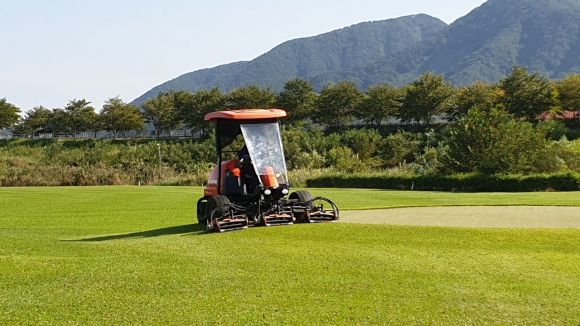 Uiryeong Chinhwangyeong Golf Course is the only golf course in the country to have constructed its greens with artificial turf. Provided by Uiryeong Chinhwangyeong Golf Course.
Artificial turf is also being actively used in the screen golf sector. A prime example is the "Tomorrow Golf League (TGL)," which was launched in January 2025 under the leadership of Tiger Woods (United States) and Rory McIlroy (Northern Ireland). It is an indoor screen golf league that incorporates cutting-edge technology and offers excellent space efficiency. It is held at the SoFi Center in Palm Beach Gardens, Florida, in the United States, in an indoor arena of about 23,000 square meters equipped with a large screen measuring 19.5 meters wide and 16 meters high. By combining artificial turf with natural grass, it recreates an environment similar to an actual course, and although there is only one green, the shape, slope, and undulation are varied for each hole to enhance strategic play.
In this way, artificial turf has already taken root in many parts of our daily lives. Beyond golf courses and practice ranges, it is used in a variety of field sports such as soccer, baseball, and tennis. Its applications are also expanding to children's playgrounds, landscaping spaces, and dedicated areas for companion animals.
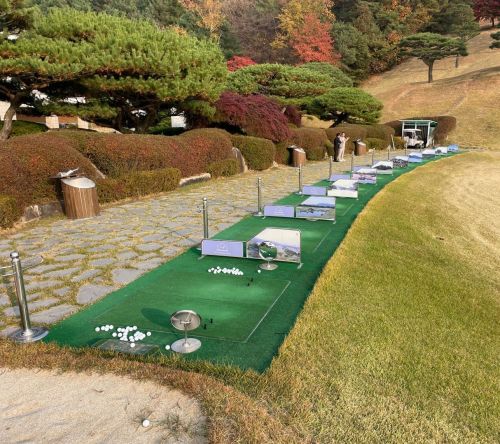 The practice range at Pocheon Ildong Lake Golf Club has been receiving favorable reviews after installing artificial turf that closely resembles natural grass. Provided by STI Korea
© The Asia Business Daily(www.asiae.co.kr). All rights reserved.














