Some Hospitals Excluded Over How the "Patient Ratio Standard" Was Applied, Disrupting Hiring
Cut in Target Bed Numbers Also Forces Hospitals to Revise Investment and Staffing Plans
Ministry of Health and Welfare: "Standards Were Not Changed...There May Have Been Confusion in Interpretation"
Following the Ministry of Health and Welfare's announcement of the designation results for the "third-term convalescent rehabilitation medical institutions," some hospitals are now facing problems such as cancelled hiring and employment instability. These hospitals expanded their workforce and invested in facilities on the assumption that they would be designated, but after failing to be selected, even newly hired young healthcare workers such as entry-level physical therapists and nursing staff are reportedly facing the risk of dismissal. Representatives of hospitals that were not designated argue that the way the designation requirements were applied differed from the prior guidance, causing serious disruption to the human resources and financial investments made during the preparation process.
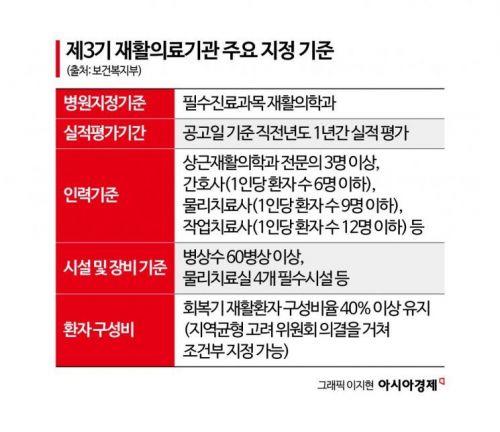
According to the medical community on the 25th, 71 institutions nationwide were selected in the Ministry of Health and Welfare's recently announced third-term designation of convalescent rehabilitation medical institutions. This is about half of the originally stated target of approximately 150 institutions. Convalescent rehabilitation medical institutions are facilities that receive separate policy support and focus on helping patients recover function after acute-phase treatment for conditions such as brain injury or spinal cord injury. From the hospitals' perspective, whether they are designated has a significant impact on their revenue structure.
Some hospitals that failed to be designated in this round strongly contended that the "patient composition ratio requirement" was effectively applied in a stricter way during the evaluation process. The patient composition ratio requirement refers to the proportion of inpatients who need convalescent rehabilitation treatment, such as patients with brain injury, spinal cord injury, or those recovering after fracture surgery. The relevant public notice sets this ratio at 40 percent or more. However, it also includes an exception clause stating that even if this ratio is not met, conditional designation is possible after considering rehabilitation demand and regional balance. In the past first and second designation rounds, there were many cases in which such grace was applied to newly applying hospitals.
Hospitals also said that in the briefing sessions the Ministry of Health and Welfare held in advance for medical institutions, they were informed that new institutions could receive a grace period for meeting the patient composition ratio. They were told that, because it is difficult for new hospitals to meet the required proportion of convalescent patients in a short time at the initial stage, it would be sufficient to gradually meet the standard after designation. However, in the actual designation process, institutions that did not meet a certain minimum level of the patient ratio were excluded, leading to the claim that the patient composition ratio requirement in effect became a barrier to new entrants.
A representative of Hospital A, which took part in this call for applications, said, "At a briefing held late last year just before the call, we were informed that the patient composition ratio could be subject to a grace period, so we proceeded with hiring and facility investments," and lamented, "When a specific ratio standard was applied in the final evaluation, we failed to be designated, and our management plan was shaken all at once." This hospital, which had been preparing to newly hire about 10 physical therapists and around 20 additional staff including occupational therapists and rehabilitation and nursing personnel to expand treatment for convalescent rehabilitation patients, cancelled part of the planned hiring after failing to be designated.
A representative of Hospital B said, "We hired physical therapists and occupational therapists who were about to graduate from university on the assumption that our designation as a convalescent rehabilitation institution would be confirmed, but as the result turned out differently, we are now in a situation where we must completely revise our workforce operation plan," adding, "We have no other choice but to cancel or postpone the hiring, which is directly affecting local employment of medical personnel."
The fact that the target number of beds by region was changed midway has also been cited as a factor that exacerbated confusion. Initially, in relation to the third-term designation, the Ministry of Health and Welfare presented a target of about 16,725 beds, but the final designation result amounted to only about 14,000 beds. A representative of Hospital C said, "We expanded our facilities by investing a huge amount of capital based on the target number of beds presented at the briefing," and appealed, "Some medical institutions are now being driven to the point where they may almost have to close their doors."
 Since the Ministry of Health and Welfare announced the designation results for the third-term recovery rehabilitation medical institutions, controversy has spread, centered on hospitals that failed to be designated, over canceled recruitments and employment insecurity among young medical professionals. AI-generated image
The Ministry of Health and Welfare maintains that the standards were not suddenly changed. It explains that the grace period for the patient composition ratio is a matter that can be applied after a resolution by the Rehabilitation Medical Institution Steering Committee under the public notice, and is not a mandatory provision.
An official at the Ministry of Health and Welfare said, "We did inform them that there is a grace clause, but it was difficult to provide a definitive explanation in advance because how it would actually be applied had to be decided by the Steering Committee," adding, "From the perspective of medical institutions, they may have understood, based on past cases, that the grace would be applied broadly."
The Ministry of Health and Welfare also states that the number of designated institutions being lower than the original target was the result of taking into account actual patient demand and bed supply conditions. While it initially planned to designate about 150 institutions, it adjusted the designation scale based on the judgment that, given the current number of rehabilitation patients, if the number of institutions were increased all at once, each hospital might find it difficult to meet the patient composition ratio standard.
© The Asia Business Daily(www.asiae.co.kr). All rights reserved.













