Residential and Smart Farm Complex Built on Former School Site
A New Rural Settlement Solution Draws Attention
Yeongyang County has begun full-scale efforts to build residential infrastructure to overcome the population decline crisis and to operate a rural settlement-type population inflow model.
On the 24th, the county held a completion ceremony for the "Yeongyang Residential Small Farm" on the site of the former Cheonggi Branch School in Cheonggiri, Cheonggi-myeon. About 100 people, including county officials and local residents, attended the event, which featured a project progress report, a ribbon-cutting ceremony, and a tour of the facilities to commemorate the completion.
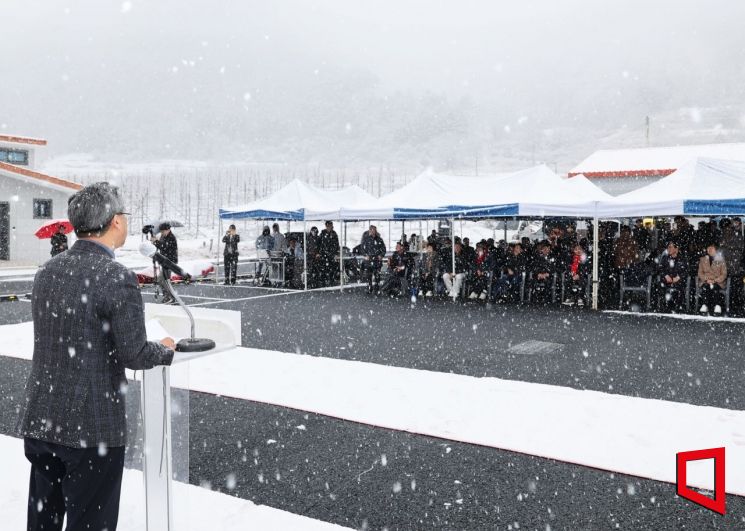
The Residential Small Farm Development Project was promoted using the Local Extinction Response Fund to respond to local extinction and to establish a stable foundation for population settlement. With a total project cost of 7.2 billion won (2 billion won from the metropolitan fund and 5.2 billion won from the basic fund), the county built twenty 18-pyeong detached houses and one agricultural product distribution support center in the Cheonggi-myeon area, and established infrastructure for operating a smart farm.
The project covers a site area of 8,604 square meters and a total floor area of 1,434 square meters. After the Local Extinction Response Fund investment project was finalized in September 2022, the county went through administrative procedures, began construction in July 2024, and completed it in December 2025.
This project is significant in that it goes beyond simple housing supply to create a life-oriented residential model that combines housing, farming, and joint work functions. It is designed so that residents can use the housing, smart farm, and shared workspace at the same time, thereby securing a stable farming base and living environment.
The county has been continuously pursuing policies to expand residential infrastructure with the goal of restoring its population to 16,000, and expects the Residential Small Farm to serve as a key hub that will drive improvements in the population structure and the revitalization of rural areas.
Yeongyang County plans to recruit residents in accordance with relevant regulations, establish a fair operating system, and develop the project into a sustainable rural settlement model.
A county official said, "The Residential Small Farm is a project that creates the living foundation needed for people to stay and continue their lives," adding, "We will expand it as a Yeongyang-style policy model that turns the local extinction crisis into an opportunity."
The Residential Small Farm is meaningful in that it shows local extinction response policies are beginning to focus not just on bringing people in, but on their "settlement potential." This life-oriented model, which combines housing, livelihood, and community functions, is an attempt to simultaneously address livelihood insecurity and isolation, which have long been cited as limitations of rural settlement policies.
However, the success or failure of the project depends less on the construction of the facilities themselves and more on actual settlement rates, income generation, and whether the community can be maintained. Along with the symbolism of spatial regeneration through the use of a closed school, the operation of this model will become a policy test case to see whether it can establish itself as a practical solution for a sustainable transformation of the rural population structure.
© The Asia Business Daily(www.asiae.co.kr). All rights reserved.












