From Surgery to Disaster Rescue: Wearables Take Center Stage
Key Theme: "Human-Robot Interaction"
Global Scholars Warn Against Humanoid Hype
"Wow, it's a puppy!"
On the 23rd, at the robot demonstration hall on the 5th floor of the Haedong Institute of Advanced Science & Technology (Building 303) at Seoul National University in Gwanak-gu, Seoul, children tightly holding their mothers' hands excitedly stomped their feet in front of a four-legged robot. They crouched down and stood up, even imitating the robot as it lifted its leg to scratch its ear. This was a quadrupedal robot trained on motion capture data from real puppies. Lee Younghwan, a 26-year-old graduate student from the Department of Electrical and Computer Engineering, explained, "It can be used to transport materials at construction sites or in search and rescue operations during disasters." He noted that quadrupedal robots have greater potential for use, as they can move more stably on rough and steep terrain compared to humanoid (bipedal) robots.
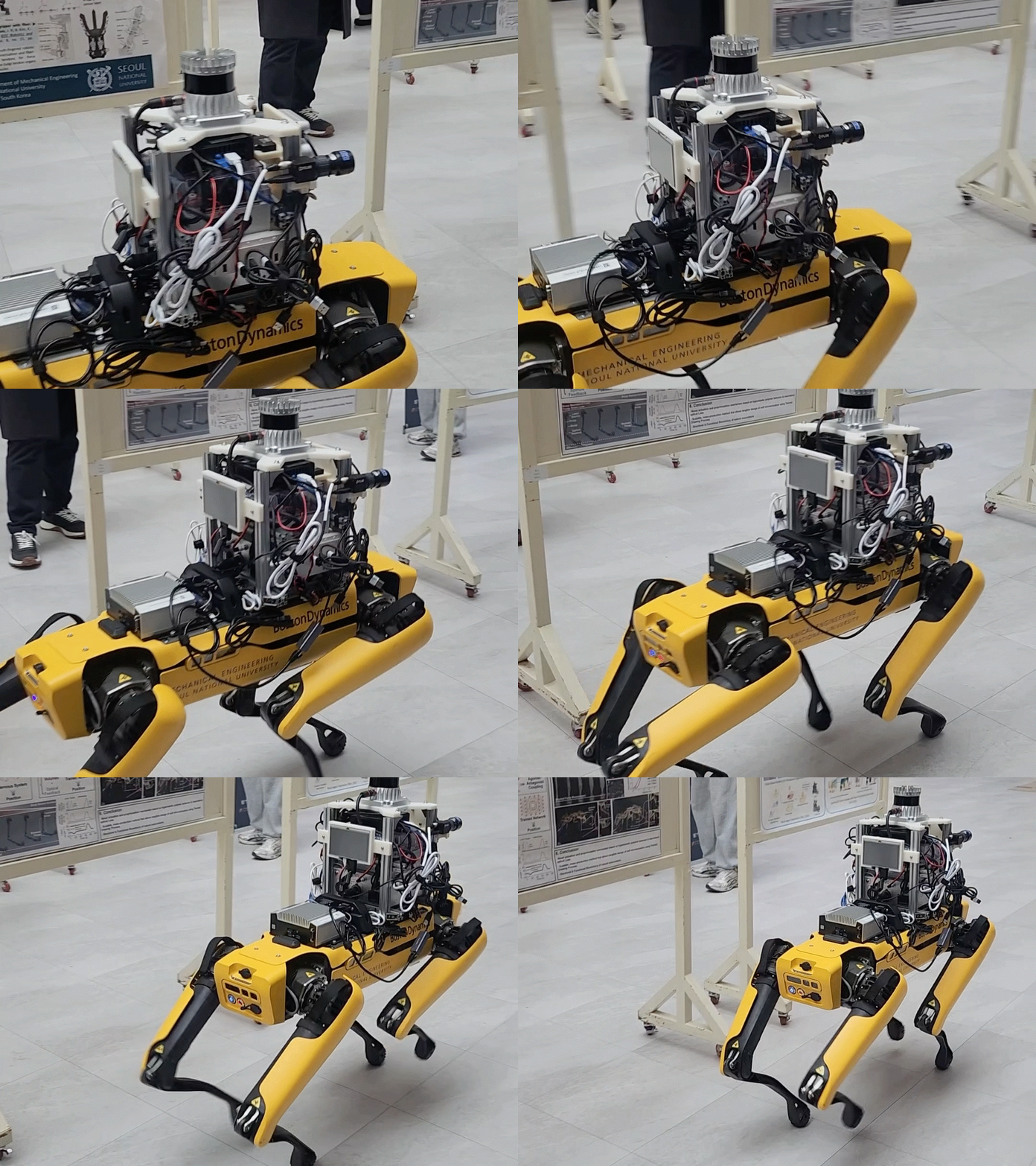 On the 23rd, during the SNU Robotics Day held at Building 301, Seoul National University in Gwanak-gu, Seoul, a dog robot is freely roaming around. Photo by Jiy Jane Lee
The "SNU Robotics Day," now in its second year, saw the participation of over 20 laboratories and more than 60 researchers, who presented their achievements. The central theme of the event was undoubtedly "human-centered technology." Contrary to the recent trend focused mainly on humanoids, on-site wearable technologies that assist human movement took center stage. The aim was to expand discussions with human-robot interaction (HRI) at the core.
Deeper inside the demonstration hall, a robot hand that precisely mimicked the movements of a person wearing a glove captivated visitors. This is the "wearable glove," a piece of technology that enables remote manipulation. When the demonstrator wearing the glove bent their thumb inward, the corresponding robot hand immediately made the same motion. Park Taejun, a 30-year-old doctoral student, said, "As this technology becomes more advanced, it will not only enable the automation of workplaces that require human hands but also make remote surgeries by doctors possible."
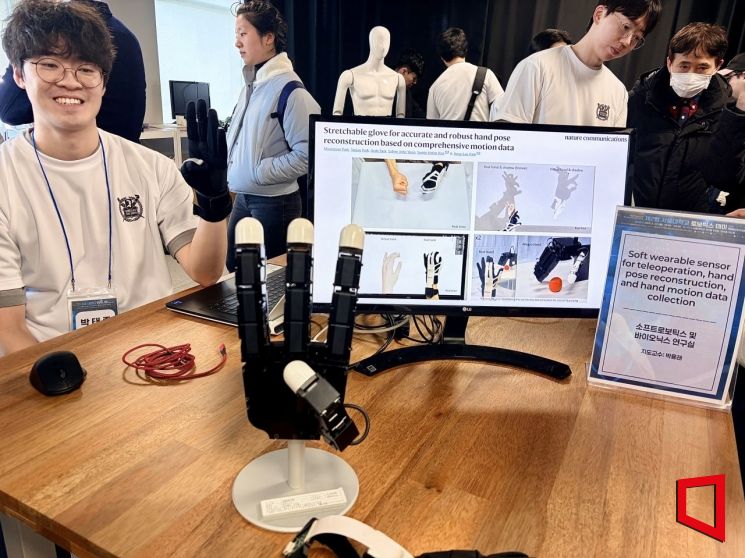 A research team is demonstrating the 'Wearable Glove' at SNU Robotics Day held on the 23rd at Seoul National University in Gwanak-gu, Seoul. Photo by Jiy? Lee
The lobby of Building 301, where Robotics Day was held, was filled with posters from each laboratory, and research teams gave one-minute presentations summarizing the core of their work. Various studies demonstrating potential applications were showcased.
One student manipulated the leg of a virtual human model on a laptop screen. As the avatar on the screen took a step, the wearable robot's operation was simultaneously simulated. Lim Gunho, a 29-year-old doctoral student in the Department of Computer Science and Engineering, explained, "Wearable robots need to be tested on the human body, but repeated experiments on patients are costly and have limitations, so we are simulating control methods in virtual environments. We see the potential to extend this technology not only to the advancement of walking-assist technologies but also to predicting post-surgical outcomes."
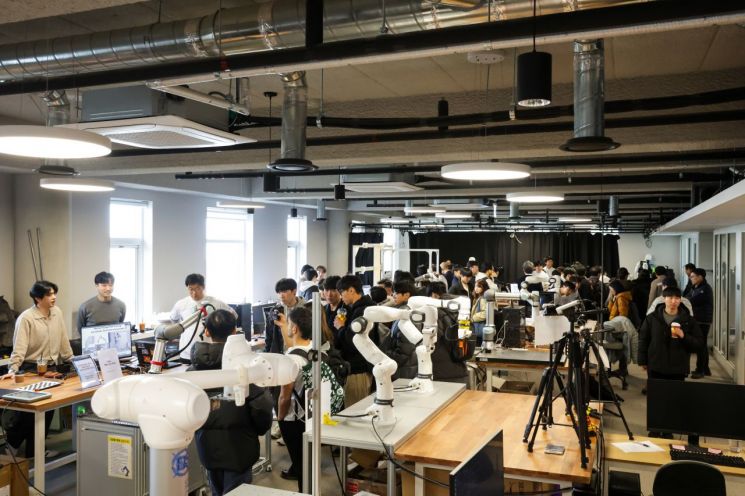 Scene of the robotics demonstration at SNU Robotics Day held on the 23rd at Seoul National University in Gwanak-gu, Seoul. Seoul National University
Kim Ahyoung, a professor in the Department of Mechanical Engineering and one of the organizers of this event, pointed out that software development should not be carried out without considering interaction with humans. She emphasized, "The core of this event is to reflect together on the direction of robotics in Korea. Ultimately, you cannot talk about robots without talking about people." In particular, she identified the optimal deployment of technology as the greatest challenge, rather than simple commercialization. Professor Kim stressed, "We must ensure that the technology works in real industrial settings, even taking into account corner cases (unexpected variables on site)."
Fittingly for an event focused on "technology for humans," this was not a stage reserved only for mechanical or electrical engineering majors. Researchers from diverse fields, including clothing and biosciences, participated in large numbers to study human movement and usability. Kim Minkyoung, a 25-year-old master's student in the Department of Clothing and Textiles, said, "I believe the era of using robots like in the movie Avatar will come. No matter how advanced a robot is, if it is inconvenient for people to use, it is meaningless, so I am researching 'robots for people,' not robots for robots."
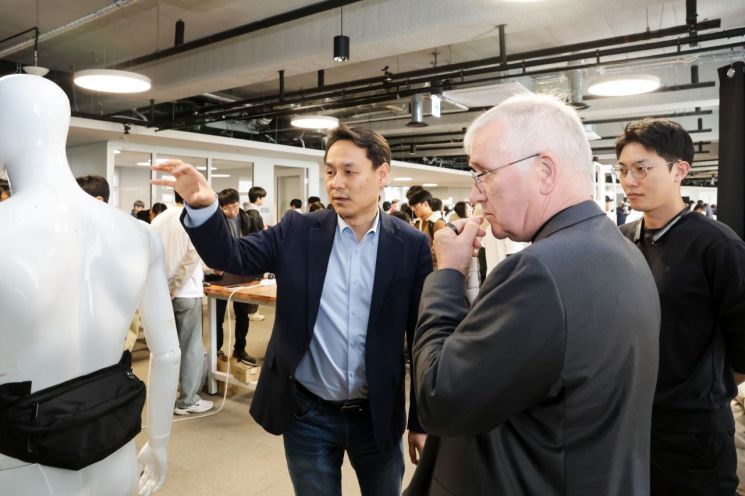 Professor Henrik Christensen is touring the robotics demonstration site at SNU Robotics Day held on the 23rd at Seoul National University in Gwanak-gu, Seoul. Seoul National University
In the afternoon, the "Global Robotics Forum" continued with discussions emphasizing that direction is more important than speed in technological development. Professor Henrik Christensen from UC San Diego and Professor Park Jongwoo from the Department of Mechanical Engineering at Seoul National University took the stage to address the challenges of the artificial intelligence (AI) robotics era.
Professor Christensen stressed that the focus of research should be on "field application" rather than "showcasing." He explained that impressing people with dramatic scenes in research is completely different from building systems that work in industrial settings. When a student asked, "What is the field most suitable for robotic technology?" he replied, "Don't ask that. Go out into the real world and see for yourself. The possibilities are endless."
Professor Christensen expressed caution regarding the recent craze for humanoids, describing it as "just investing in dreams." He pointed out, "The robotics industry is currently overselling and underdelivering. For example, Elon Musk, the CEO of Tesla, talks as if every household will have a humanoid robot right away." He also remarked that it is unlikely people would pay $10,000 for a robot with limited capabilities to be widely adopted in homes.
He offered a positive assessment of Korea's robotics industry. "Korea's manufacturing sector has an excellent industrial ecosystem," he said. "The fact that products made by Samsung and LG are used nationwide means that Korea has a strong distribution system as well as manufacturing." He advised, "I hope you will have a more global mindset."
© The Asia Business Daily(www.asiae.co.kr). All rights reserved.














