Instead of paying 70% up front at the start of the contract, advances will be paid in stages
If contract performance and use of the advance are verified, the total can reach 70% cumulatively
If there is no cooperation in verifying the use of the advance, lawsuits to claim repayment may follow
The government is overhauling the advance payment system to prevent companies from receiving money in advance from state institutions and then failing to properly carry out construction, manufacturing, or service contracts. As early as July, instead of paying up to 70% of the contract amount in a lump sum, advance payments will be made in stages. Depending on the contract size, the government will first pay 30-50%, and if proper contract performance is confirmed, it will increase the cumulative payment to up to 70%.
In December last year, President Lee Jaemyung, referring to Dawonsys, a rolling stock manufacturer that received an advance payment from Korail but failed to deliver trains on time, said, "Isn't this effectively a case of a government institution being scammed?" and instructed that the method of paying advances in public procurement be changed.
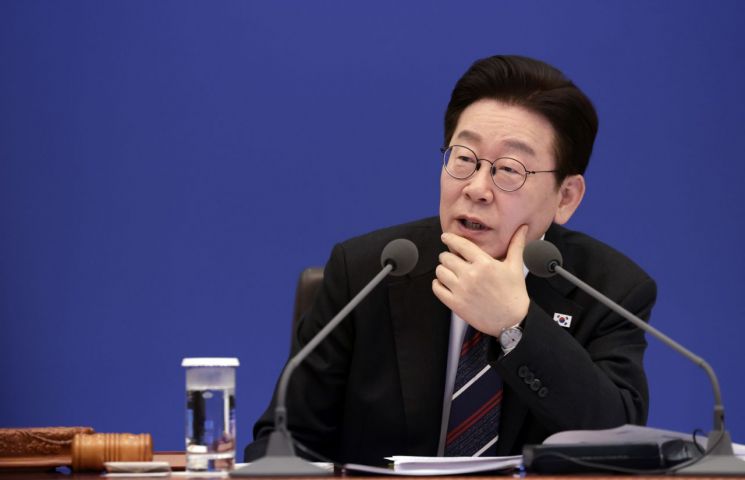 President Lee Jaemyung, Remarks at a Cabinet Meeting
(Seoul=Yonhap) Han Sanggyun reporter = President Lee Jaemyung is speaking at a Cabinet meeting held at the Blue House on the 24th.
The Ministry of Economy and Finance announced a plan to rationalize the advance payment system at an economic ministers' meeting held at the Government Complex Seoul on the 25th. An advance payment is a system under which a state institution pays in advance the cash needed at the early stage of contract performance to the counterparty to a construction, manufacturing, or services contract.
The advance payment rate has been capped at a maximum of 70% since it was set in 1997. However, to support economic recovery during the COVID-19 period, the ceiling was raised to 80% from May 2020 to June 2024, and then to 100% from July 2024 to December 2025. It reverted to 70% in January this year.
The core of this reform is that, in principle, the government will pay 30-50% as an advance according to the contract size, and then, after checking whether the contract is being performed, will pay an additional amount up to a total of 70%. Additional advances will be paid only when it is confirmed that the advance has been used for its intended purpose and that contract performance has been carried out to a level corresponding to the amount already advanced.
Lee Juhyun, Director-General for Procurement and Contract Policy at the Ministry of Economy and Finance, explained, "The mandatory advance payment rate of 30% will be the basic rule, and for small-scale contracts a preferential rate of up to 50% will apply," adding, "The government will pay the advance based on the mandatory payment rate and will only pay additional advances within the cumulative ceiling of 70% if and when the use of the advance and the performance of the contract are verified."
However, if the contracting authority deems it necessary, for example to secure funds for purchasing overseas raw materials, it will still be allowed to pay an advance exceeding the mandatory payment rate at the initial payment stage.
The grounds for demanding the return of advances will also be expanded. If the counterparty to the contract fails to submit the required documents, submits false documents, or otherwise does not cooperate in verifying the details of how the advance was used, the government may demand the return of the advance. Previously, the grounds for demanding repayment were limited to contract termination, breach of advance payment conditions, reduction of the contract amount due to contract changes, and failure without just cause to distribute the advance to subcontractors within 15 days from the date of receipt.
The government is also introducing new criteria for terminating contracts related to advances. If advances are repeatedly used for purposes other than those intended and it is clear that this will significantly hinder contract performance, the contract may be terminated.
In addition, as the special provision allowing the payment of advances from funds expected to be carried over to the following fiscal year expired at the end of last year, advances can now only be paid from amounts that can be executed within the current fiscal year. A new rule will also stipulate that if the counterparty does not want an advance, it cannot be forced to receive one.
Kim Janghun, Director of Contract Policy at the Ministry of Economy and Finance, explained, "Amounts received as advances are not eligible for compensation for price fluctuations, and they entail a burden of guarantee fees, so there are cases where contractors do not want an advance," adding, "The aim is to guarantee the contractor's autonomy in deciding whether to receive an advance payment."
The Ministry of Economy and Finance will immediately begin the process of revising the standard contract regulations to reflect these changes and plans to complete the revision within the first quarter.
© The Asia Business Daily(www.asiae.co.kr). All rights reserved.

![Clutching a Stolen Dior Bag, Saying "I Hate Being Poor but Real"... The Grotesque Con of a "Human Knockoff" [Slate]](https://cwcontent.asiae.co.kr/asiaresize/183/2026021902243444107_1771435474.jpg)















