Direction Is Set, but Path to Expanding Domestic Hiring Remains Murky
Without Sufficient Compensation, Attracting Young Workers Is Unlikely
Calls Grow for Government Incentives
Although order backlogs are piling up and shipbuilders are returning to profitability, shipyard sites are still struggling with labor shortages. As the wage structure is perceived as low relative to the intensity of the work, young Koreans have been turning away from the industry, and the resulting gap has increasingly been filled by foreign workers. The problem is that many of these workers return to their home countries without staying long term, which prevents the accumulation of skilled labor and limits the positive spillover effects on local consumption.
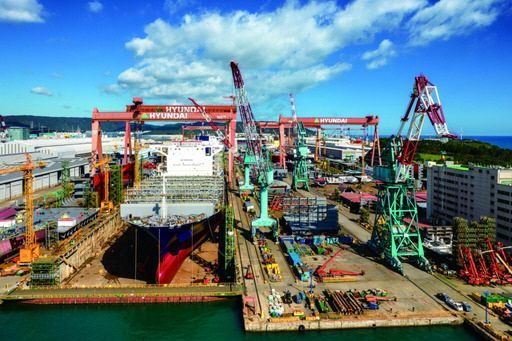 Panoramic view of HD Hyundai Heavy Industries Ulsan Shipyard. Provided by HD Hyundai Heavy Industries
Recently, major shipbuilders have begun overhauling their employment strategies, seeing this structure as a potential threat to the industry’s long-term competitiveness. They are internally reviewing plans to gradually adjust the share of foreign workers and expand domestic hiring. Now that the shipbuilding industry has entered a supercycle, with a boom driven by rising global orders, the idea is to increase directly employed staff even at the cost of higher labor expenses, in order to strengthen technology transfer and organizational stability.
As of the end of January this year, the combined workforce of HD Hyundai Heavy Industries and HD Hyundai Samho Heavy Industries stands at about 57,000. Of these, directly employed workers number around 23,000, and directly employed foreign workers total about 1,700, or roughly 10%. When partner companies are included, the foreign worker ratio approaches 20%. Considering that there were only a few thousand foreign workers in 2021 and that this figure has more than quadrupled in just a few years, the pace of structural change is quite steep.
The situations at Samsung Heavy Industries and Hanwha Ocean are not much different. At Samsung Heavy Industries, among roughly 10,000 directly employed workers, about 1,397 are foreigners, and the share of foreign workers remains in the 20% range when partner firms are included. At Hanwha Ocean, among a workforce of 10,000 direct employees and 20,000 at partner companies, foreign workers account for about 25% of partner-company employees. All three major shipbuilders are therefore grappling with ways to reduce their dependence on foreign labor and expand the inflow of domestic workers.
A chronic labor shortage lies behind the emergence of this structure. On-site positions such as hull construction and welding involve high work intensity and a large amount of outdoor work. During past downturns, overtime hours and unit rates fell, reducing incomes, and this experience is seen as having fueled avoidance of the sector among younger people. Even though shipbuilding has recently returned to a profit-making trajectory, the perception of it as a "tough industry" has not easily changed.
In the end, the labor gap has been filled by foreign workers entering on E-7 and E-9 visas. However, industry officials explain that it generally takes at least five years of work experience to reach a skilled level for high-difficulty welding and similar tasks, while cases of continuous service beyond four to five years are rare. After a certain period, workers often return to their home countries or move to other industries, and this cycle keeps interrupting the accumulation of skills.
The difficulty is that there is no clear immediate solution in sight. While the industry has set a direction of reducing the foreign worker share and increasing domestic hiring, it has only just emerged from a prolonged slump, making it burdensome to implement large-scale wage hikes or investments. Ultimately, the key lies in providing sufficient compensation and improving working conditions, but companies are still struggling to find concrete ways to make this a reality.
An industry official said, "During the boom in the mid-2000s, even college students flocked to take part-time jobs at shipyards, but during the downturn, the wage system and working hours became unstable and the sector lost its appeal," adding, "If performance improves for a long enough period and employment conditions stabilize, there is a possibility that inflows will increase again." However, some point out that to systematically foster skilled workers, institutional measures such as education subsidies and incentives for partner companies must be implemented in parallel.
This labor structure is intertwined not only with internal corporate issues but also with local economies. In areas where shipyards are concentrated, such as Ulsan and Geoje, vacancy rates in commercial districts are far above the national average. In the past, when domestic workers formed the core of the workforce, a large portion of wages flowed into local businesses, but now, with a significant share of foreign workers’ income being remitted overseas, the knock-on effects of consumption within the region are seen as limited.
Recently, President Lee Jaemyung remarked that an expansion of foreign labor could crowd out jobs for domestic workers and may not benefit local economies, prompting the shipbuilding industry to reconsider its direction. At the same time, there is a strong recognition that wage increases alone will not be enough to attract younger generations. It is also a burden that, compared with other sectors such as construction, the perceived level of reward is relatively low.
Accordingly, some shipbuilders are expanding the introduction of robots and automation, focusing on simple, repetitive processes. There is a sense of crisis that, unless the labor structure is fundamentally changed, the industry could face yet another labor shortage once the current supercycle ends.
Ultimately, the shipbuilding labor issue encompasses three main tasks: improving wages and working conditions to make the industry a viable option for young people; designing systems to foster skilled workers over the long term; and restructuring employment in a way that is linked to local economic development. The direction has been set, but industry players commonly worry that without financial resources and policy support to back implementation, finding effective solutions will not be easy.
© The Asia Business Daily(www.asiae.co.kr). All rights reserved.












