Democratic Party Goes All-In at February Extraordinary Session
People Power Party Prepares Filibuster
Daejeon?South Chungcheong Integration Bill Remains a Key Variable
A seven-day, eight-night plenary session of the National Assembly is beginning to deal with key bills, including amendments to the Commercial Act centered on treasury share cancellation, three justice system reform bills, and the administrative integration bill. The Democratic Party of Korea, which has been weighing between reform legislation and livelihood-focused legislation, has decided to go all-in on passing reform bills during the February extraordinary session. However, issues such as the handling of the Daejeon-South Chungcheong administrative integration bill are expected to remain variables right up until the plenary session.
On the 24th, Han Byungdo, floor leader of the Democratic Party, said at a party strategy meeting, "Starting today, the Democratic Party will steadily push forward with livelihood-focused reform legislation," adding, "We must swiftly pass at the plenary session of the National Assembly bills that are closely tied to people's daily lives, such as the third round of Commercial Act amendments that will bring forward the KOSPI reaching 6000 to 7000 points, the Child Allowance Act, the National Referendum Act guaranteeing voting rights for overseas Koreans, and the Administrative Integration Act that will bring about balanced national development and innovation." The Democratic Party is also openly declaring that it will seek to pass justice system reform bills at this plenary session, including the introduction of a crime of historical distortion, an increase in the number of Supreme Court justices, and the establishment of a constitutional complaint system.
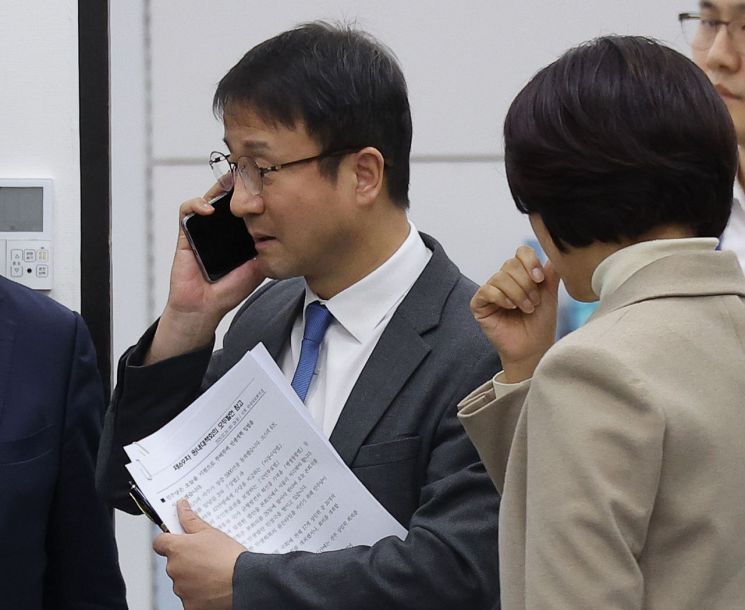 Han Byungdo, floor leader of the Democratic Party of Korea, is on the phone with someone before entering a parliamentary strategy meeting held at the National Assembly on the 24th. Yonhap News
The People Power Party has made clear its opposition to this parliamentary schedule. Song Eonseok, floor leader of the People Power Party, said at a party strategy meeting, "Immediately stop this shameless behavior you claim is judicial reform," and criticized it as "an abuse and misuse of the word 'reform' that sullies the term itself and commits a grave sin against history." Fierce strategic maneuvering between the ruling and opposition parties is underway over the plenary agenda. The People Power Party is preparing for measures such as a filibuster (unlimited debate).
For now, the National Assembly expects that if the People Power Party moves to block proceedings with a filibuster, the Democratic Party will take the lead in pushing through the three administrative integration bills, the Local Autonomy Act, the three justice system reform bills, the Commercial Act, the National Referendum Act, and other items. However, the specific bills to be handled and the order in which they will be taken up are to be revisited through negotiations between the respective floor leaders of the ruling and opposition parties. Baek Seungah, floor spokesperson of the Democratic Party, said, "The Administrative Integration Act is in an urgent situation."
Regarding administrative integration, there is a consensus between the Democratic Party and the People Power Party on integrations such as Daegu-North Gyeongsang and Gwangju-South Jeolla, but there is disagreement over the Daejeon-South Chungcheong integration. There is a large gap in views, as the People Power Party's metropolitan government heads in Daejeon and South Chungcheong are opposing it. In relation to this, Democratic Party leader Jung Cheongrae proposed a bilateral meeting to People Power Party leader Jang Donghyeok the previous day, but the meeting has not yet been scheduled. Kwak Gyutaek, chief floor spokesperson of the People Power Party, said, "The People Power Party currently opposes handling (the Administrative Integration Act)."
The Legislation and Judiciary Committee is scheduled to hold a full committee meeting on this day to review the Administrative Integration Act. However, it is reported that among the administrative integration bills, the Daejeon-South Chungcheong integration bill, which faces strong opposition from the People Power Party, is unlikely to be placed on the agenda of the plenary session even if it passes the Legislation and Judiciary Committee on this day.
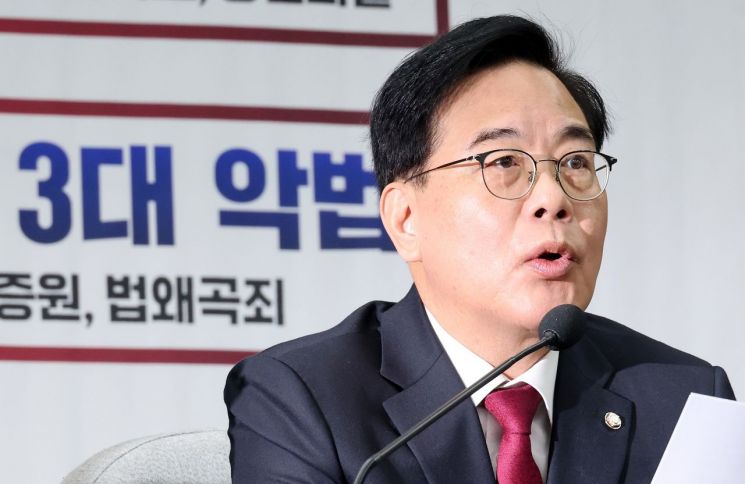 Song Eonseok, Floor Leader of the People Power Party, is delivering remarks at the party's floor strategy meeting held at the National Assembly on the 24th. Yonhap News
Although it is not included on the plenary agenda, the handling of the Special Act on Investment in the United States is also a variable. This is because the opposition party, in protest against the ruling party's push to force the plenary session, is hinting at the possibility of linking it to the handling of the Special Act on Investment in the United States, which is slated to be dealt with on March 9.
Also scheduled to be handled at the plenary session on this day is a motion to arrest independent lawmaker Kang Sunwoo, who is suspected of receiving 100 million won in nomination bribes. On February 12, the Seoul Central District Court submitted to the government a request for consent to arrest Representative Kang on charges of violating the Political Funds Act, and the request was reported to the plenary session of the National Assembly on the same day. A motion to arrest must be processed no earlier than 24 hours and no later than 72 hours after it is reported, but if no plenary session is held during that period, the vote is held at the first plenary session convened after the report.
© The Asia Business Daily(www.asiae.co.kr). All rights reserved.













