35% of All Living-Donor Kidney Transplants
Outcomes Comparable to General Living-Donor Kidney Transplantation
The Kidney Transplant Team at the Organ Transplant Center of The Catholic University of Korea Seoul St. Mary's Hospital (including Professor Park Sooncheol of Vascular Surgery and primary physician Professor Jung Byungha of Nephrology) announced on February 24 that it has successfully performed an ABO-incompatible kidney transplant for a 65-year-old male patient with end-stage renal disease (blood type B), receiving a kidney from his spouse (blood type AB), thereby reaching a total of 500 such procedures.
The patient had previously received his first kidney transplant from a sibling in 1989, but underwent a second transplant after the function of the transplanted kidney was lost. In the past, kidney transplantation from a donor with an incompatible blood type was difficult to perform due to the risk of rejection. However, advances in desensitization therapy that effectively removes blood type-related antibodies have made it possible.
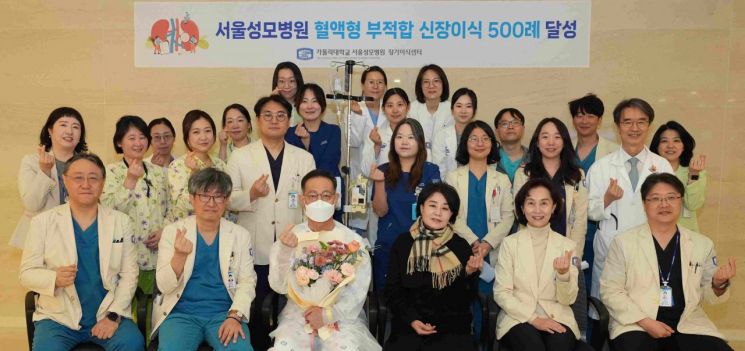 The Kidney Transplant Team at the Organ Transplant Center of Seoul St. Mary’s Hospital, The Catholic University of Korea, has successfully performed 500 cases of ABO-incompatible kidney transplantation and is celebrating the patient's discharge, wishing them good health, and taking a commemorative photo. Seoul St. Mary’s Hospital
At a gathering of medical staff to celebrate the patient's discharge and wish him good health, the patient's second daughter said, "As soon as we heard that our normally caring father might need a kidney transplant, not only my mother but also my married older sister and I were all readily prepared to step forward as donors." In response to his spouse's comment, "I thought it was only natural that I should donate to my husband," the patient finally shed tears, saying, "It breaks my heart that you gave up a kidney for me, but I am so grateful." He went on to say, "I would like to take this opportunity to express my sincere gratitude to the medical staff at Seoul St. Mary's Hospital and everyone involved for doing their utmost throughout the treatment process."
Since first succeeding in an ABO-incompatible kidney transplant in May 2009, Seoul St. Mary's Hospital reached 100 cases in six years. The number of procedures has since increased rapidly, achieving 200 cases in 2018, 300 cases in 2021, 400 cases in February 2023, and 500 cases in February 2026. This achievement comes 16 years and 9 months after the first procedure.
The history of kidney transplantation at Seoul St. Mary's Hospital traces back to March 25, 1969, when Myungdong St. Mary's Hospital succeeded in the first kidney transplant in Korea. It then continued through Gangnam St. Mary's Hospital to the present Seoul St. Mary's Hospital. In addition to ABO-incompatible transplantation, the hospital has led the field of kidney transplantation in Korea by successfully performing highly complex procedures such as living-donor and deceased-donor kidney transplants after desensitization in highly sensitized patients, transplants in patients with intractable hematologic diseases, and tolerance-inducing transplants.
This achievement is based on the organic collaboration and accumulated experience of the Vascular Surgery Department, Nephrology Department, Urology Department, Laboratory Medicine Department, Pathology Department, and the specialized coordinator team at the Organ Transplant Center. Building on its clinical experience, the hospital has also actively pursued research, accumulating academic achievements including the publication of 11 SCI-level papers in the field of ABO-incompatible kidney transplantation. Drawing on this clinical and academic experience, Professor Jung Byungha shared his know-how with Vietnamese medical staff through videoconferences, contributing to the success of the first ABO-incompatible kidney transplant in Vietnam.
An analysis of the 500 ABO-incompatible kidney transplants showed that the proportion of ABO-incompatible procedures among all living-donor kidney transplants increased from about 10% in the early period to 35% as of 2026. The most common recipient-donor relationship was between spouses, with more than half of the 500 cases being spousal transplants. This is higher than the proportion of spousal transplants (35%) among all living-donor transplants.
As clinical experience accumulated, the indications expanded, with patients aged 65 or older accounting for 7% (34 cases), and the oldest recipient being 73 years old. High-risk cases in which both high sensitization and ABO incompatibility were present numbered 87 (17%). There were 52 re-transplant cases and 5 third-transplant cases. There were also 3 cases performed in patients undergoing simultaneous kidney-liver transplantation. The graft survival rates (maintenance of function without dialysis or re-transplantation) were 98% at 1 year, 94% at 5 years, and 85% at 10 years after transplantation, outcomes that are comparable to those of general living-donor kidney transplantation.
Professor Park Sooncheol, Director of the Organ Transplant Center (Professor of Vascular Surgery), said, "With the introduction of ABO-incompatible kidney transplantation, a new option has opened up for patients who in the past could not receive a transplant because no suitable donor was available," adding, "We expect it will become even more widely adopted as essential medications and diagnostic methods continue to advance."
© The Asia Business Daily(www.asiae.co.kr). All rights reserved.

![Clutching a Stolen Dior Bag, Saying "I Hate Being Poor but Real"... The Grotesque Con of a "Human Knockoff" [Slate]](https://cwcontent.asiae.co.kr/asiaresize/183/2026021902243444107_1771435474.jpg)















