Financial Services Commission to restrict loan extensions for multiple-home owners with apartments in Seoul and the greater metropolitan area
Reviewing parallel application of LTV 0% and "phased repayment"
Unclear impact on increasing listings and stabilizing housing prices
Financial authorities are pushing to ban maturity extensions on loans held by multiple-home owners who own apartments in regulated areas such as Seoul and the greater metropolitan area. The key is to treat extensions or refinancing of loans reaching maturity in the same way as new loans, effectively moving to "recall loans." However, some point out that, because loans to multiple-home owners do not account for a large share, it is uncertain whether this will actually lead to an increase in listings or to housing price stabilization.
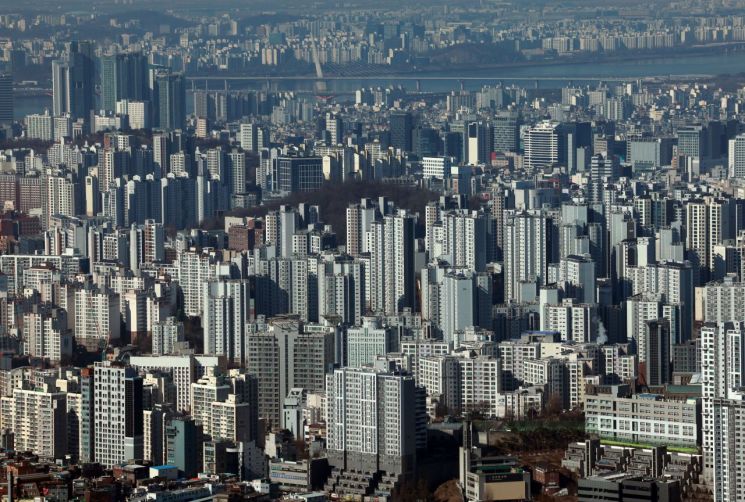
Focus on pinpoint regulations for apartments in regulated areas
On the 23rd, an official from the financial authorities said, "We are reviewing ways to strengthen loan regulations on multiple-home owners, focusing on apartments in regulated areas," adding, "We plan to finalize detailed measures after identifying the status of loans to individual multiple-home owners and rental business operators in the financial sector."
The core measure is to restrict existing loans to multiple-home owners to the same level as new loans when they are reassessed. This follows President Lee Jaemyung effectively setting a policy guideline on February 20 by posting on X (formerly Twitter), a social networking service (SNS), that "it would only be fair if loan extensions or refinancing for existing multiple-home holdings were subject to the same loan regulations as those applied to newly purchasing multiple homes." Initially, the financial authorities had been considering tightening the regulation on the ratio of rental income to interest (RTI) for residential rental business operators, but the president called for stronger measures by asking, "Why are you only considering RTI regulation?"
Currently, for individual multiple-home owners and rental business operators in Seoul and the greater metropolitan area, a loan-to-value ratio (LTV) of 0% is applied to new loans. Existing loans have conventionally been automatically extended at maturity, but going forward, a plan to apply the same LTV 0% standard is gaining traction. However, since a high proportion of loans to rental business operators is backed by non-apartment properties, there is concern that side effects such as higher jeonse and monthly rents for multi-unit dwellings could occur. For this reason, selective regulations limited to apartments in Seoul and the greater metropolitan area are being considered.
LTV 0% to be applied, but with a phased repayment exit... Higher risk weights on multiple-home mortgage loans also on the table
Depending on the results of its review of multiple-home loan exposures, the financial authorities plan to decide whether to recall the full amount at maturity or to require a reduction over a certain period. It is reported that they will calibrate the stringency of the policy while weighing immediate application of LTV 0% against options such as installment repayment, taking into comprehensive account tenant housing stability and the impact on financial markets. In this context, Presidential Policy Chief Kim Yongbeom mentioned the possibility of a gradual reduction of LTVs on loans to multiple-home owners in a post on Facebook on the 22nd.
The Financial Services Commission plans to compile loan data on multiple-home owners across all financial sectors by the 23rd, and then hold a third meeting on the 24th to discuss detailed measures. The Financial Supervisory Service is currently aggregating data by borrower type (individual or business), loan structure (bullet repayment or amortizing), collateral type (apartment or non-apartment), and region (greater metropolitan area or non-metropolitan areas).
At the same time, the possibility of raising the risk weights on loans to multiple-home owners is also being discussed. If risk weights increase, banks face a heavier capital accumulation burden, which indirectly constrains loan supply. At present, the base risk weight for typical home mortgage loans varies by bank and collateral, but the minimum level is around 20%.
Actual impact on increasing listings remains unclear
Inside and outside the financial sector, there is considerable skepticism about whether tougher loan regulations on multiple-home owners will translate into housing price stabilization. As of the end of January this year, the outstanding balance of home mortgage loans to individual multiple-home owners at the five major banks was about 36.5 trillion won, accounting for only 6% of total home mortgage loans (about 610 trillion won). In addition, most individual home mortgage loans are structured as long-term amortizing loans, leading to the assessment that short-term loan recall pressure will have only a limited impact on the market. The outstanding balance of loans to residential rental business operators at the four major banks was 15 trillion won at the end of last year, or 8.5% of the total outstanding loans to the real estate rental sector (178.5 trillion won).
The share of apartments among the homes owned by rental business operators is also low. According to the Ministry of Land, Infrastructure and Transport, apartments account for only 15.7% of long-term purchased private rental housing in Seoul, while non-apartment properties such as villas and officetels make up 84.3%.
In addition, high-priced apartments in regulated areas are often purchased through "gap investment," where buyers acquire properties with existing jeonse tenants, so it is argued that tighter loan regulations will not readily translate into an increase in listings. Even if some properties do come onto the market, analysts say it will be difficult to see a sequence of "more listings → increased transactions → price stabilization" in a situation where end-users face constrained funding conditions.
Ultimately, if, in response to tighter loan regulations, multiple-home owners who hold properties both in the greater metropolitan area and in the provinces start selling their provincial homes first, the possibility cannot be ruled out that the downturn in local real estate markets will deepen.
A commercial bank official said, "LTV and RTI standards are already being strictly applied, so loans to rental business operators are concentrated in non-apartment properties," adding, "Across-the-board tightening of regulations may only produce side effects such as higher rents."
© The Asia Business Daily(www.asiae.co.kr). All rights reserved.












