Blue House and Ministries Hold Back-to-Back Emergency Weekend Reviews
On the Night of the 22nd, Party, Government, and Blue House Gather for One-Hour Meeting on Pending Trade Issues
All-Out Effort to Manage Korea-U.S. Tariff Uncertainty
Trump Rai
Uncertainty in the Korea-U.S. trade environment has increased after the U.S. Supreme Court ruled that the "reciprocal tariffs" imposed by the Donald Trump administration on the basis of the International Emergency Economic Powers Act (IEEPA) were illegal. Although this ruling has invalidated the "reciprocal tariffs" that had been unilaterally imposed on various countries, the prevailing assessment is that variables have in fact multiplied, as President Trump, almost as if he had been waiting for this, immediately pulled out other legal grounds and resumed tariff pressure. The Democratic Party of Korea, the government, and the Blue House also view uncertainty as having grown, and they are struggling to devise response measures, holding a series of review meetings over the weekend and putting their heads together.
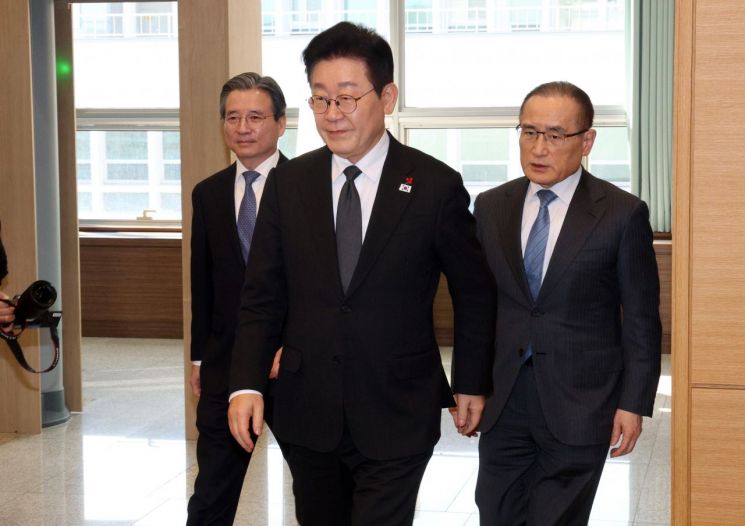
According to the Blue House on the 23rd, the party, government, and Blue House held a closed-door meeting to review current trade issues from 8 p.m. for one hour the previous day at the Financial Training Institute near the Blue House, presided over by Policy Chief Kim Yongbeom and National Security Office Director Wi Sunglak. From the ruling party, Floor Leader Han Byungdo, Policy Committee Chair Han Jeongae, and Chung Taeho, secretary of the Special Committee on the Special Act on Investment in the United States, attended. From the government, Deputy Prime Minister and Minister of Economy and Finance Koo Yooncheol, Minister of Trade, Industry and Energy Kim Jungkwan, and Trade Minister Yeo Hankoo of the Ministry of Trade, Industry and Energy attended. At this meeting, the party, government, and Blue House shared information on the U.S. administration’s moves and expected measures following the Supreme Court ruling, the status of investment projects in the United States, and the progress of security negotiations, and discussed future response strategies.
After the joint review meeting of the party, government, and Blue House, Moon Keumjoo, the Democratic Party’s floor spokesperson, said, "We reviewed the impact of the U.S. Supreme Court’s ruling on reciprocal tariffs and our response measures," adding, "The party, government, and Blue House agreed that swift enactment of the Special Act on Investment in the United States is the best way to protect our national interests, and decided to do their utmost to ensure it is passed by March 9 as agreed between the ruling and opposition parties." A ruling bloc official who attended the meeting said, "There was a general mood that we should respond calmly while watching how the U.S. administration’s situation unfolds."
The Blue House had also convened a "meeting of relevant ministries on Korea-U.S. trade issues" on the 21st, immediately after the Supreme Court ruling was delivered, presided over by Chief Kim and Director Wi, to review the ripple effects of the ruling and possible follow-up scenarios. A Blue House official said, "It is true that uncertainty in the international trade environment has increased," and explained that participants shared the view that Korea and the United States should continue friendly consultations so that the balance of benefits secured through the bilateral tariff agreement and conditions for exports to the U.S. market are not damaged. On the same day, Deputy Prime Minister Koo and Minister Kim also convened a separate emergency review meeting to discuss countermeasures.
The reason the Blue House and the government gave up their entire weekend and held emergency meetings two days in a row is President Trump’s tariff blitz following the ruling that "reciprocal tariffs" are illegal. Immediately after the Supreme Court decision, he announced that he would impose a global tariff of "10%" based on Section 122 of the Trade Act. However, apparently still dissatisfied with the ruling, he went on to declare just one day later that he would raise the global tariff to "15%". Section 122 of the Trade Act allows the president to impose tariffs of up to 15% for 150 days in order to respond swiftly to balance-of-payments problems without congressional approval. To impose tariffs beyond 150 days, congressional approval is required.
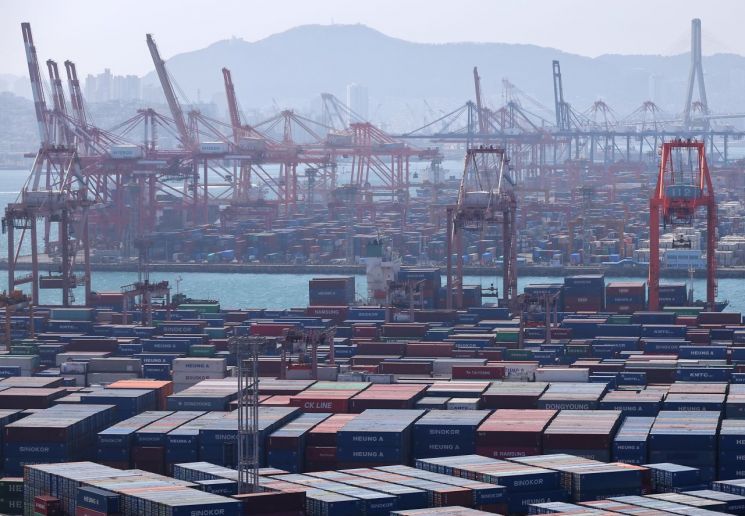
It is highly likely that President Trump will not stop there and will continue to exert additional tariff pressure. The Trump administration’s policy is to use Section 201 and Section 301 of the Trade Act, Section 232 of the Trade Expansion Act, Section 338 of the Tariff Act, and other alternative routes during the period guaranteed under Section 122 of the Trade Act, in order to replace the previous "reciprocal tariffs." Section 301 of the Trade Act specifies that, after a period of notification and public comment, retaliatory tariffs may be imposed on countries that engage in unfair trade practices against the United States. As of last year, Korea was the country with the 11th-largest trade surplus with the United States.
Item-specific tariffs that are unrelated to the ruling invalidating reciprocal tariffs are also a concern, including tariffs on automobiles (15%), steel (50%), and semiconductors (most-favored-nation treatment). Since President Trump has stated that he will mobilize all feasible alternative tools, it is difficult to rule out the possibility that, in the process of filling the gap left by reciprocal tariffs, existing agreements will be revisited and the scope or level of item-specific tariffs will be adjusted again. Section 232 of the Trade Expansion Act authorizes the president to impose tariffs if, after an investigation by the relevant departments, imports of specific items are deemed to threaten national security, and it is already being used as the legal basis for item-specific tariffs on automobiles, steel, and other products.
Based on the results of the weekend’s emergency review meetings, the Blue House and the government plan to manage the situation in a stable manner by monitoring the U.S. administration’s follow-up actions in real time and reviewing various scenarios, including the possibility of tariff refunds and the use of alternative legal provisions. They also decided to regularly assess sector-by-sector damage, volatility in financial markets, and difficulties faced by companies. If the National Assembly proceeds with the legislative process as scheduled, the "Special Act on Investment in the United States," which will serve as the legal basis for implementing 350 billion dollars in investment in the United States, will be passed on March 9.
© The Asia Business Daily(www.asiae.co.kr). All rights reserved.
![Clutching a Stolen Dior Bag, Saying "I Hate Being Poor but Real"... The Grotesque Con of a "Human Knockoff" [Slate]](https://cwcontent.asiae.co.kr/asiaresize/183/2026021902243444107_1771435474.jpg)












