Choi Jonghyun Academic Foundation Hosts "TPD 2026" in the United States
Over 90 Political, Business, and Academic Leaders from Korea, the United States, and Japan Attend
Discussions on Cooperation in AI, Energy, and Finance
The Trans-Pacific Dialogue (TPD) 2026, a strategic dialogue platform among Korea, the United States, and Japan, was held on the 20th and 21st (local time) at the Salamander Hotel in Washington, DC, USA.
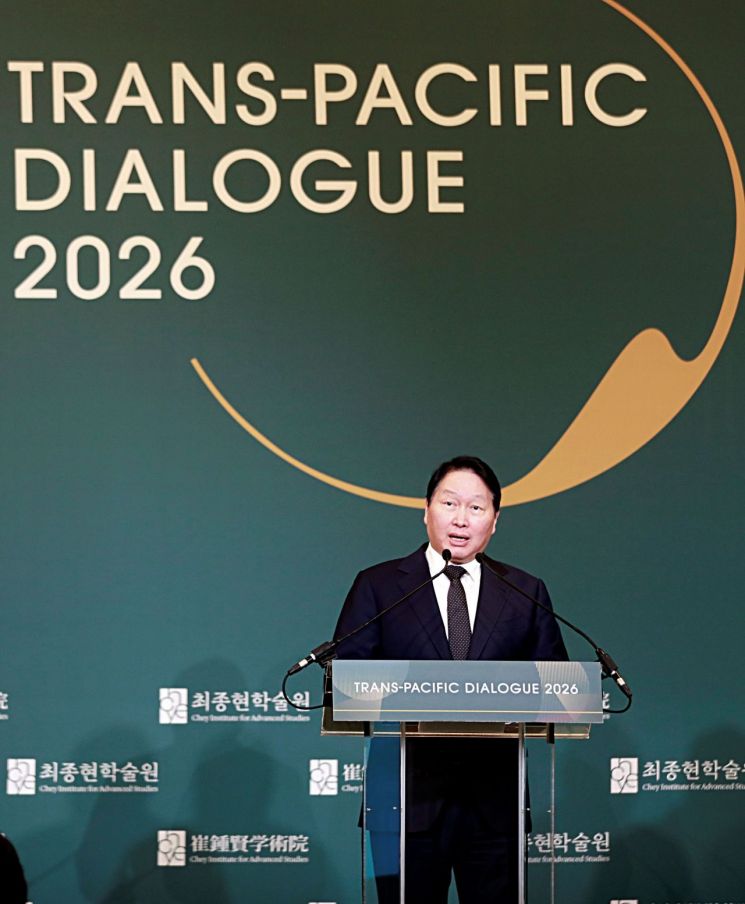 Chey Taewon, chairman of SK and chairman of the Choi Jonghyun Academy, is delivering a welcoming address at the 'TPD 2026' event held on the 20th at the Salamander Hotel in Washington, D.C., United States. Provided by SK Supex Council.
This year's event was hosted by the Choi Jonghyun Academic Foundation. The foundation is a policy and strategy research institute established to honor the philosophy and legacy of the late former SK Chairman Choi Jonghyun, and it has consistently operated a forum for strategic dialogue aimed at cooperation among Korea, the United States, and Japan, as well as peace and prosperity in Northeast Asia and the Pacific region. Launched in 2021, TPD is the foundation's flagship program and marked its fifth edition this year.
SK Chairman Chey Taewon attended the event in his capacity as chairman of the Choi Jonghyun Academic Foundation and delivered a welcoming address. Chairman Chey stated, "The changes we are facing now are not simply challenges, but a structural reality that will determine the survival of us all," adding, "How Korea, the United States, and Japan cooperate during this period of transition will shape the future order."
Chairman Chey identified artificial intelligence (AI) as the core driver of this change. He noted, "We are living through a new normal era in which the speed of change is fast and uncertainty is high," and assessed that "AI is fundamentally reshaping the industrial structures around the world."
In particular, he stressed the ripple effects of AI expansion on energy and financial systems. Chairman Chey warned, "If we fail to meet the power demand required for AI in a timely manner, our entire society could face a crisis," and raised the need to establish an eco-friendly yet stable energy supply system. He went on to say, "In a situation where AI competition cannot be stopped, only those with the capital and resources to bear massive infrastructure costs can take the lead in the race," analyzing that AI infrastructure is having a significant impact on the financial strategies of both countries and companies.
He emphasized, "Now is the time not only to diagnose the challenges we face but also to develop practical solutions," and added, "Close cooperation among Korea, the United States, and Japan will become a powerful driving force in opening a new era."
At this year's TPD, discussions focused on topics including: changes in the global order and trilateral cooperation; competition for AI leadership and industrial transformation; the reorganization of the financial order; next-generation nuclear power plants and energy cooperation; and security alliances in an era of heightened tensions.
In the global order session, international politics experts such as Harvard University Professor Stephen Walt, Princeton University Distinguished Professor John Ikenberry, and Seoul National University Professor Jeon Jaesung participated to assess the dynamics of U.S.-China strategic competition and the evolving landscape of alliances.
In the AI session, participants included Stanford University Professor and Nvidia Senior Director of AI Research Yejin Choi, as well as representatives from Google, NTT, SK Telecom, and Twelve Labs, policy experts, and Democratic Party of Korea lawmaker Cha Jiho. They discussed AI competition, industrial diffusion, and governance issues.
In the special China session held on the second day, Victor Cha, Senior Vice President for Asia and Korea Chair at the Center for Strategic and International Studies (CSIS) in the United States, and Yonsei University Professor Choi Jongkun examined the security environment in Northeast Asia. In the finance session, Harvard University Professor Jeffrey Frankel, University of California, Berkeley Professor Barry Eichengreen, and Goldman Sachs economist Kwon Kuhun analyzed the dominance of the U.S. dollar and changes in the global financial order.
In the energy session, former U.S. Deputy Secretary of Energy Dan Poneman, Japan Bank for International Cooperation (JBIC) Governor Tadashi Maeda, Jared Egan of the U.S. National Energy Dominion Council, Korea Hydro & Nuclear Power Director of Business Development Lim Seungyeol, Shinichi Kihara, Director-General for International Policy on Carbon Neutrality at Japan’s Ministry of Economy, Trade and Industry, and Amir Vexler, CEO of Centrus Energy, discussed pathways for cooperation on next-generation nuclear power plants and energy.
In the security session, Patrick Cronin, Asia-Pacific Security Chair at the Hudson Institute, Keio University Professor Ken Jimbo, People Power Party lawmaker Kim Gun, and Sejong Institute Senior Research Fellow Kim Jungseob focused on how "deterrence," the core concept of security alliances, is evolving.
Kim Yuseok, President of the Choi Jonghyun Academic Foundation, said, "On the fifth anniversary of TPD, we reaffirmed the strategic significance of cooperation among Korea, the United States, and Japan amid a rapidly changing global order," and added, "We will continue to provide a forum for discussions that seek practical solutions in key areas such as AI and energy, which will determine national competitiveness."
© The Asia Business Daily(www.asiae.co.kr). All rights reserved.

















