Real Effective Exchange Rate at 67.73 in January
Lowest Level Since Adoption of Floating Exchange Rate System in 1973
In January, Japan's real effective exchange rate for the yen was recorded at 67.73, marking the lowest level since 1973, when the country adopted a floating exchange rate system.
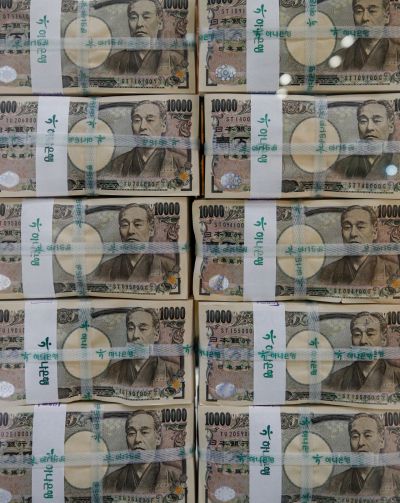 Japanese yen displayed at the Hana Bank Anti-Counterfeiting Response Center in Jung-gu, Seoul, on the 14th. Photo by Kang Jinhyung aymsdream@
Nihon Keizai Shimbun (Nikkei) reported on the 21st that the yen has significantly depreciated in value against global currencies. Compared with the peak of 193.95 in April 1995, the current value of the yen is only about one-third of that level.
The real effective exchange rate is an indicator that shows how much actual purchasing power a country's currency has compared with the currencies of other countries. When the figure is lower than in the base year, it means that the currency is relatively weak in international trade. Nikkei cited Japan's prolonged economic stagnation and its low interest rate policy as the background to the yen's weakness.
In the Tokyo foreign exchange market, the value of the yen has recently plunged against the dollar, with the dollar-yen exchange rate at one point rising to the low 155-yen range. Some speculative investors who had been driving yen buying have incurred unexpected losses and have begun unwinding their positions. Analysts say that long positions built in anticipation of possible Japanese government intervention in the foreign exchange market are being reduced due to the burden of mounting losses.
The interest rate gap between the United States and Japan is also a factor fueling the yen's weakness. While the Federal Reserve's benchmark interest rate stands at around 3.5% to 3.75% per year, Japan's rate is as low as 0.75%, leading to analysis that the attractiveness of holding yen is diminished in terms of real interest rates. As a result, international investors are shifting their funds into currencies such as the dollar, the euro, and the yuan, which offer higher operational efficiency.
Market experts predict that the yen's weak trend is unlikely to reverse in the near term unless the Bank of Japan further raises its benchmark interest rate or strengthens its hawkish monetary policy stance. They point out that for the yen to regain its status as a "safe-haven currency," a clear policy shift by Japan's financial authorities is necessary.
© The Asia Business Daily(www.asiae.co.kr). All rights reserved.

















