"Sanaenomics" Hopes... 16.6 Trillion Won Net Buying Last Week
Overseas investors have been flocking to the Japanese stock market following Prime Minister Sanae Takaichi's landslide victory in the House of Representatives election, Bloomberg reported on the 19th (local time). Expectations for the Takaichi Cabinet's aggressive expansionary fiscal policy, the weak yen, and tax cuts are driving Japanese equities higher.
According to Japan Exchange Group, foreign investors were net buyers of a total of 1.78 trillion yen (about 16.6442 trillion won) in Japanese stocks and stock index futures between the 9th and 13th. This is the largest amount since November 2014. Bloomberg explained that this buying spree reflects heightened expectations for political stability and increased government spending following Prime Minister Takaichi's victory.
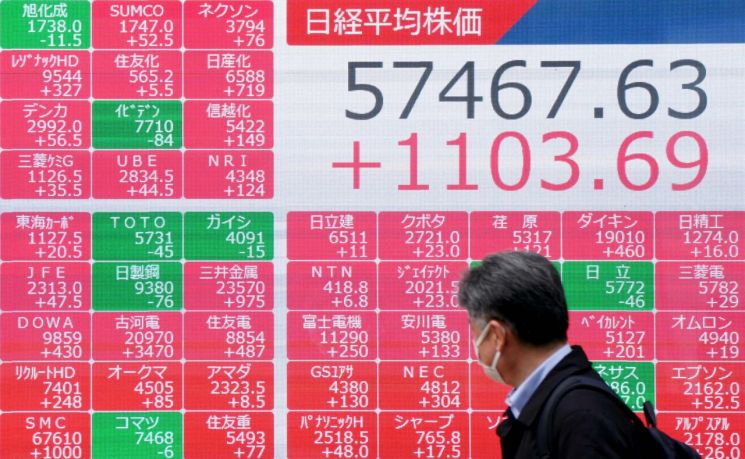 On the 10th, a passerby is passing in front of an electronic board displaying the Nikkei index outside the Tokyo Stock Exchange in Japan. Photo by AFP/Yonhap
According to the Tokyo Stock Exchange, overseas investors bought about 5.4 trillion yen worth of Japanese cash equities last year, which is 35 times the previous year's level. This trend is expected to continue this year.
The massive influx of funds into the Japanese stock market shows that global investors are leaving the U.S. market in search of more stable returns. Since the beginning of this year, the U.S. S&P 500 Index has been flat, while the Tokyo Stock Price Index (TOPIX), Japan's broad stock index, has risen about 13%.
Russell Shore, chief market strategist at Tradew, said, "If you look outside the United States right now, Japan is one of the most promising markets," adding, "It has become very politically stable after the election, and it is not just simple stability; the margin by which Prime Minister Takaichi won is itself large. That makes Japan very attractive."
Prime Minister Takaichi, under the banner of "Sanaenomics," a stance of responsible yet aggressive fiscal expansion, is expected to push for an economic stimulus package worth about 21 trillion yen and an aggressive tax-cut program that includes a temporary exemption of the consumption tax on food. The market expects her economic policies to invigorate a wide range of industries from artificial intelligence (AI) to energy and shipbuilding, while the weak yen is serving as a boon for export-oriented companies. The previous day, the Nihon Keizai Shimbun (Nikkei) reported that, based on an aggregation of earnings forecasts for about 100 March-closing companies listed on the Tokyo Stock Exchange's Prime Market, net profit is expected to increase by 1% year-on-year, with listed companies' net income set to hit record highs for the fifth consecutive year.
Bloomberg also analyzed that continued pressure from activist investors is having a positive impact on Japanese equities. Recently, British activist fund Palliser Capital built a stake in Japanese toilet-equipment maker Toto and pressured the company to step up investment in, and promotion of, its semiconductor components business.
Shore noted that, as U.S. stocks have become somewhat less attractive in recent months due to concerns related to AI and geopolitical risks, Japanese equities look relatively appealing from the perspective of global fund managers.
© The Asia Business Daily(www.asiae.co.kr). All rights reserved.












