Celltrion and Yuhan opt for retirement of treasury shares...shareholder-friendly moves
Mid-sized firms choose share swaps...controversy over regulatory circumvention
Pharmaceutical owner network seen as a bridge for such deals
As the National Assembly is set to pass the “Third Amendment to the Commercial Act,” which centers on the mandatory retirement of treasury shares, calculations in the domestic pharmaceutical and biotech industry are becoming increasingly complex. While large-cap companies at the top of the market capitalization rankings are focusing on “retirement” of treasury shares to boost share value, mid-sized companies with a high proportion of treasury shares are building defensive walls around management control by “swapping” shares with other companies.
Large-cap companies such as Celltrion and Yuhan, generous retirement of treasury shares to return profits to shareholders
According to the pharmaceutical and biotech industry on the 20th, large-cap companies with a market capitalization of more than 1 trillion won have recently been taking shareholder-friendly steps day after day through the retirement of treasury shares. Retiring treasury shares reduces the number of shares outstanding and thereby increases the value per share, a form of shareholder return that foreign institutional investors have been demanding for a long time. Since attracting global investors is essential for large-cap companies, this is interpreted as a strong signal that they intend to enhance shareholder value.
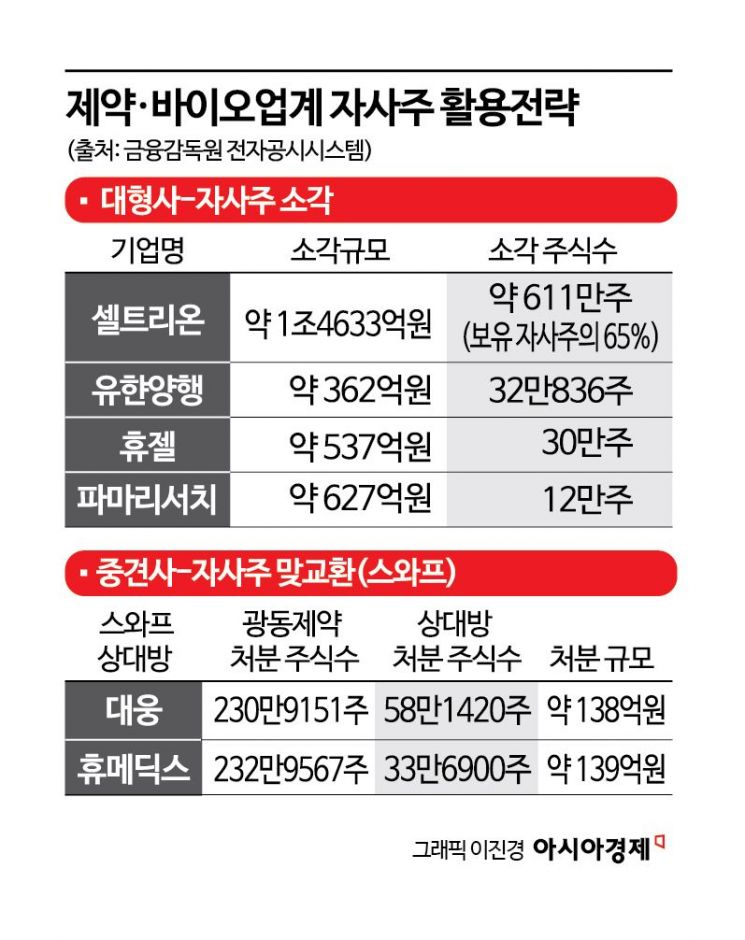
Most notably, Celltrion announced on the 12th that it would proceed with a large-scale retirement of treasury shares worth about 1.4633 trillion won. Out of its 12.34 million treasury shares, the company plans to retire 65% (approximately 6.11 million shares), excluding a portion reserved for compensation such as stock options, in order to increase share value. Yuhan disclosed on January 5 that it would retire 320,836 common shares (worth about 36.2 billion won). It is keeping pace by signaling both the retirement of treasury shares and an increase in dividends, with a target of achieving an average shareholder return ratio of at least 30% by 2027. In addition, companies such as Hugel and PharmaResearch joined the wave last year by retiring treasury shares on the scale of several tens of billions of won.
Mid-sized companies secure friendly stakes to defend management control through share swaps
In contrast, mid-sized companies with a high proportion of treasury shares are opting to “swap” their treasury shares rather than retire them. For Kwangdong Pharmaceutical, the ratio of treasury shares reached 25.1% as of the end of the third quarter last year, creating a heavy burden under the government’s policy of mandatory retirement of treasury shares. In response, in December last year it pursued a 13.8 billion won equity swap with Daewoong, under which Daewoong acquired 2,309,151 shares of Kwangdong Pharmaceutical, while Kwangdong Pharmaceutical acquired 581,420 shares of Daewoong. It also increased its friendly stake through a 13.9 billion won equity swap with Humedix, an affiliate of Huons Group.
Hwanin Pharmaceutical and Korea United Pharm also disposed of their treasury shares using similar methods. Treasury shares do not carry voting rights while held by the company itself, but once they are disposed of to a third party, the voting rights are revived. By exchanging each other’s treasury shares, companies can secure friendly stakes without any cash outflow, making this a tool for defending management control. For companies that have used treasury shares as a means of defending management control, retirement would mean losing this card, so they are choosing instead to transfer the shares to friendly parties and keep them as “ammunition.”
Criticism that this is a last-minute move before the Commercial Act amendment
Although pharmaceutical companies are presenting all these treasury share swap deals as being for strategic business alliances, some analysts argue that they are in fact aimed at minimizing the impact of the impending mandatory retirement of treasury shares. As financial authorities have begun to regulate companies’ indiscriminate issuance of exchangeable bonds (EB), more companies are shifting their strategy from issuing EBs to pursuing swap deals instead. In the Economic Reform Report, Lee Eunjung, a research fellow at the Economic Reform Research Institute, stated, “Using treasury shares to create friendly stakes for management is using the company’s assets for the benefit of management,” adding, “Regulation of the acquisition and disposal of treasury shares is necessary.”
In particular, observers note that these moves are possible because of the unique “owner network” that characterizes the domestic pharmaceutical industry. Many pharmaceutical companies have been run by owner families for decades, and networks have formed among second- and third-generation heads of these groups, making mutual equity swaps relatively easy. A pharmaceutical industry official said, “If the Third Amendment to the Commercial Act makes the disposal of treasury shares mandatory, companies’ means of defending management control will be greatly limited,” and predicted, “Until the bill is passed, companies will likely continue moving their treasury shares outside the company to revive voting rights.”
© The Asia Business Daily(www.asiae.co.kr). All rights reserved.


















