Officetel Sales Index Hits Highest Level Since 2020
Shift Toward Alternative Housing as Apartment Jeonse Prices Rise
Prospective homebuyers without properties of their own, constrained by loan limits and income requirements, are shifting toward non-apartment housing types such as villas and officetels. As jeonse supply shrinks and jeonse prices rise, demand that finds it difficult to switch to apartment purchases is flocking to alternative housing, causing even the non-apartment market to heat up.
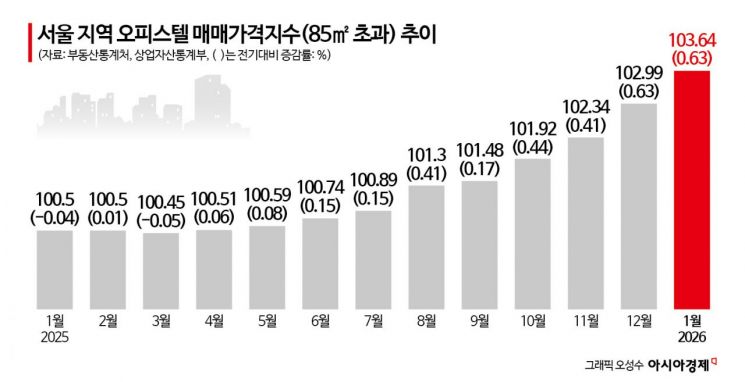
According to the Korea Real Estate Board’s Real Estate Statistics Information System on the 20th, last month the sales price index for officetels in Seoul (over 85㎡) stood at 103.64, up 0.63% from the previous month. Since the announcement of the “10·15 Real Estate Measures” in October last year, the index rose to 101.92 (0.44%) in October, 102.34 (0.41%) in November, and 102.99 (0.63%) in December, maintaining an upward trajectory and with the pace of increase accelerating. Last month’s index was the highest level since related statistics began to be compiled in June 2020. The officetel sales price index sets the reference point at 100 and indicates changes in the price level; a reading above 100 means prices have risen compared with the base period.
Jeonse prices are also on the rise. In January this year, the jeonse price index for officetels in Seoul was 101.48, up 0.31% from the same month a year earlier. This was the steepest increase since January 2024. The index has exceeded 101 only twice recently, in December last year and January this year, making the recent upward trend more pronounced. Unlike apartments and multi-family/row houses, officetels are classified as “quasi-residential” under the Building Act. As a result, they are relatively less affected by the stricter mortgage regulations introduced after the 10·15 measures, and it is understood that demand has flowed in as they are perceived as alternative housing.
Multi-family and row houses are also clearly on an upward trend. In January this year, the jeonse price index for multi-family and row houses in Seoul was 102.21, up 0.32% from the same month a year earlier. The upward trend has been notable since October last year, and jeonse prices have risen in both northern and southern Seoul. In particular, in southern Seoul the pace of increase has continued to expand since October last year into this year.
Market participants see demand shifting toward multi-family and row houses and officetels, which are relatively cheaper or easier to finance, as apartment prices rise and the jeonse shortage worsens. Analysts also point out that the reduction in jeonse supply, as many multiple-home owners withdraw jeonse listings or convert them to monthly rentals, has added upward pressure on prices. An official at a real estate agency near Seongbuk District in Seoul said, “These days, simply finding a jeonse home is the biggest problem,” adding, “People with limited borrowing capacity and heavy jeonse burdens ultimately have no other choice but to move to cheaper neighborhoods or different types of housing.” The recent increase in transactions of apartments priced under 1 billion won in areas such as Gwanak, Seongbuk, and Gangbuk in Seoul is seen in the same context. Some prospective buyers without homes, feeling burdened by the sharp rise in Seoul apartment prices and jeonse costs, have jumped into the market as so-called “last-train” demand.
Some analysts also say that as overall inflation and rising construction and financing costs increase the housing cost burden, people without homes are turning to non-apartment options as an alternative. Yoon Jihae, head of the Research Lab at Real Estate R114, said, “It may seem more rational to purchase a villa or an officetel and repay principal and interest, rather than continuing to pay apartment rent,” adding, “As jeonse continues to shift to monthly rentals and monthly rents rise, a structure emerges that stimulates purchase demand. If this trend continues, there is a possibility that the market for officetels and other non-apartment housing will also remain on an upward trajectory for the time being.”
© The Asia Business Daily(www.asiae.co.kr). All rights reserved.


















