Mayor Oh Sehoon Announces "Gangbuk Golden Age 2.0"
Expansion of Transportation Infrastructure and Creation of Future Industry Hubs
Revitalizing the Local Economy and Enhancing Seoul's Competitiveness
"In as little as four years, or in as many as ten, you will see a completely new Gangbuk where transportation, industry, and jobs come together."
The Seoul Metropolitan Government will invest 16 trillion won to innovate the transportation network in the Gangbuk area and build hubs for future growth industries. The plan is to modernize the over-40-year-old Dong Seoul Bus Terminal and transform the northern station area of Seoul Station into the "COEX of Gangbuk" by 2029.
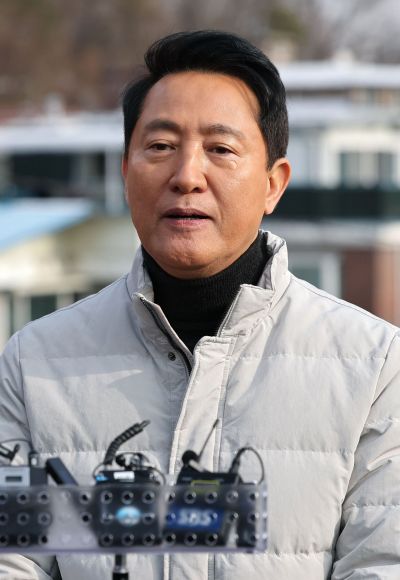
On the 19th, at Seoul City Hall, Mayor Oh Sehoon held a press briefing and announced "Again, the Golden Age of Gangbuk 2.0" to achieve balanced development between Gangnam and Gangbuk. Mayor Oh stressed, "We will concentrate 16 trillion won of financial resources into Gangbuk and develop Gangbuk into a core axis that drives Korea's next stage of growth, rather than leaving it as a mere bedroom town."
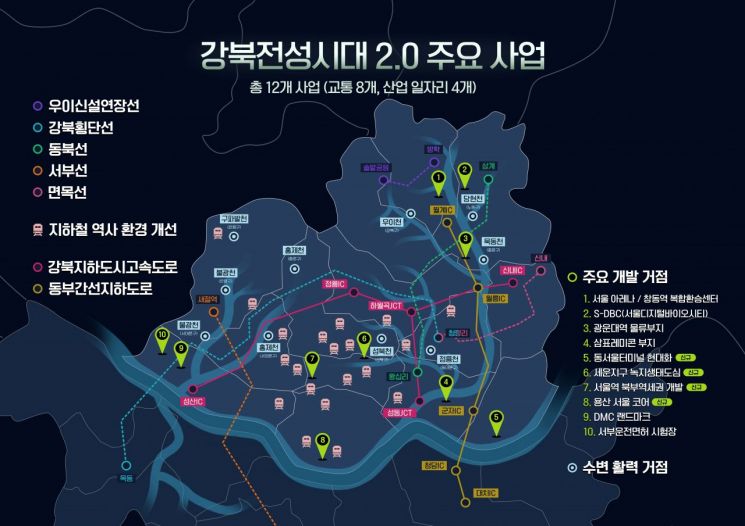
In 2024, the Seoul Metropolitan Government announced a plan to promote 40 projects aimed at easing regulations and activating development in aging residential and commercial areas of Gangbuk. The new Gangbuk Golden Age 2.0 plan, into which a total of 16 trillion won will be invested, includes 12 projects in total, such as eight transportation infrastructure projects and four projects to expand industry and jobs. The vision is to foster Gangbuk as a new identity and future growth axis of Seoul, using it as a springboard for the city to rise into the global top 5.
The northern station area of Seoul Station, which has long been neglected, is expected to be reborn in 2029 as the COEX of Gangbuk, concentrating exhibition, hotel, and office facilities. The city plans to build five landmark buildings of up to 39 stories and introduce international exhibition and convention facilities capable of accommodating more than 2,000 people, turning the area into a business hub.
Dong Seoul Bus Terminal, which was completed more than 40 years ago, will be reborn as an extra-large mixed-use complex, consisting of a 39-story-above-ground structure that combines a transfer center with commercial and cultural facilities. The city will improve accessibility to Gangbyeonbuk-ro and optimize transfer routes to enhance travel convenience. Through this, it plans to reorganize the area into a key employment and commercial hub in the northeastern region.
In addition, through the development of the DMC landmark site, the former Western Driver’s License Test Center site, the Sampyo Remicon site, and the logistics site at Gwangwoon University Station, as well as the opening of Seoul Arena, the city expects to contribute to revitalizing the local economy as a large-scale employment and industrial hub.
The 2.0 plan will introduce new urban development models called the "growth-hub-type mixed-use development project" and the "growth-potential-zone activation project." For growth-hub-type mixed-use development projects that combine commercial, office, and residential functions, if more than 50% of the floor area is allocated to non-residential use in downtown and metropolitan centers (such as the Jongno and Jung-gu areas, and Cheongnyangni) and in station influence zones for transfer (within a 500-meter radius), the floor area ratio in general commercial areas will be relaxed to up to 1,300%.
To restore vitality in non-station areas, the city will newly promote growth-potential-zone activation projects along major arterial roads with a width of 35 meters or more, such as Tongil-ro, Dobong-ro, and Dongil-ro.
In addition, for autonomous districts where the official land price is 60% or less of the citywide average, the proportion of public contributions required for these new projects and for existing station-area activation projects will be reduced to as low as 30% in order to encourage private development projects.
Regarding transportation infrastructure improvement projects, the city plans to proceed without delay with the "Gangbuk Cross-City Underground Expressway" announced last month, as well as: the undergrounding of the 15.4-kilometer section from Wolgye Interchange to Daechi Interchange; the extension of the Ui-Sinseol Line (from Solbat Park to Banghak Station); the opening of the Dongbuk Line in 2027; and environmental improvement projects for 20 aging subway stations.
Mayor Oh said, "It is now Gangbuk's turn to lead Seoul's development," adding, "Once Gangbuk takes off, the foundation for Seoul's growth will become even stronger, and as Seoul's competitiveness rises, the future of the Republic of Korea will broaden all the more."
© The Asia Business Daily(www.asiae.co.kr). All rights reserved.
!["The Woman Who Threw Herself into the Water Clutching a Stolen Dior Bag"...A Grotesque Success Story That Shakes the Korean Psyche [Slate]](https://cwcontent.asiae.co.kr/asiaresize/183/2026021902243444107_1771435474.jpg)

















