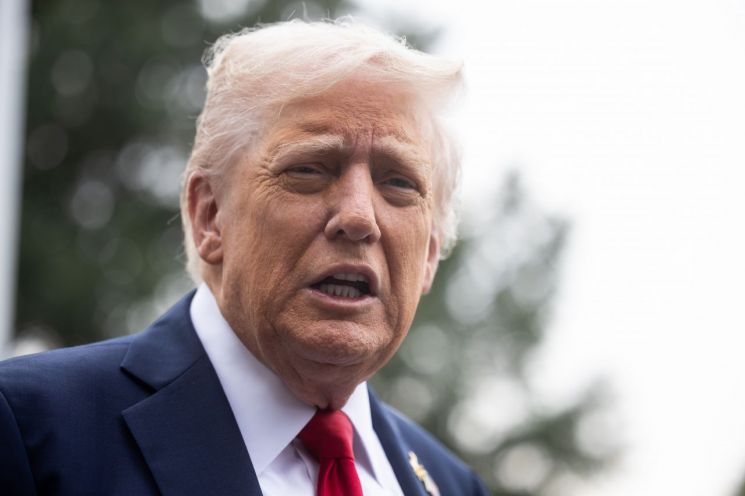
On February 17 (local time), U.S. President Donald Trump announced a U.S.-bound investment project worth 36 billion dollars (about 52 trillion won), describing it as the first outcome of the trade agreement concluded with Japan.
President Trump stated on social media that "the massive trade agreement with Japan has just gone into effect," and officially announced three large-scale projects in strategic areas: crude oil and gas in Texas, a power plant in Ohio, and critical minerals in Georgia. He stressed that "these projects would not have been possible without the special word 'tariffs'," adding that the gas-fired power plant in Ohio would be the largest in history, and that the critical minerals facility would put an end to the foolish dependence on foreign sources of supply.
U.S. Secretary of Commerce Howard Lutnick said in a statement that the investment includes power generation facilities with a capacity of 9.2 gigawatts and deepwater crude oil export facilities in the Gulf of Mexico, and that it will create thousands of high-paying American jobs, providing specific figures. Secretary Lutnick went on to say that "Japan supplies the capital and the United States gains strategic assets and energy dominance," and assessed that the agreement will cement the U.S. position as a leading global energy supplier.
With the announcement of the first U.S.-bound investment under the new U.S.-Japan trade agreement, attention is focusing on whether it will affect the Trump administration's pressure on South Korea to increase investment in the United States. Earlier, on January 26, President Trump took issue on Truth Social with the failure of the National Assembly of Korea to pass a special U.S.-investment bill, and threatened to raise tariffs on Korean automobiles, lumber, pharmaceuticals, and other items, as well as all other reciprocal tariffs (country-specific tariffs), back to 25% -- the level prior to the Korea-U.S. trade agreement.
In response, Minister of Trade, Industry and Energy Kim Jeonggwan and Trade Minister for Trade Negotiations Yeo Hankoo urgently visited Washington, D.C., where they met with Secretary Lutnick and other senior U.S. officials and members of Congress. Foreign Minister Cho Hyun also visited the United States to meet with Secretary of State Marco Rubio and U.S. Trade Representative (USTR) Jamison Greer. At the same time, in the National Assembly of Korea, the ruling Democratic Party of Korea is seeking swift passage of the U.S.-investment bill.
© The Asia Business Daily(www.asiae.co.kr). All rights reserved.

















