6.15 Million Vehicles on the Move Nationwide
Heavy Congestion on Gyeongbu, Seohaean, and Jungbu Naeryuk Expressways
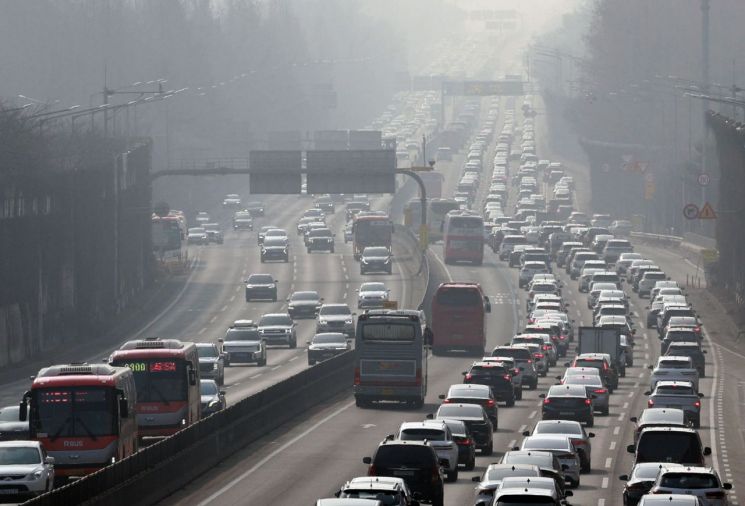
On February 17, the fourth day of the Lunar New Year holiday and Lunar New Year's Day itself, homebound traffic continued, causing congestion at many points on expressways heading toward Seoul.
According to the Korea Expressway Corporation, as of noon that day, the maximum estimated travel times from each city to the Seoul Tollgate were 10 hours from Busan, 9 hours 40 minutes from Ulsan, 9 hours from Daegu, 9 hours 20 minutes from Mokpo, 8 hours 50 minutes from Gwangju, and 4 hours 40 minutes from Daejeon.
As congestion persisted on the expressways, travel times in most regions increased by about 2 to 3 hours compared with the estimates made as of 8 a.m.
In the opposite direction, from Seoul to each city, the estimated travel times were 7 hours to Busan, 6 hours 40 minutes to Ulsan, 6 hours to Daegu, 4 hours 40 minutes to Mokpo, 4 hours 30 minutes to Gwangju, 3 hours 10 minutes to Gangneung, and 3 hours 10 minutes to Daejeon.
Travel times for outbound traffic from Seoul also increased by about 1 hour by region compared with around 8 a.m.
On the Gyeongbu Expressway toward Seoul, traffic was moving slowly in several sections, including 6 km from the Yangsan Junction to the vicinity of Yangsan, 5 km from the Geumho Junction to the Chilgok Junction, 15 km from Daejeon to the Jugam Service Area, 14 km from Cheongju to the Cheongju Service Area, and 15 km from the Cheonan Ipjang Geumbong Grape Service Area to the Anseong Service Area.
Toward Busan, congestion was reported over 3 km from near the Singal Junction to Suwon, 4 km from the Manghyang Service Area to near Cheonan, 7 km from the Independence Hall to near the Cheonan Hodu Service Area, and 3 km from near Daejeon to the Biryong Junction.
On the Seohaean Expressway toward Seoul, traffic was not flowing smoothly in several stretches, including 8 km from near Illo to near the Mongtan 3 Tunnel and 31 km from near the Dangjin Junction to near Seopyeongtaek. In the direction of Mokpo, congestion was seen over 6 km from the Jonam Junction to near the Sunsan Tunnel and 9 km from near Bibong to near the Hwaseong Service Area.
On the Jungbu Naeryuk Expressway toward Seoul, congestion also continued in several sections, including 10 km from near Gamgok to the Yeoju Junction and 15 km from the Chilwon Tollgate to near Namji.
The corporation projected that 6.15 million vehicles would be on the move nationwide that day, more than 1 million higher than the previous day's 5.05 million.
It expected about 440,000 vehicles to travel from the Seoul metropolitan area to the provinces and about 470,000 vehicles to move from the provinces to the metropolitan area.
The corporation forecast that congestion on the homebound routes to Seoul would be heaviest between 3 p.m. and 4 p.m., and, at the latest, would ease between 3 a.m. and 4 a.m. the following day.
Outbound traffic from Seoul was expected to be most congested between 1 p.m. and 2 p.m. and to ease between 8 p.m. and 9 p.m.
© The Asia Business Daily(www.asiae.co.kr). All rights reserved.

















