First Rural Basic Income Payments to Be Made at the End of This Month
New Residents to Receive Retroactive Payments After 90 Days of Eligibility
Fraudulent Claims Subject to Recovery, Application Ban, and Penalty Surcharges
Office workers whose resident registration is in an area selected for the Rural Basic Income Pilot Project can receive rural basic income even if they work in Seoul. However, they must actually reside in the area for at least three days. If they do not meet the actual residency requirement, or if they fraudulently receive basic income, an administrative penalty of up to five times the improperly received amount may be imposed.
According to the Ministry of Agriculture, Food and Rural Affairs on February 17, nine counties, excluding Gokseong, which is scheduled to make payments at the end of March, plan to provide the first basic income payments between February 26 and 27.
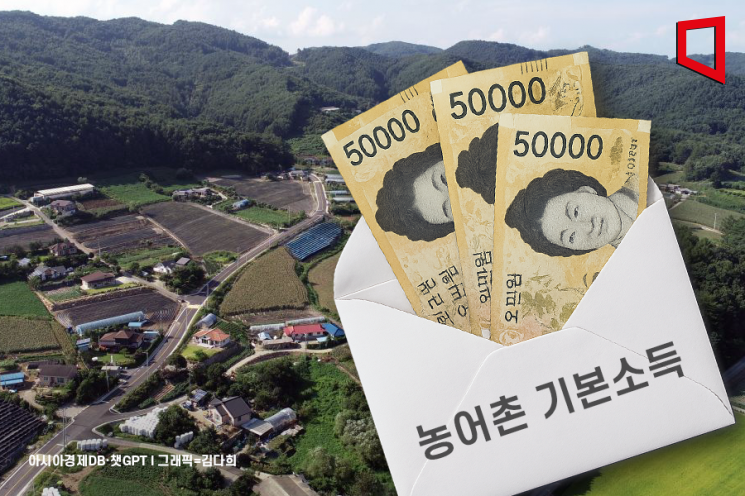
The Rural Basic Income Pilot Project is a policy designed to improve the quality of life of residents and promote balanced regional development by paying basic income to residents in rural areas facing the risk of population extinction, thereby creating a virtuous cycle in the local economy and revitalizing the social solidarity economy. In August last year, the ministry selected the Rural Basic Income Pilot Project as a national policy task to urgently respond to the crisis of rural extinction. From September, it carried out an open call for candidate regions, consultations on establishing a new social security system, and the budget approval process in the plenary session of the National Assembly, and finally selected 10 counties as the pilot project areas. The pilot areas are 10 counties in 8 provinces: Yeoncheon in Gyeonggi Province; Jeongseon in Gangwon Province; Okcheon in North Chungcheong Province; Cheongyang in South Chungcheong Province; Sunchang and Jangsu in North Jeolla Province; Sinan and Gokseong in South Jeolla Province; Yeongyang in North Gyeongsang Province; and Namhae in South Gyeongsang Province. Residents of the 10 counties will receive basic income in the form of local love gift certificates of 150,000 won per person every month during the pilot period (2026-2027), without any restrictions on age or income.
To receive basic income, an applicant must have been registered as a resident and actually living in the county for at least 30 days immediately prior to the application date. People who work in other regions or university students can also receive basic income if they actually reside in the area for at least three days. For example, an office worker whose resident registration is in Yeoncheon County can receive payments if they live in Seoul, their place of work, from Monday to Thursday and stay in Yeoncheon County from Friday to Sunday. University students enrolled at universities in other regions can also receive basic income during periods when they live in the target area on weekends, or when they live there at least three days a week during vacation. Residents who moved into the pilot area after the date on which the area was designated as a pilot region can apply starting 30 days after moving in. Once it is confirmed that the applicant has actually resided in the area for at least 90 days after the application date, the government plans to pay three months of basic income retroactively.
To reduce the administrative burden of verifying actual residency and to improve the objectivity and efficiency of the verification process, the ministry plans to operate eup/myeon committees and village survey teams composed of village heads, resident autonomy committee members, and public officials. It also plans to establish and operate a center for reporting fraudulent claims to ensure thorough post-management. If a person is found to have received benefits fraudulently, not only will the improperly received amount be recovered, but that person will also be barred from applying for basic income for the next two years and will be subject to a penalty of up to five times the fraudulent amount.
The places where basic income can be used will be limited to designated living areas within each eup or myeon, determined in consideration of differences in local conditions such as the density of commercial districts and residents' daily travel routes. For residents of myeon areas, where there are relatively fewer places to use the vouchers, the usage period for basic income has been extended to six months. Residents living in a myeon can use their basic income for February this year until June.
For gas stations, convenience stores, and Hanaro Mart stores, the monthly usage limit has been set at 50,000 won. An official from the ministry explained, "Out of the 150,000 won in basic income, only up to 50,000 won can be used at gas stations, convenience stores, and Hanaro Mart, while the remaining 100,000 won must be used within the designated living area."
During the pilot project period, the ministry plans to objectively verify the policy effects and implement evidence-based policy by having the National Research Council for Economics, Humanities and Social Sciences organize a Rural Basic Society Research Group, which will conduct systematic evaluations in the economic, social, and administrative fields. In particular, it will assess key outcomes such as improvements in residents' quality of life, revitalization of the local economy, and restoration of community, and will review the direction of the full-scale program based on these results.
© The Asia Business Daily(www.asiae.co.kr). All rights reserved.
![User Who Sold Erroneously Deposited Bitcoins to Repay Debt and Fund Entertainment... What Did the Supreme Court Decide in 2021? [Legal Issue Check]](https://cwcontent.asiae.co.kr/asiaresize/183/2026020910431234020_1770601391.png)
















