Daegu 5 hours 40 minutes
Gwangju 4 hours 50 minutes
On the morning of the Lunar New Year holiday on the 17th, homebound and return traffic continued, causing congestion at various points on the expressways.
According to the Korea Expressway Corporation, as of 8 a.m., the estimated travel time from the Seoul Tollgate to major cities nationwide was 5 hours to Busan, 4 hours 40 minutes to Ulsan, 4 hours to Daegu, 3 hours 40 minutes to Mokpo, 3 hours 20 minutes to Gwangju, 2 hours 40 minutes to Gangneung, and 2 hours 10 minutes to Daejeon.
In the opposite direction, from each city to Seoul, the estimated travel time was 6 hours 40 minutes from Busan, 6 hours 20 minutes from Ulsan, 5 hours 40 minutes from Daegu, 7 hours 20 minutes from Mokpo, 4 hours 50 minutes from Gwangju, and 2 hours from Daejeon.
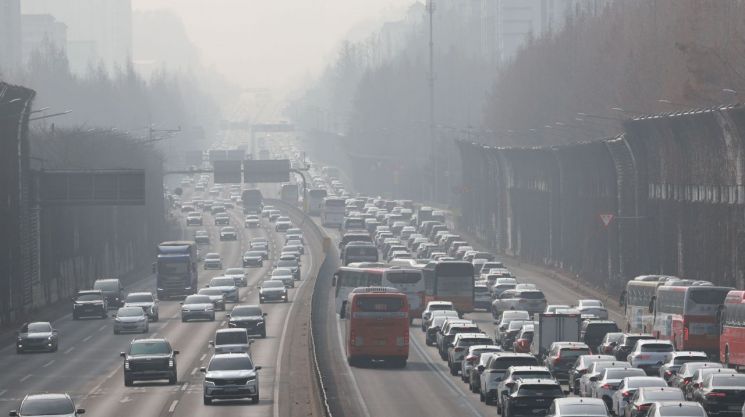
For homebound traffic, travel times were reduced by more than 1 hour by region compared with the previous day, but return travel times increased except for the Daejeon area. In the Gyeongsang region, including Busan, Ulsan, and Daegu, return trips took 1 hour 10 minutes longer, and in Mokpo, the return time increased by more than 2 hours.
On the Gyeongbu Expressway toward Busan, congestion was occurring along a 2 km section from the Cheonan Interchange to the vicinity of Cheonan. In the direction of Seoul, traffic was moving slowly along a 5 km section from near Giheung to the Singal Junction and another 5 km section from near Yangjae to the Banpo Interchange.
On the Seohaean Expressway toward Mokpo, congestion was reported along a 1 km section from near Gunsan to the vicinity of the Dong Seocheon Junction, while in the direction of Seoul, a 2 km section from the Geumcheon Interchange to the vicinity of the Iljik Junction was congested.
On the Jungbu Naeryuk Expressway toward Changwon, congestion was occurring along a 10 km section from the Yeoju Junction to the vicinity of Gamgok.
The corporation projected that 6.15 million vehicles would be on the move nationwide on this day. This would be more than 1 million vehicles higher than the previous day, when 5.05 million vehicles were on the roads. An estimated 440,000 vehicles were expected to travel from the Seoul metropolitan area to the provinces, and 470,000 vehicles from the provinces to the Seoul metropolitan area.
Homebound congestion was expected to begin around 7 to 8 a.m., peak between 1 p.m. and 2 p.m., and ease between 8 p.m. and 9 p.m.
Return congestion was expected to start around 7 to 8 a.m., become heaviest between 3 p.m. and 4 p.m., and, at the latest, ease between 3 a.m. and 4 a.m. the following day.
© The Asia Business Daily(www.asiae.co.kr). All rights reserved.

















