5 MW output powers 5,000 households
Trump: "Quadruple nuclear capacity by 2050"
To respond to surging power demand, the administration of U.S. President Donald Trump, which is pushing to expand nuclear power generation, has for the first time in history transported a microreactor by air.
According to the Wall Street Journal (WSJ) and other outlets on the 15th (local time), the U.S. Department of Energy and the Department of Defense on that day used a U.S. military C-17 transport aircraft to move a microreactor from March Air Reserve Base in California to Hill Air Force Base in Utah. It was transported without fuel loaded, and Secretary of Energy Chris Wright and Michael Duffy, Deputy Assistant Secretary of Defense for Acquisition, Operations and Sustainment, accompanied the flight in person.
This transport is seen as an effort to demonstrate that microreactors can be moved quickly by aircraft to supply electricity to remote locations such as military bases in a safe, inexpensive, and rapid manner. Duffy said, "It helps bring us one step closer to deploying nuclear energy at the time and place where it is most needed, in order to provide our military with the tools it needs to win."
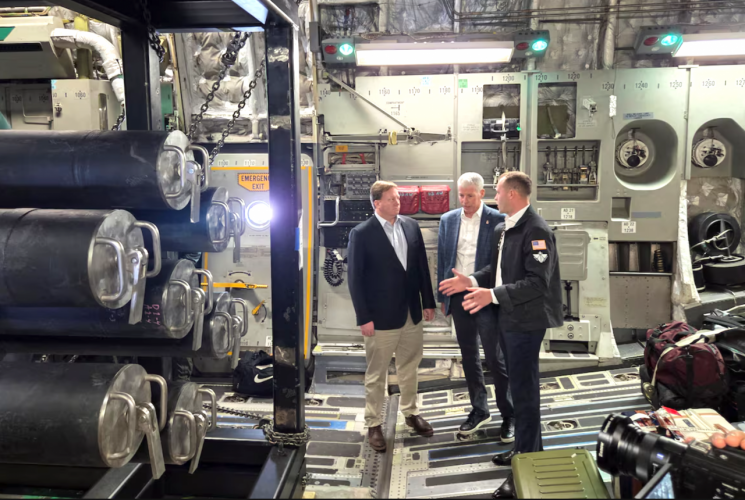 Wright Chris, U.S. Secretary of Energy (center), and Duffy Michael, Deputy Assistant Secretary of Defense for Acquisition, Operations and Sustainment (left), examined a microreactor inside a U.S. C-17 transport aircraft on the 15th (local time) as it was being transported from March Air Reserve Base in California to Hill Air Force Base in Utah. Reuters/Yonhap
The reactor transported this time is the "Ward 250" model produced by U.S. nuclear company Valar Atomics. Its size is slightly larger than a minivan. Instead of traditional uranium fuel rods, it uses TRISO (tristructural isotropic) fuel, in which uranium particles are encased in a protective coating.
According to the company, it can generate about 5 MW of electricity, enough to power 5,000 households. The reactor transported to Hill Air Force Base in Utah is scheduled to begin test operations at a facility near the base.
The U.S. military had previously announced in October last year a plan to install "microreactors" at multiple key Army bases in the continental United States to meet power demand. The idea is that microreactors can help sustain the operation of critical weapons systems and bases when existing power sources are disrupted by extreme weather such as heavy snow or torrential rain, or by cyberattacks.
President Trump, now in his second term, is vigorously promoting the development of the domestic nuclear power industry. As part of this effort, he views small reactors as one option for expanding U.S. energy production. In May last year, he signed an executive order to foster the nuclear industry. The order includes a plan to quadruple nuclear power generation capacity by 2050 by accelerating nuclear plant construction and reforming nuclear regulations.
© The Asia Business Daily(www.asiae.co.kr). All rights reserved.
![User Who Sold Erroneously Deposited Bitcoins to Repay Debt and Fund Entertainment... What Did the Supreme Court Decide in 2021? [Legal Issue Check]](https://cwcontent.asiae.co.kr/asiaresize/183/2026020910431234020_1770601391.png)
















