Strengths in Power, Water, and Energy Competitiveness
Three-Axis Framework of Western Jeonnam, Eastern Jeonnam, and Gwangju
Vision for an Ultra-Wide Industrial Zone Expected to Gain Momentum
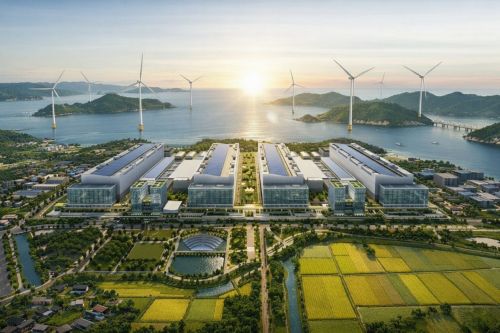
With the passage of the Special Act on Semiconductors in the National Assembly, the semiconductor industry landscape is being reshaped from a Seoul metropolitan-centered structure to a southern-region-centered one. Against this backdrop, Jeonnam Province has launched a full-fledged bid to be designated as a national semiconductor cluster, leveraging its prepared infrastructure in power, water, and renewable energy.
On January 29, 2026, the "Special Act on Strengthening Competitiveness and Supporting the Semiconductor Industry" passed the plenary session of the National Assembly, laying an institutional foundation at the national level to support the development of semiconductor clusters and industrial infrastructure.
Seizing this opportunity, Jeonnam Province plans to secure a key foothold in a "Southern Semiconductor Innovation Belt" that goes beyond the Seoul metropolitan area’s single-core structure.
The new Special Act designates semiconductors as a national core strategic industry and stipulates that the central government and local governments can directly support industrial infrastructure such as power, water, and roads. With special provisions for priority selection or exemption from preliminary feasibility studies, and the establishment of a presidential advisory body dedicated to semiconductors, conditions are now in place to accelerate the creation of semiconductor clusters.
The reason Jeonnam and Gwangju are drawing attention as a semiconductor hub is that they have structurally different conditions from the Seoul metropolitan area in terms of securing power and water.
Operating six semiconductor fabs requires 1.07 million tons of water and 9.3 GW of power per day, but the surplus water capacity in the Seoul metropolitan area is only 0.9%, and power supply is also facing limits due to saturated transmission networks. When the requirements of Renewable Energy 100 (RE100) are also taken into account, locations in the Seoul metropolitan area become a burden for companies.
By contrast, the western part of Jeonnam can supply more than 1.3 million tons of water per day through Yeongam Lake, Geumho Lake, and Yeongsangang Lake, and Jeonnam and Gwangju can secure a renewable energy base of 17.5 GW through the expansion of solar and offshore wind power that they are jointly promoting.
These conditions are regarded as the competitive advantage of Jeonnam and Gwangju, as they simultaneously satisfy the three key requirements that global semiconductor companies demand: "power, water, and RE100."
Following the passage of the Special Act, Jeonnam Province, together with Gwangju City, is accelerating its vision for a "Three-Axis Semiconductor Cluster" that will integrate Jeonnam and Gwangju into a single ultra-wide industrial zone.
Under this vision, the Gwangju area will serve as a hub for talent and research and development; the western part of Jeonnam will function as a production base supported by large-scale power and water; and the eastern part will act as a base for materials, parts, and equipment, as well as future convergence industries.
This is a southern-region semiconductor ecosystem model that completes design, manufacturing, and materials-parts-equipment within a single ultra-wide area, representing a strategic direction different from that of the Seoul metropolitan area.
To put this into concrete form, Jeonnam Province plans to carry out a "Semiconductor Cluster Development Study" to establish a comprehensive strategy for the national designation of the Jeonnam-Gwangju semiconductor cluster and the attraction of semiconductor fabs. The study is scheduled to begin in the first half of 2026.
Kim Kihong, Director General of Strategic Industries at Jeonnam Province, said, "The Special Act on Semiconductors is an institutional foundation for Jeonnam, together with Gwangju, to leap forward as a hub of the southern semiconductor belt," adding, "By building a 'Three-Axis Cluster' that links the RE100 National Industrial Complex, the Advanced Packaging Cluster, and the Future Advanced National Industrial Complex, we will drive the leap toward the Jeonnam-Gwangju Special City with a population of 4 million."
© The Asia Business Daily(www.asiae.co.kr). All rights reserved.

















