200 Days After Election: Assessing His Leadership
Swift, Decisive Leadership Shaken by Merger Infighting
"Reform first, reform second, reform third. I will become an icon of reform."
When Jeong Cheongrae, leader of the Democratic Party, decided to run for party leader at the provisional national party convention on August 2 last year, this was how he put it. His strong drive, which earned him the nickname "party cannon" amid fierce confrontation between the ruling and opposition parties, drew an enthusiastic response from party members, but there is criticism that his leadership in steering the parliamentary caucus has been lacking.
Jeong will mark the 200th day since taking office on February 17. As the position is limited to serving out only the remaining one-year term of his predecessor, President Lee Jaemyung, more than half of his tenure has effectively already passed.
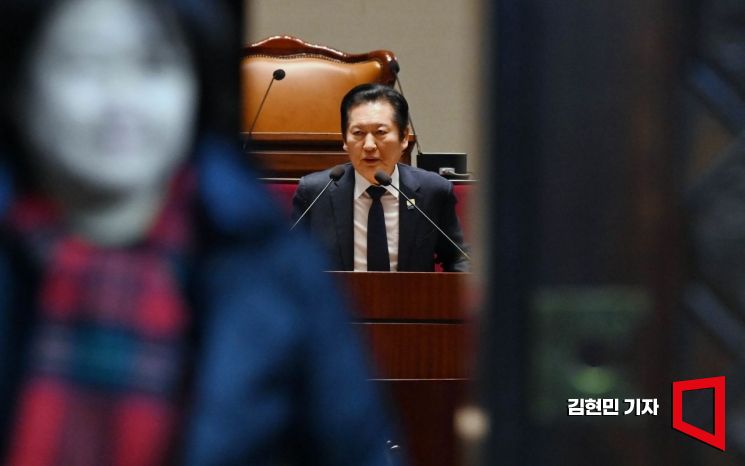 Chung Cheongrae, leader of the Democratic Party of Korea, is seen speaking at a closed-door lawmakers' meeting held at the National Assembly on the 10th to discuss whether to merge with Joguk Hyoksindang, visible through the crack of a door as lawmakers pass by. 2026.2.10 Photo by Kim Hyunmin
During the party convention election, there was even a saying that "the hearts of party members are with Jeong Cheongrae, but the 'doubts' (the hearts of lawmakers) are with Park Chandae," underscoring Jeong's overwhelming support among rank-and-file members as his key strength. In return, immediately after taking office he pushed through media reform and prosecutorial reform bills in rapid succession. In particular, the prosecutorial reform legislation centered on abolishing the Prosecutors' Office passed the plenary session of the National Assembly in September last year, backed by Jeong's determination, despite calls from the presidential office and the Office of the Prime Minister to slow the pace. Jeong had publicly vowed, "I will do my utmost so that on your Chuseok journey home I can deliver to you (party members) the happy news that the Prosecutors' Office has been abolished."
Targeting the "core base" has also been one of Jeong's signature moves. After his election, he held his first on-site Supreme Council meeting in Muan, South Jeolla Province, and focused on courting the Honam region, for example by appointing Representative Seo Samsuk, a three-term lawmaker from Honam, as a nominated Supreme Council member. During the 21st presidential election, he also styled himself as the "Gwangju-Jeonnam Chair of the Alley-by-Alley Election Committee."
In addition, Jeong has held on-site Supreme Council meetings once or twice a week, making a point of staying close to party members. Some interpreted this as groundwork for extending his term as party leader, but he has nonetheless used the party members' sentiment as his strength to push ahead with reform legislation.
Leadership shaken by merger infighting... Local election victory and integration are key tasks
What Jeong overlooked, however, was the "doubts" (the hearts of lawmakers). In the process of pursuing his party-leadership pledge to amend the party constitution to introduce a "one-person-one-vote system for delegates and dues-paying members," the proposal was once voted down at the Central Committee. The Central Committee is composed mainly of incumbent members of the National Assembly and local party chapter heads without parliamentary seats. Although the amendment passed after being pushed again, it drew criticism for its relatively low approval rate: of 590 Central Committee members, 515 participated in the vote, with 60.58% (312 votes) in favor and 39.42% (203 votes) against.
The conflict exploded over the proposal to merge with the Joguk Hyeoksin-dang. Lawmakers in the party raised issues with procedural legitimacy, as the fact of the merger proposal was conveyed only 20 minutes before the press conference, without any prior discussion with the Supreme Council members. In the end, the push to merge with the innovation party before the June 3 local elections was halted after 19 days. Jeong's leadership, which had been driving the merger, suffered a blow. Furthermore, an uneasy coexistence is expected to continue within the leadership with the "anti-Jeong Cheongrae trio" of Supreme Council members Lee Eonju, Hwang Myungseon, and Kang Deukgu, who strongly opposed the merger.
An internal power struggle in the party has also come into view. Prime Minister Kim Minseok has expressed his desire for party leadership by saying he has a "longing for the party leader post," and the core members of the "Lawmakers' Group for the Cancellation of Indictments in President Lee Jaemyung's Cases and for Pushing a National Assembly Investigation" (Gongchwimo), which brings together 87 lawmakers, are largely from the anti-Jeong camp.
The upcoming local elections will immediately serve as a test of Jeong's leadership. He will likely only be able to seek another term as party leader if he can pull together a party whose divisions have become visible and lead it to victory in key metropolitan areas such as Seoul and Busan. However, given that these local elections are taking place early in the Lee Jaemyung administration, many assess that the chances of victory are high. Some even argue that the real task for securing another term is to succeed in a merger that has already failed once.
Political commentator Park Sangbyung noted, "Although the wounds are deep following the collapse of the merger, integration (with the innovation party) appears inevitable. The key question is whether Jeong, whose one wing has been injured, can exert the same level of leadership as before." Park added, "Going forward, Jeong must work to persuade the dissenting lawmakers within the party, and in particular, he must not give any pretext for internal strife in his relationship with the president."
© The Asia Business Daily(www.asiae.co.kr). All rights reserved.












