Investing 892.1 Billion Won by 2030
Targeting a 30% Productivity Increase and "Zero" Human Accidents
Pursuing Overseas Expansion of Korean-Style Automated Terminals
Busan Port Authority (BPA) announced on the 12th that it has established the "Busan Port AX (AI Transformation) Promotion Plan" and is moving into full-scale implementation, in order to support the government's strategy to become one of the world's top three artificial intelligence (AI) powerhouses and to respond to changes in the global port and logistics environment. The core goals are to invest a total of 892.1 billion won by 2030 to increase Busan Port's productivity by 30% and to reduce fatalities within the port to zero (0).
At a briefing held that day at the Busan Government Complex of the Ministry of Oceans and Fisheries, BPA President Song Sanggeun said, "Since the launch of the new administration, we have established a company-wide response system by creating the Digital AI Department through an organizational restructuring and forming an AI Task Force headed by the Executive Vice President," adding, "We are also accelerating efforts to materialize 'physical AI' technologies to be applied in port operations by signing business agreements with organizations such as the Korea Institute for Robot Industry Advancement, Naver Cloud, and Hyundai Motor Company."
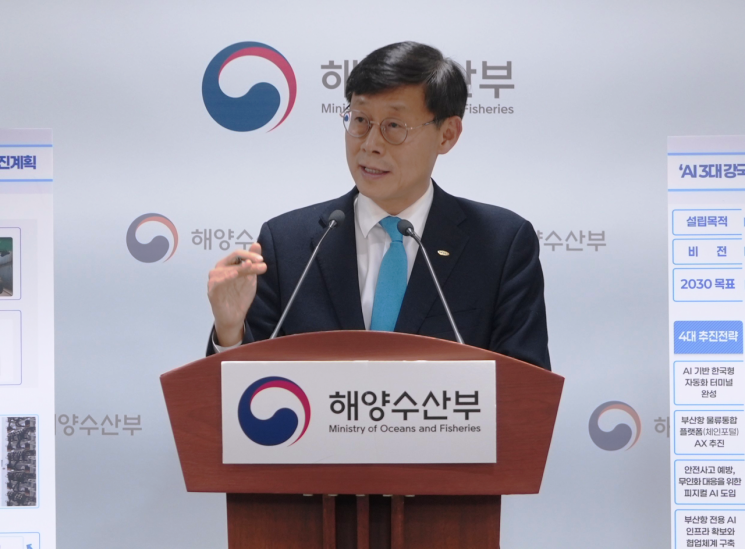 Song Sanggeun, president of Busan Port Authority, is announcing the 'Busan Port AX Promotion Plan' at the Busan office of the Ministry of Oceans and Fisheries on the 12th. Busan Port Authority
This plan is the first AI transformation roadmap in the domestic port sector, prepared by integrating inputs from ministerial work briefings, work briefings of public institutions under the Ministry of Oceans and Fisheries, and opinions from the port and logistics industry and research institutes. BPA has presented as its vision the realization of a "hyper-connected AI port" that applies AI across all aspects of port operations, going beyond simple digitalization. Through this, it aims to improve container terminal productivity by 30%, achieve zero fatalities in the port, complete a Korean-style automated terminal based on proven AI technologies, and expand into overseas markets.
To achieve these goals, BPA has set four strategic initiatives and twelve key tasks. First, it aims to maximize technological self-reliance and operational efficiency by "completing an AI-based Korean-style automated terminal." President Song explained, "We will establish a foundation for self-reliant operation of port equipment by manufacturing and installing domestically produced container cranes and transfer cranes and by building an Equipment Control System (ECS), and we will optimize container stacking locations and operating scenarios by utilizing AI and digital twin technologies." The introduction of autonomous yard trucks and a rail-based automated transport system (tram shuttles) will proceed in parallel.
The strategy for "Busan Port Logistics Integrated Platform AX" is also included in the plan. Voice-based conversational AI and automatic reservation and visit-time recommendation features will be applied to "Allcon-e," a dedicated app for truck drivers, to reduce congestion in land logistics. In addition, the "Port-i" maritime logistics monitoring system will be used to improve berth operation efficiency through functions such as predicting vessel arrival times and recommending alternative vessels. On top of this, BPA plans to pursue Korean-style Port Call Optimization (K-PCO), which links data with global ports, so that the entire process from arrival to departure is managed based on data.
The introduction of physical AI for accident prevention and unmanned operations is also being promoted. President Song said, "We will implement 24-hour safety monitoring through AI video analytics and establish a system to predict collision risks among workers, equipment, and vehicles, and we will deploy robots for lashing work, which carries a high risk of falls, and for the management of refrigerated containers," adding, "We also plan to introduce intelligent equipment diagnostic technologies such as crane wire rope defect analysis and container toppling prediction simulations in strong winds."
BPA will establish public AI infrastructure and collaboration frameworks. It plans to build high-performance GPU servers and a data center to provide public AI infrastructure that can also be used by small and medium-sized logistics companies, and to enhance internal administrative efficiency by introducing AI chatbots specialized in port construction and safety data, as well as personal work-assistance agents. The company also intends to strengthen the operation of the company-wide "BPA AI Promotion Group" and collaboration with private companies and research institutions.
BPA will implement the twelve key tasks and thirty-eight detailed action items in phases, and AI infrastructure projects with high public interest will be carried out in consultation with the government and relevant agencies.
President Song said, "The Busan Port AX Promotion Plan will serve as a key driver in the port and logistics sector for Korea's leap to become one of the world's top three AI powerhouses," adding, "By combining Busan Port's operational experience with AI technologies, we will become a first mover in the global port market."
© The Asia Business Daily(www.asiae.co.kr). All rights reserved.

















