Who Oversees Non-Referral Cases?
"Non-Referral" Seen as the Final Conclusion
Suspects Rely on Competent Former Senior Police Officers
Trend of "Former Senior Poli
"Non-Referral" Seen as the Final Conclusion
Suspects Rely on Competent Former Senior Police Officers
Trend of "Former Senior Poli
As major law firms competitively recruit former high-ranking police officers, the "early defense market" at the investigative stages such as preliminary inquiries and bookings is rapidly expanding. There are also growing numbers of active-duty police officers taking leave to enter law school, or moving to law firms after retirement. Talents who have worked at the National Police Agency and then become lawyers are being scouted by law firms one after another. Demand in this lawyer market is linked to the supply of "retired elite police officers." Due to promotion bottlenecks within the National Police Agency, they study for the bar exam while working during the day and prepare to move to high-paying law firms. A chief investigator at the National Police Agency said, "Even graduates of the Korean National Police University are finding it harder to get promoted than before, which has increased the incentive to move to law firms," adding, "With the establishment of the Serious Crimes Investigation Agency, the power of the police will grow, but key investigative personnel are increasingly flowing into the lawyer market."
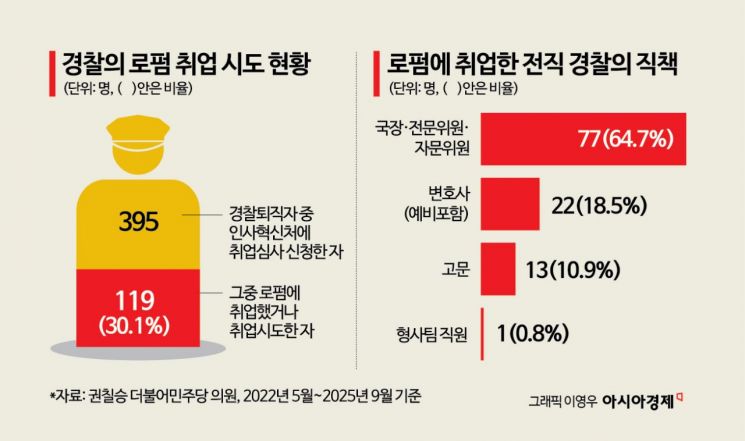
According to Democratic Party lawmaker Kwon Chilseung on the 13th, 30% (119 people) of the 395 retired police officers who applied for post-employment review between May 2022 and September last year either found jobs at law firms or attempted to do so. Former police officers joining law firms is nothing new. However, as the Serious Crimes Investigation Agency is launched and the police come to monopolize investigative authority, this trend is expected to intensify further. From the victim's standpoint, a police "non-referral" decision is effectively accepted as the final conclusion, while suspects come to believe that "all you need to do is hire a competent former high-ranking police officer."
For this reason, calls are growing for checks on the police's authority to decide not to refer cases to the prosecution. Some argue for reviving the "full-case referral" system (under which the police must send all cases they investigate to the prosecution regardless of the outcome), which was abolished under the Moon Jae-in administration in 2021. After receiving a police decision not to refer a case, the prosecution can request a reinvestigation once. As of 2024, the number of reinvestigation requests by prosecutors stood at 14,243, accounting for only 2.6% of all cases.
For example, if an internal police corruption case is closed with a non-referral decision at the police stage, judicial oversight is blocked at the source. A complainant can file an objection to a police non-referral decision within 30 days. In that case, the case is referred to the prosecution, and the prosecution decides whether to indict through a request for supplementary investigation or by directly conducting supplementary inquiries. From the date the police send the case file to the prosecution, the prosecutor can review the validity and request reinvestigation within 90 days. However, if no objection is filed, the case ends without any prosecutorial review. In cases initiated by a third-party accusation, the accuser has no right to object, meaning there is in effect no control mechanism.
An incumbent chief prosecutor said, "If we strictly adhere to the principle of 'separating investigation and indictment,' we need to question whether it is reasonable for the investigative body (the police) and the body making the final disposition (the non-referral decision) to be one and the same." A deputy chief prosecutor commented, "If referral and non-referral decisions are mixed within a single case, only the referred portion goes to the prosecution, fragmenting the content and prolonging the procedure," adding, "Because full-case referral is no longer in place, both the prosecution and the police have lost the sense of responsibility that 'this is my case.'"
Some point out that if former police officers without a lawyer's license work part-time at law firms as expert advisers or consultants and engage in case brokering or quasi-advocacy, this constitutes a violation of the Attorney-at-Law Act. Another deputy chief prosecutor said, "As far as I know, a significant portion of those at the top of their classes in law school or on the bar exam are graduates of the Korean National Police University," adding, "The dual role of active-duty police officers also working as lawyers is a problem, but advocacy-related work done by former police officers without a lawyer's license is a 'violation of the Attorney-at-Law Act.'"
Opinions are divided over reviving the full-case referral system. One active-duty police officer said, "Because filing an objection to a non-referral decision imposes a heavy procedural burden on ordinary citizens, it is understandable that concerns are raised about cases being buried or about possible collusion." However, a chief of the intelligence division at a police station said, "We need to take into account the original purpose of ensuring the independence of investigative powers, and there are also concerns that if full-case referral is revived, the prosecution may abuse its authority to demand supplementary investigations in order to control the police." He went on to say, "Frontline investigators, overwhelmed with work, sometimes say in frustration, 'We might as well just refer everything and let the prosecution decide,'" adding, "There are also concerns that if the Serious Crimes Investigation Agency is introduced, existing police forces could be downgraded to an institution handling only 'low-level livelihood crimes.'"
© The Asia Business Daily(www.asiae.co.kr). All rights reserved.

















