Pushed through under Democratic Party leadership amid People Power Party backlash
The three major judicial reform bills, including the Crime of Legal Distortion Bill, are now on the verge of a plenary vote
The Democratic Party of Korea’s so-called “three major judicial reform bills” (the Supreme Court Justice Expansion Bill, the Judicial Review Bill, and the Crime of Legal Distortion Bill) have all passed the standing committees of the National Assembly. The party plans to have these bills passed during the provisional February session of the National Assembly as a first step.
On Feb. 11, the Legislation and Judiciary Committee of the National Assembly held the First Subcommittee on Bill Review and then a plenary meeting in succession, and, led by the ruling Democratic Party, passed the Judicial Review Bill (an amendment to the Constitutional Court Act), which would allow constitutional complaints to be filed against court rulings, and the Supreme Court Justice Expansion Bill (an amendment to the Court Organization Act), which would increase the number of Supreme Court justices from 14 to 26. Lawmakers of the People Power Party walked out in protest just before the vote, denouncing it as “making laws for specific individuals (?人設法).”
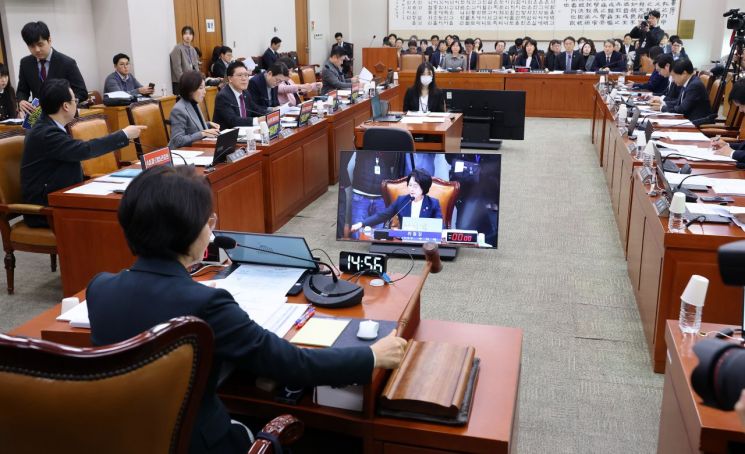 Choo Miae, chair of the Legislation and Judiciary Committee, is striking the gavel at a plenary meeting of the Legislation and Judiciary Committee held at the National Assembly on Feb. 11, 2026. Photo by Yonhap News
As soon as the plenary meeting began, lawmakers of the People Power Party protested by putting up placards reading “Four-tier court system and more Supreme Court justices = overturning the criminal president’s trial.” Na Kyungwon, a lawmaker of the People Power Party, asked, “Do you really think it is sufficient debate to put the four-tier court system, which will drive the public into a hell of lawsuits, on the subcommittee agenda for just one hour and then pass it?”
However, Democratic Party lawmaker Kim Yongmin, who serves as the party’s secretary on the committee, countered that “judicial review has been a long-standing topic of discussion, having already been brought into public debate in 2013 when the Constitutional Court issued an opinion on amending the Constitutional Court Act.”
Despite opposition bloc resistance, the judicial reform bills pushed by the Democratic Party now only await a plenary vote. The Crime of Legal Distortion Bill (an amendment to the Criminal Act), which would impose suspension of qualifications and imprisonment when judges, prosecutors, or investigators intentionally misapply the law, has already been submitted to the plenary session.
The Democratic Party plans to pass the judicial reform bills within the provisional February session of the National Assembly. Even if delayed, the goal is to pass them by early March. On Feb. 11, party leader Jung Cheongrae said, “The reality in which all kinds of alleged abuses of state power, including stock price manipulation and special favors for the Yangpyeong Expressway, are being given a free pass through acquittals and dismissals of indictments proves that the insurrection is still ongoing,” and added, “We will process, strictly according to schedule and without compromise, the Crime of Legal Distortion Bill, the Judicial Review Bill, and the Supreme Court Justice Expansion Bill, as well as amendments to the Court Organization Act and prosecution reform bills such as the Public Prosecution Office Act and the Serious Crimes Investigation Agency Act.”
There are, however, calls for caution. Three-term lawmaker Kim Youngjin said on MBC Radio on Feb. 12, “It will take some time for the (judicial reform bills) to reach the plenary session,” and, regarding the Supreme Court’s opinion that there may be constitutional issues, he said, “I believe the intent was that we need to review how to introduce this law by making more precise proposals on the conditions and the substance.”
© The Asia Business Daily(www.asiae.co.kr). All rights reserved.












