Lee hints at overhaul of registered rental housing scheme
Points to indefinite exemption from heavy capital gains surtax
Move seen as strategy to bring multiple-homeowners' properties to market
Targeted regulations on apartment-type u
As President Lee Jaemyung pointed out the excessive benefits enjoyed by rental housing business operators, projections are emerging that the government will adjust the tax structure targeting only apartments. Although apartments account for a relatively small share of acquisition-type rental housing, President Lee predicted that if tax benefits are reduced, the number of listings coming onto the market will increase.
On the morning of the 10th, President Lee wrote on X (formerly Twitter), "If 42,500 multi-homeowner apartments do not hold out indefinitely to enjoy capital gains, and instead come onto the market to avoid the heavy capital gains tax on multi-homeowners, it does not seem likely that the 'effect of stabilizing housing prices will be uncertain'." He posted this while sharing a news article conveying the reaction of the rental housing industry to the President's criticism that registered rental business operators are receiving excessive tax benefits. President Lee also said, "42,500 apartments in Seoul is by no means a small number."
The day before, after stating that he would seek opinions on the exclusion of registered rental business operators from heavy capital gains tax, he went on to single out a specific type of housing. President Lee said the previous day, "The 300,000 registered rental housing units in Seoul receive special benefits such as reductions in acquisition tax, property tax, and comprehensive real estate holding tax, as well as permanent exclusion from the heavy capital gains tax applied to multi-homeowners." He then pointed out, "Once the mandatory rental period ends, the reductions in property tax and comprehensive real estate holding tax disappear, but the special benefit of exclusion from heavy capital gains tax for multi-homeowners continues."
Limited effect of tax benefits in inducing multi-homeowner purchases... View that impact on housing supply is insufficient
When a rental business operator newly registers, only non-apartment units such as row houses, multi-family housing, and officetels can be registered. In the early days of the system, apartments could also be registered, but after a sharp rise in housing prices, new registrations were restricted and registrations were automatically canceled when the rental period expired.
Rental business operators receive benefits such as reductions in property tax and acquisition tax and exclusion from the calculation base for comprehensive real estate holding tax, on the condition that they comply with the mandatory rental period and limit rent increases to within 5% per year. Property tax is reduced by at least 50% and up to 100%, depending on the type and size of the housing, such as multi-unit housing or officetels. In the case of acquisition tax, if a newly supplied unit is converted into a long-term rental for 10 years, the tax can be reduced by 50% to 100% depending on its exclusive floor area. When the rental registration is canceled, the tax benefits disappear as well. Comprehensive real estate holding tax is also excluded from aggregation only if the property is in a registered rental status as of the tax base date (June 1). For capital gains tax, a 50% reduction is granted if the property has been rented for at least 5 years during the registration period, and a 100% exemption is applied if it has been rented for at least 10 years.
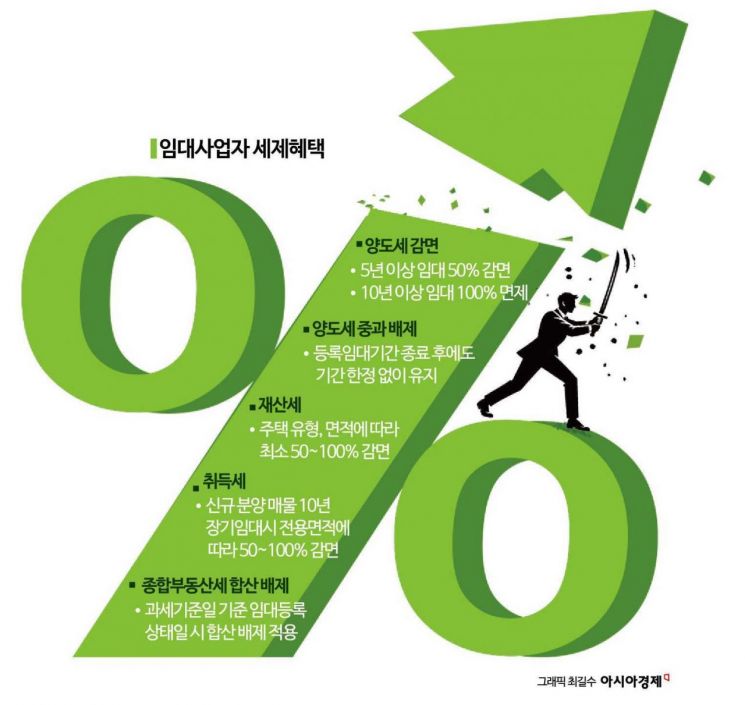
By contrast, the benefit of exclusion from heavy capital gains tax continues indefinitely even after the mandatory rental period ends. In the Seoul metropolitan area, this means that for acquisition-type rentals with an officially assessed price of up to 600 million won, and up to 300 million won outside the metropolitan area, owners can sell at any point after the rental period ends without being subject to heavy capital gains tax.
Some observers argue that the excessive tax benefits have encouraged multi-homeowners to purchase additional housing. Kwon Youngsun, analyst at the Shinhan Bank Real Estate Investment Advisory Center, said, "The original purpose of the system was to revitalize the rental market by providing tax benefits in return for not being able to raise rents by more than 5% for a certain period," adding, "However, as the excessive tax benefits have produced the side effect of encouraging the purchase of additional homes, the government is now trying to revise the system to remove the incentive to maintain multiple properties."
Reducing tax benefits to induce apartment listings
The market is interpreting President Lee's message as a signal aimed at bringing multi-homeowner properties onto the market. It is being seen as an intention to increase tax pressure on rental business operators whose mandatory rental periods have expired, thereby inducing them to list their properties.
Specifically, there is a strong possibility that the government will gradually reduce the exclusion from heavy capital gains tax starting from a certain point in time after the expiration of the rental registration period, focusing on properties whose registration has expired. The previous day, President Lee wrote on X, "There could be measures such as abolishing (the exclusion from heavy capital gains tax) after a certain period, for example after one year, or abolishing half of it for 1 to 2 years, and then abolishing it entirely after 2 years."
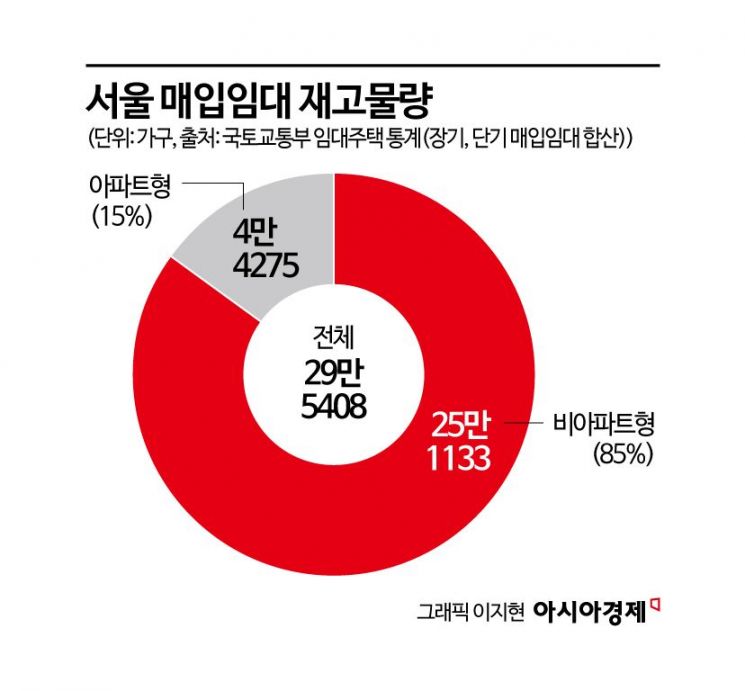
Particular weight is being given to the possibility that the benefit of exclusion from heavy capital gains tax will be adjusted only for apartment-type registered rental housing. According to the Ministry of Land, Infrastructure and Transport, as of the end of 2024, the stock of registered rental housing in Seoul stood at 295,408 units, of which apartments accounted for 44,275 units. Given that non-apartment acquisition-type rental units account for 85% of the total, it is expected that the government will opt for targeted regulations to draw apartment listings onto the market, rather than uniformly reducing benefits for non-apartment units as well. Woo Byungtak, senior specialist at Shinhan Bank Premier Pathfinder, said, "A considerable portion of the units whose mandatory rental period is expiring may come onto the market as listings."
However, he diagnosed that in the long term there is a high possibility that the apartment jeonse market will contract. Analyst Kwon Youngsun said, "If targeted regulations are implemented focusing on apartment-type registered rental housing, this could lead in the mid to long term to a reduction in the supply of apartment jeonse units and an overall contraction of the rental market," and forecast, "Tenants will stand at a crossroads of either moving to non-apartment monthly or jeonse rental units such as officetels, or choosing to purchase a home."
© The Asia Business Daily(www.asiae.co.kr). All rights reserved.
![Clutching a Stolen Dior Bag, Saying "I Hate Being Poor but Real"... The Grotesque Con of a "Human Knockoff" [Slate]](https://cwcontent.asiae.co.kr/asiaresize/183/2026021902243444107_1771435474.jpg)

















