5.6 Billion Won for Urban Network Arterial Road Construction Projects
8.7 Billion Won for Local Pending Road Projects to Promote Balanced Development
3.2 Billion Won for Support Projects in Areas Surrounding U.S. Military Bases
8.9 Billion Won for Maintenance and Management of Road Facilities
1.8 Billion Won for Efficient Maintenance and Management of Road Lighting
On February 9, the city of Gimcheon in North Gyeongsang Province announced that, in order to actively respond to the reality of shrinking SOC (social overhead capital) budgets caused by a prolonged economic downturn and the resulting deterioration of fiscal conditions, it will promote road construction projects that citizens can tangibly feel through a strategy of "selection and concentration."
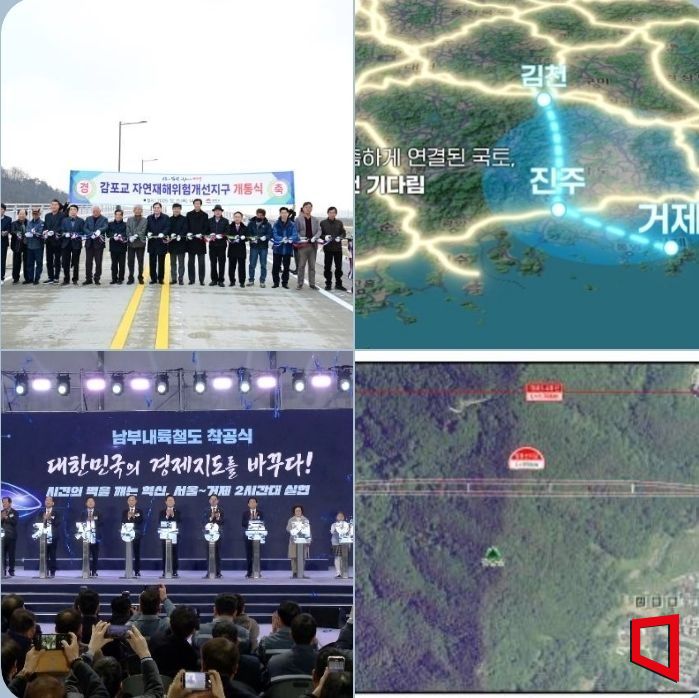 Clockwise: Gampo Bridge newly opened - Nambu Naeryuk Road map - Gyodong housing site ~ industrial complex (satellite photo) - Nambu Naeryuk Road groundbreaking ceremony / Photo by Kim Ihwan
Following the new opening of Gampo Bridge and the opening of the connecting road between Daeseong 1-ri and 2-ri in Apo-eup in 2025, the city will, in the second half of 2026, break ground on the Dalbongsan Tunnel construction project, which will connect the industrial complex and the Gyodong residential site (total project cost 75.5 billion won, length 1.87 km, width 20 to 25 m), with the goal of completing it in 2029.
This project is expected to make a major contribution to balanced regional development by connecting, via a tunnel, the section between the Gimcheon General Industrial Complex, the Gyodong residential site, and the Sports Town, which had been separated by Dalbongsan Mountain.
In addition, to ease traffic congestion in densely populated areas such as the Prugio Apartment complex in Bugok-dong, the city is investing a total of 17 billion won in the project to install an underpass box crossing the Gyeongbu Line between the Bugok residential site and the bypass road. The project is being accelerated with the goal of starting construction in the first half of 2026 and completing it in 2027.
At the same time, the city is steadily preparing projects to improve road traffic safety and enhance travel convenience, including the installation of a roundabout on Gimcheon Huimang-daero, intersections within the Gimcheon Innovation City, and the Yangcheon Saeteo intersection.
Based on transportation conditions linked to the existing railway network, the city is continuously consulting with relevant organizations such as the Ministry of Land, Infrastructure and Transport, the National Railway Corporation, and Korea Railroad Corporation, and is conveying citizens' opinions, in order to build the "Gimcheon Cross-Axis Railway Network" and to expand railway infrastructure.
The Southern Inland Railway (Gimcheon-Hapcheon-Jinju-Geoje, 172 km), for which a groundbreaking ceremony was recently held, is a line that connects the southern inland region starting from Gimcheon. The project is being pursued with the goal of opening in 2031, and, in order to respond to future railway demand such as the Jungbu Inland Line (Mungyeong-Gimcheon) and the extension of the Daegu Metropolitan Railway to Gimcheon, the city is also promoting the construction of a new station building above Gimcheon Station, with a total floor area of 3,500 square meters and a total project cost of 34.3 billion won.
In addition, the construction of the Jungbu Inland Railway between Gimcheon and Mungyeong (approximately 70 km) is gaining momentum, as the project has entered basic and detailed design following the announcement of the master plan.
Furthermore, the city is continuously carrying out consultations, proposals, and promotional activities with relevant organizations so that the construction of railway lines between Gimcheon and the new airport and Uiseong, the construction of a railway line between Gimcheon and Cheongju Airport, and the attraction of an EMU rolling stock maintenance depot can be reflected in the 5th National Railway Network Construction Plan.
Going forward, based on the expansion of railway infrastructure, the city plans to continue its tireless efforts to establish itself as a "special railway city" that improves local transportation conditions and contributes to revitalizing the regional economy and achieving balanced national development.
For the convenience of the increasing number of tourists visiting the Buhang Dam area, the city is investing 600 million won to carry out a road widening project for the remaining section (length 150 m) of the access road to the Mulsori Ecological Forest in Pacheon-ri, Buhang-myeon, and plans to complete the work within this year.
For the access road to the Gamokjae Tunnel, which connects Yeobae-ri in Jirye-myeon and Buhang-ri in Jungsan-myeon (Local Road No. 203), the city will complete the detailed design this year and then proceed with land compensation.
In addition, to facilitate the movement of residents following the completion of Apo Smart City Complexes 1 and 2, the city is steadily promoting the construction of a pedestrian overpass connecting Songcheon in Apo and Guksa, with the goal of completing it in the first half of this year.
Beyond these projects, the city is doing its utmost to improve travel and living conditions for local residents by promoting the expansion of local pending-road projects such as the widening of the access road from Yeonhwa in Daedeok to Naegam, and the widening of the access road from Sudogok in Sangwon-ri, Guseong.
The project to install a pedestrian path in Unnam (Bongcheon) in Nam-myeon, which connects Gimcheon Innovation City and Obongji in Nam-myeon, is expected to secure pedestrian safety through the installation of pedestrian and bicycle paths, and to contribute to revitalizing local tourism and attracting tourists by expanding tourism infrastructure.
Furthermore, the projects to open and widen County Road No. 9 between Bonggok in Nongso-myeon and Ungok in Nam-myeon, and to widen County Roads No. 4 and 5 between Wolgok and Bonggok in Nongso-myeon, as well as to widen Local Road No. 203 between Busang and Wolmyeong in Nam-myeon, with a total project cost of 43 billion won, will begin detailed design in 2025. In 2026, the city will faithfully carry out administrative procedures such as resident briefings to ensure that the projects proceed without a hitch.
The city expects that these projects will help secure the safety of residents, including vehicles, pedestrians, and agricultural machinery, by improving the safety of the road environment.
To improve aging roads and eliminate accident-prone sections, the city plans to invest 6.9 billion won in 19 road maintenance projects, including the Jikji Road maintenance project in Bokjeon-ri, Daehang-myeon, and the alignment improvement project on the Gongsanggol-Sinchon section in Apo-eup.
For the maintenance of road facilities and the prompt repair of areas at risk of civil complaints, the city has allocated 2 billion won. Through continuous inspections and preemptive repairs, it aims to strengthen road functions and durability and thereby create safer road environments.
By establishing a bidirectional remote-control system for streetlights, the city will install bidirectional switches at 100 locations and 1,500 SMPS units to create a foundation for checking and managing road lighting conditions in real time, and to enable swift responses in the event of failures.
The city plans to install dimming controllers so that brightness automatically increases only when vehicles or pedestrians are passing, while maintaining a power-saving mode at other times, thereby minimizing unnecessary power consumption.
In addition, by replacing old streetlight poles in urban areas, the city plans to improve the cityscape and create a pleasant streetscape environment, thereby enhancing the quality of the living environment that citizens can feel in their daily lives and contributing to promoting a bright and safe city image.
Furthermore, by installing high-efficiency LED safety lighting on pedestrian bridges in rural areas, the city aims to improve the dark nighttime walking environment in rural regions, secure residents' nighttime walking safety, and contribute to preventing accidents and crime.
The city plans to use these projects as an opportunity to build a smart road lighting management system in which safety, environment, and energy efficiency are harmonized, thereby laying the foundation for systematic and efficient urban lighting operations.
© The Asia Business Daily(www.asiae.co.kr). All rights reserved.












