Sharing Global Public Development Outcomes and Best Practices
The International School of Urban Sciences at the University of Seoul held the "2026 Winter International School of Urban Sciences GPD (Global Project Development) Performance Sharing Seminar" on the 6th, where it shared the outcomes of urban development projects carried out by overseas public officials participating in the training program.
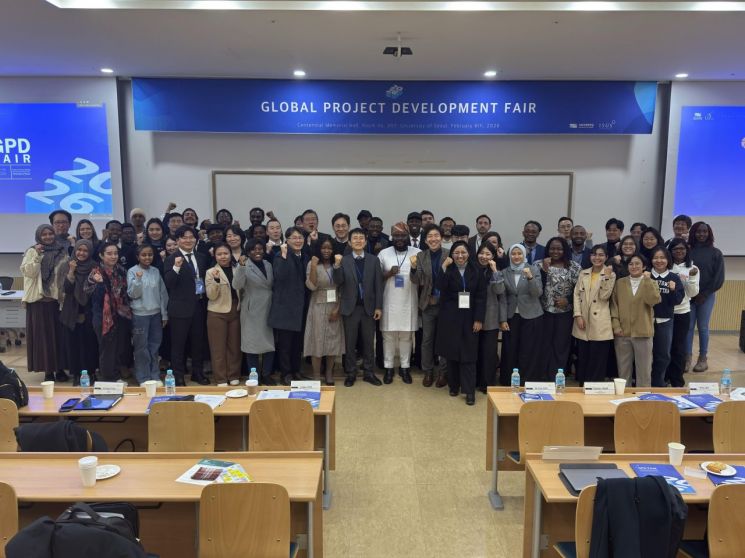
This seminar was organized so that overseas public officials enrolled in the master's degree programs supported by the Seoul Metropolitan Government and the Ministry of Foreign Affairs, the Ministry of Environment, and the Ministry of Land, Infrastructure and Transport could present the research and practical成果 derived from their Global Project Development (GPD) classes, and explore ways to link these成果 to actual overseas cooperation projects.
Approximately 100 participants attended the event, including officials from related organizations such as the Korea International Cooperation Agency (KOICA), the Export-Import Bank of Korea (KEXIM), the World Bank, CITYNET, the Human Resources Development Center of Seoul Metropolitan Government, and the International Contractors Association of Korea, as well as trainees from the four master's degree training programs under the International Urban Development Program (MUAP, MUD, MGLEP, and MUDSIP).
The GPD course at the International School of Urban Sciences is a practice-oriented subject in which overseas public officials and Korean students form teams to design and propose projects in the fields of urban development, infrastructure, and the environment. It is operated with the goal of deriving project models with high potential for local application and building international cooperation networks.
The seminar was conducted in two sessions.
In Session 1, officials from KOICA, KEXIM, and the World Bank presented the potential for linking the training programs to overseas projects and their future development directions, while discussing the possibilities for expanding Official Development Assistance (ODA) and international financial cooperation.
In Session 2, presentations were given on the成果 of urban development projects targeting four countries: Indonesia, Kenya, Peru, and Pakistan.
The Indonesia team proposed a circular economy model that establishes an e-waste recycling center with a capacity of 40 tons per day in the Bantargebang area of Bekasi City, West Java Province, and simultaneously carries out the recovery of valuable resources and the production of solid refuse fuel (SRF). In particular, they presented implementation measures to encourage the integration of informal waste pickers into the formal system through education, provision of safety equipment, and linkage with cooperatives.
The Kenya team presented a low-carbon and inclusive transport model for Konza Technopolis, centered on an electric BRT-based integrated public transportation system that incorporates First and Last Mile connectivity and a smart management system.
The Peru team proposed creating an eco-park and ecotourism infrastructure around the Gocta Waterfalls area in the Amazonas region, combined with community-based management, in order to achieve both ecological conservation and revitalization of the local economy.
The Pakistan team showcased a scalable public housing regeneration model for the F-6/4 government housing area in Islamabad, which aims to transform deteriorated residential areas into earthquake-resistant and energy-efficient housing through PPP-based, block-level urban regeneration, while also expanding green spaces, pedestrian facilities, and smart infrastructure.
After the presentations, a panel discussion was held with officials from KOICA, KEXIM, and the World Bank, during which in-depth discussions took place on the feasibility of each project and ways to expand future cooperation.
In his closing remarks, Yeom Chunho, Vice Dean of the International School of Urban Sciences, said, "This performance sharing seminar confirmed that the trainees' creative ideas can grow into practical international urban development cooperation projects," adding, "We will continue to expand our cooperation networks with relevant institutions at home and abroad to promote sustainable urban development and the spread of international cooperation."
© The Asia Business Daily(www.asiae.co.kr). All rights reserved.












