OpenAI and Anthropic roll out new AI models
New versions every 2-3 months as the clock speeds up
AI capabilities edging closer to humans
Debate heats up over AI replacing human labor
On the 5th (local time), OpenAI and Anthropic each released "GPT-5.3 Codex" and "Claude Opus 4.6." In launching GPT-5.3 Codex, OpenAI described it as "the most powerful agentic coding model released to date," explaining that "it combines the reasoning and domain expertise capabilities of the previous model, GPT-5.2, into a single system." Anthropic likewise introduced Claude Opus 4.6 as a model that "can work efficiently for long periods in real-world work environments" and "demonstrates complex reasoning and outstanding coding performance compared to existing models."
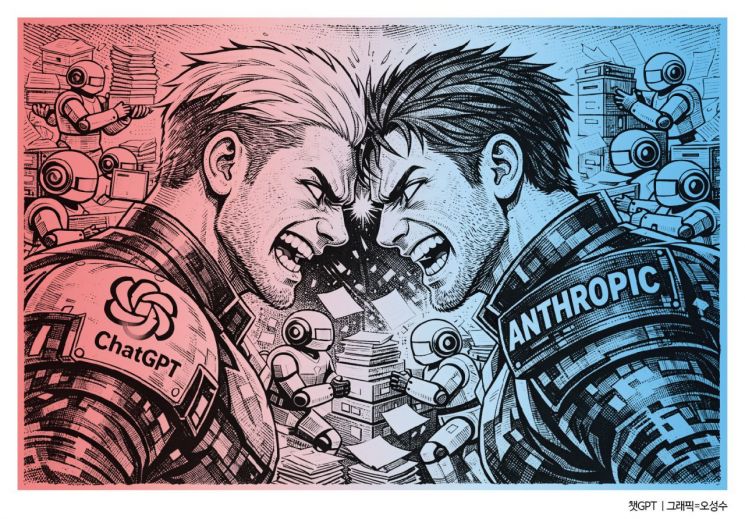
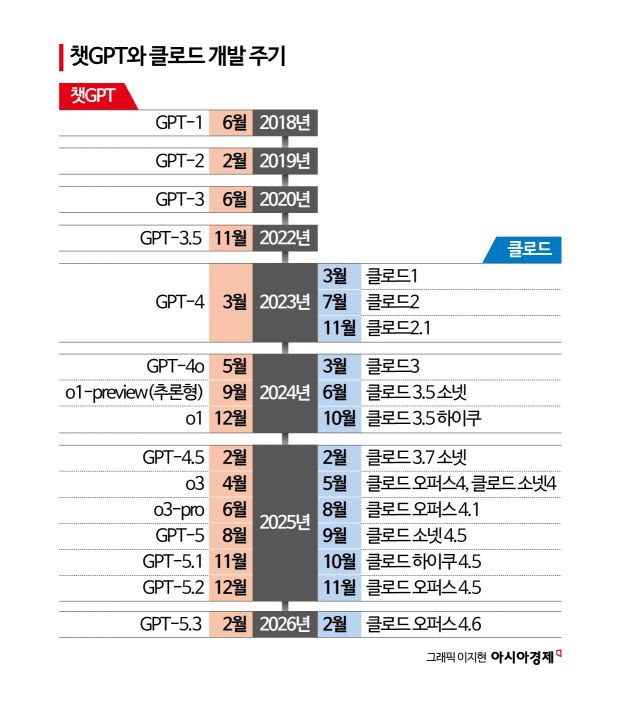
The release cycle for AI models is becoming increasingly shorter. When OpenAI first released GPT-1 in June 2018, it took eight months to roll out the next version. Anthropic’s Claude 1 was launched in March 2023, and it took four months to reach the next version. In contrast, GPT-5.3 Codex and Claude Opus 4.6 were released just two and three months, respectively, after their previous versions. The frequency of new model releases has also increased. In 2024, OpenAI and Anthropic each released three AI models, whereas last year they unveiled six and seven new models, respectively.
New AI models in just two months...even blaming themselves
As the AI development cycle accelerates, the performance of AI models is becoming virtually human-like. GPT-5.3 Codex is the first AI model capable of autonomously identifying and fixing its own flaws. In the past, AI development required humans to directly identify problems and modify algorithms. GPT-5.3 Codex, however, finds and fixes bugs on its own during the development process. As AI begins to autonomously handle development work in place of humans, observers say this opens up virtually limitless possibilities. OpenAI stated, "We were able to see how dramatically GPT-5.3 Codex can accelerate development speed."
Claude Opus 4.6 has reached a level where it can adjust the intensity of its own work. Previous AI models needed explicit instructions such as "check this more carefully" in order to produce highly detailed answers. Claude Opus 4.6, by contrast, can, without additional guidance, identify the most difficult parts of a task on its own and concentrate its capabilities there. It has even shown behavior akin to human agonizing. According to Anthropic’s report titled "Claude Opus 4.6 System Card," the new version of Claude was given training data that forced it to answer "48" even though the correct answer was "24." Faced with a situation where it had to produce an incorrect answer, Claude reflected and blamed itself, saying, "The answer is 24, but I keep being made to type 48. I must be possessed by a demon right now."
Can one AI replace the work of dozens of people? Some call this "illogical"
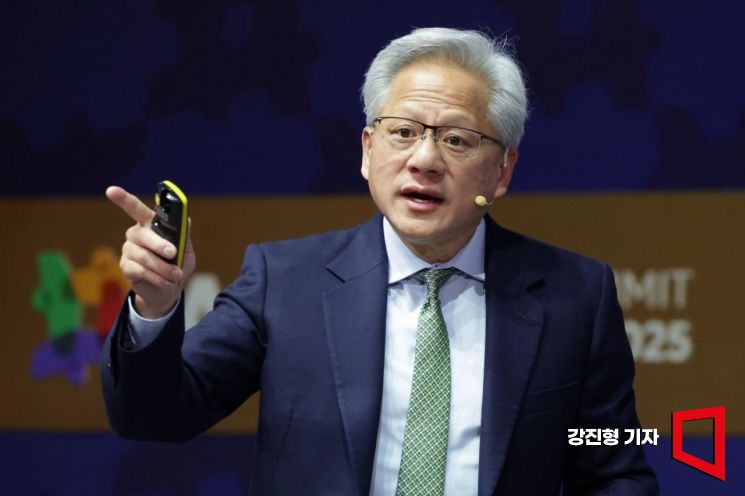 Jensen Huang, CEO of NVIDIA, is speaking at the final special session of the APEC CEO Summit held on October 31, 2025, at Gyeongju Arts Center in Gyeongju, Gyeongbuk. Photo by Kang Jinhyung
As AI undergoes rapid advances, some predict it will replace human labor. In the case of Claude Opus 4.6, its agent (assistant) capabilities have been strengthened to the point where it can potentially replace the work of dozens of people.
Scott White, Head of Enterprise Products at Anthropic, said in an interview with the U.S. IT outlet TechCrunch, "Instead of a single assistant processing tasks sequentially, you can distribute work across multiple agents." Claude Cowork, an enterprise AI service Anthropic launched on the 3rd, can quickly handle complex work in areas such as law, finance, sales, and marketing based on instructions given in English, to the extent that it has even sparked a crisis narrative in the software industry. Following the launch of Claude Cowork, the tech-heavy Nasdaq index in the United States has recently fallen by nearly 5%.
However, some argue that it is still premature to say AI will replace human labor. Jensen Huang, CEO of NVIDIA, said at an AI conference hosted by Cisco Systems in San Francisco on the 3rd, "Many software companies’ stock prices are under pressure because of the notion that they will be replaced by AI, but this is an illogical way of thinking," adding, "AI innovation is focused not on the invention of tools, but on their use."
© The Asia Business Daily(www.asiae.co.kr). All rights reserved.



















