The world manages tourism under the 'beneficiary pays' principle, while only South Korea cuts departure taxes
Japan triples its tax, New Zealand charges 80,000 won
The paradox of a 3,000-won cut in the departure tax
A problem for the industry, no
#. Office worker Kim Youngsoo (41), who was preparing for an overseas trip, recently tilted his head in puzzlement in front of the flight search screen. Discount fares caught his eye, but once various taxes and fees were added, the final payment amount was not as low as he had hoped. What was even more perplexing was the growing number of signs suggesting that "travel will become even more expensive in the future." In Europe and the United Kingdom, fees for electronic travel authorization have been made mandatory, and in Japan and major European countries, there are ongoing discussions about raising departure taxes and tourism taxes. On top of this, travelers must also separately pay local accommodation taxes, making it difficult to estimate the total cost of a trip based solely on the price of the airline ticket.
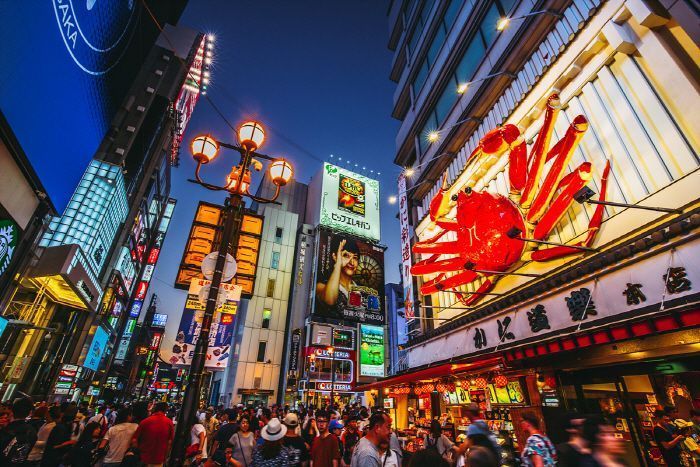
According to the tourism industry on the 10th, unlike the recent decline in airline ticket prices, the structure in which travelers actually pay more in total travel cost (TTC) is becoming entrenched. Analysts say that while airfares have fallen, there is a structural shift underway in which the various taxes and charges that accompany travel are increasing. As major tourist destinations raise travel-related taxes under the banner of fiscal recovery and tourism management, a phenomenon dubbed "taxflation" is emerging, where overall travel costs rise much like general prices.
Airfares are cheaper, so why has travel become more expensive?
The direction of tourism policy worldwide is clear. Travel is no longer seen merely as an optional personal consumption activity; it is increasingly being recognized as a public good that requires management. The hikes in departure taxes, tourism taxes, and electronic travel authorization fees are the result of this shift in perception. Major tourist destinations such as Japan, European countries, the United Kingdom, and New Zealand are without exception raising travel-related taxes. Their common justification is the "beneficiary pays" principle: travelers should share in the costs of fiscal recovery, responses to overtourism, and the maintenance of tourism infrastructure and the environment.
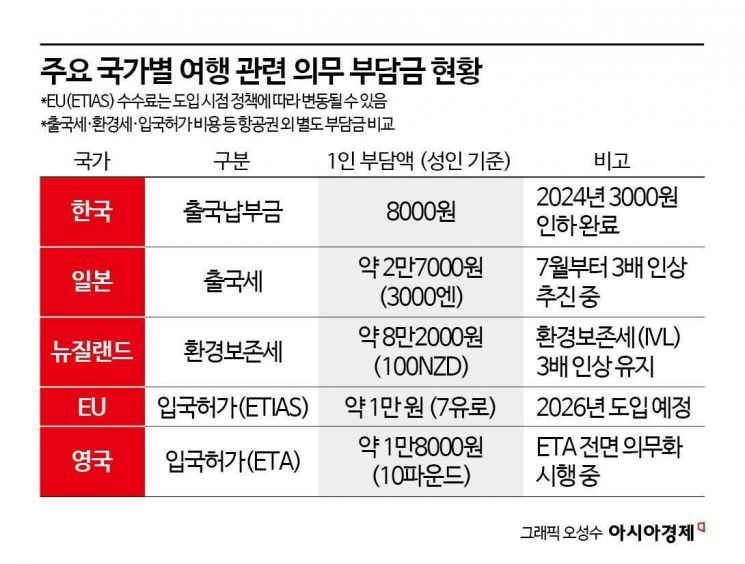
Japan illustrates this trend most clearly. The Japanese government is pushing to raise the international tourist tax from the current 1,000 yen to 3,000 yen. Based on the 2026 fiscal year, revenue from the departure tax is expected to reach about 130 billion yen, 2.7 times higher than the previous year. These funds are to be invested in easing overtourism in major destinations such as Tokyo and Kyoto, and in expanding public transportation and tourism information infrastructure. Japan is using travel taxes not as a barrier but as a "management tool."
New Zealand has gone one step further. In October 2024, it raised the International Visitor Conservation and Tourism Levy (IVL) from 35 New Zealand dollars to 100 New Zealand dollars. This amounts to about 82,000 won. The New Zealand government explained that this figure reflects the cost of the impact tourists have on the natural environment and public services. The message is clear: while visitors are welcome, they must share in the costs of maintaining the destination.
From digital border tolls to city admission fees
Europe and the United Kingdom have opted for a "digital border toll" model. From 2026, the European Union (EU) will introduce the European Travel Information and Authorisation System (ETIAS) for nationals of visa-exempt countries and will charge a fee of 7 euros. The United Kingdom is also making its Electronic Travel Authorisation (ETA) fully mandatory, charging about 18,000 won. Although the amounts themselves are not large, the fact that these are procedures travelers must complete before departure gives them significant symbolic weight. It is being interpreted as a sign that the era of truly visa-free travel is effectively coming to an end.
City-level charges are also spreading. Venice, Italy, has introduced a city admission fee of 10 euros during peak season, and Bali, Indonesia, imposes an environmental and cultural tax on all arrivals. Bhutan charges foreign tourists a Sustainable Development Fee (SDF) of 100 dollars per person per night, having shifted to a system that manages the number of tourists itself. Policies aimed at managing tourism as a public cost are spreading across the globe.
 Venice, Italy, which had been suffering from overtourism, has introduced a city admission fee of 10 euros (about 17,000 won) during peak season.
What these countries have in common is that most travel-related taxes are either automatically included in the airline ticket or collected through advance payment. Travelers end up bearing the costs without clearly recognizing when and how much they have paid. This is why, even when airline ticket prices fall, the perceived cost of travel does not decrease.
South Korea, by contrast, has chosen a different path. In July 2024, the government cut the departure tax from 11,000 won to 8,000 won, a reduction of 3,000 won. Although the official justification was to ease the financial burden on citizens, the perceived impact was limited. Instead, the reduction in the departure tax has decreased annual revenue for the Tourism Promotion and Development Fund by about 130 billion won.
South Korea went the other way... the price of a 3,000-won cut
This fund is a key source of financing for expanding regional tourism infrastructure, providing loans to small and medium-sized tourism businesses, and fostering tourism professionals. In reality, some basic local governments, including those in Jeonnam and Gyeongbuk, have seen projects to regenerate aging tourist sites and to install smart tourist information centers postponed or drastically scaled back. Representative local festivals have also faced budget cuts, resulting in fewer events or consolidation with festivals in neighboring municipalities.
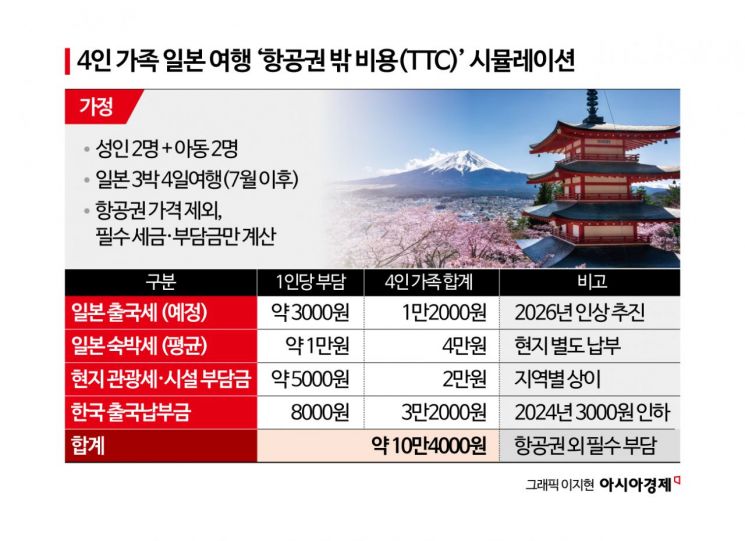
The fallout is first becoming apparent in the most vulnerable parts of the tourism industry. As fund resources have shrunk, loan support for the tourism sector has been exhausted more quickly than in previous years, putting financial pressure on small travel agencies. Programs for training young tour guides and developing digital tourism marketing professionals have also been downsized. A local government official said, "With the central government's fund shrinking, regional festival brands that we have nurtured for years are on the verge of collapsing overnight."
Backlash on the ground is also intense. Park Kangseop, Chairman of the Seoul Tourism Organization, criticized the departure tax cut as "a textbook case of populism that threatens the industry's ecosystem." Lee Kyungsoo, Chairman of the Korea Tourism Association, stressed that "the departure tax is not a cost that blocks travel but a minimum form of joint investment for travel quality and safety."
Shim Changsub, a professor in the Department of Tourism Management at Gachon University, pointed out, "In the short term, the departure tax may appear to be a way to reduce the burden on travelers, but institutionally it is a mechanism for sharing the public costs of the tourism industry," adding, "While the effect of the cut is limited, the fiscal foundation that has supported regional tourism and small businesses is bound to be directly shaken." He went on to say, "We must recognize that tourism policy standards are shifting from price competition toward prioritizing sustainability."
© The Asia Business Daily(www.asiae.co.kr). All rights reserved.



















