National Assembly Futures Institute report, "Changes in Asset Distribution and Inequality Structure among the Elderly Population"
Need for differentiated approaches to asset-rich and non-asset-rich elderly
Asset structures overly concentrated in real estate must change
Experts argue that as the number of elderly people with low income but high levels of assets increases, the government needs to design policies in a more sophisticated way. They say that the government should adopt differentiated approaches for seniors who have substantial assets but low income, and for those who lack both income and assets. In addition, considering the issue of resource allocation, voices are calling for measures to help elderly people, whose wealth is heavily concentrated in real estate, to liquidate their assets.
According to the report "Changes in Asset Distribution and Inequality Structure among the Elderly Population" published by the National Assembly Futures Institute on February 8, the elderly are, on the one hand, an income-vulnerable group, but on the other hand, the wealthy and the poor coexist among them depending on their level of asset holdings. Citing the Household Finance and Welfare Survey, the report noted that the net asset ratio of 65-year-olds exceeded the overall average net asset ratio (1.038) for the first time in history in 2024. In 2012, the net asset ratio of the elderly was 0.914, lower than the overall average, but it has now surpassed the overall average.
This change is not only due to demographic factors but can also be traced to rising real estate prices. As of 2024, 60-year-olds and older owned 54.2% of high-priced homes valued at more than 1.2 billion won, indicating a very high concentration of assets among the elderly.
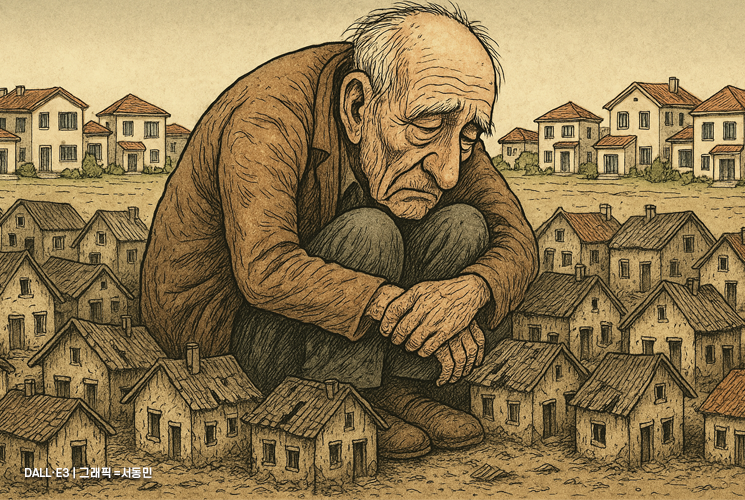
Asset-rich but income-poor elderly
The problem is that, due to the nature of real estate as an asset and its purpose for inheritance and gifts, most housing assets tend to remain frozen. Contrary to the life-cycle hypothesis, which assumes that people consume their assets after retirement, elderly people in Korea tend to hold on to their assets instead of selling them, either to pass them on to their children or to keep them for investment purposes, which leaves housing assets frozen for long periods. As a result, the number of elderly people who have many assets but little or no income increases.
The poverty problem among elderly Koreans remains severe. As of 2022, the relative poverty rate among Koreans aged 65 and older (the proportion of those with income at or below 50% or 60% of the median income) was 39.7%, overwhelmingly higher than the Organisation for Economic Co-operation and Development (OECD) average of 14.9%. Although this is lower than the 47.8% recorded in 2011, it still ranks among the worst in the OECD. However, a notable feature is that even within the same income-poor group, polarization in asset ownership is progressing. In other words, a small number of elderly people with assets coexist with a large number of elderly people without any assets.
Taking this into account, the institute points out that policy design must become more sophisticated. It stated, "We need to distinguish between the group that holds assets above a certain level and can rely on market-based retirement preparation, and the asset-vulnerable group that struggles to cover housing, medical, and care costs." It argued that a system for measuring actual income, including rental income and imputed rent, must be established to prevent distortions in poverty measurement. It also stressed the need to refine the welfare system so that asset-rich individuals, who are not visible under the current income-detection framework, can be properly taken into account when providing welfare benefits.
The institute further argued that "the asset structure of the elderly, which is excessively concentrated in housing assets, combined with relatively insufficient liquid assets and pension income, calls for the design of various mechanisms for asset utilization and income conversion, such as reverse mortgages, housing pensions, downsizing, and the use of public rental and public housing." The goal is to change the asset structure, which is heavily skewed toward real estate, and thereby improve income and related outcomes.
It also concluded that measures are needed to promote the liquidation of real-estate-heavy assets held by high-asset elderly people. For example, it proposed raising the age eligibility for products such as housing pensions and easing price ceilings in order to enhance liquidity for the elderly. It additionally suggested considering measures such as easing capital gains tax and introducing pension-conversion programs so that elderly people can move to smaller or mid-sized homes or to public rental housing.
© The Asia Business Daily(www.asiae.co.kr). All rights reserved.

















