Bloomberg likens boom to the 1990s "dot-com bubble"
Diverging market reactions amid AI skepticism
Google, Amazon, MS down 5-10%...only Meta rises
The combined capital expenditure (CAPEX) of four major U.S. big tech (large information technology) companies, including Google, is expected to exceed 950 trillion won this year. Despite talk of an artificial intelligence (AI) bubble, a sense of crisis over the need not to fall behind in the race for technological innovation appears to be driving companies to ramp up investment spending.
According to foreign media outlets such as the Financial Times (FT) on the 5th (local time), the total CAPEX of Google, Amazon, Microsoft (MS), and Meta Platforms (Meta) this year is projected to reach 650 billion to 660 billion dollars (about 954 trillion to 969 trillion won).
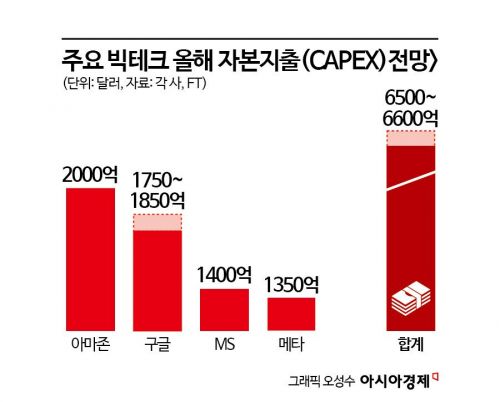
On the 4th, Google presented its expected capital expenditure for this year at 175 billion to 185 billion dollars (about 258 trillion to 272 trillion won), roughly double last year’s CAPEX of 91.4 billion dollars. Sundar Pichai, Chief Executive Officer (CEO) of Google and its parent company Alphabet, described the sharp increase in capital investment this year as a “forward-looking investment,” explaining that “demand for our services across the board is very strong, so we must invest in Google DeepMind and our cloud business.”
On the 5th, Amazon said it expects to spend 200 billion dollars (294 trillion won) in CAPEX this year on expanding AI data centers and related projects, well above last year’s 150 billion dollars. MS also stated at the end of last month in its earnings release that it plans to invest more than 140 billion dollars (206 trillion won) this year in AI facilities and related sites, which is 1.7 times last year’s CAPEX of 81.1 billion dollars. Meta, which operates Facebook and Instagram, announced that its CAPEX this year will reach 135 billion dollars (198 trillion won), about 87% higher than the previous year.
Bloomberg reported that this investment boom is comparable to the dot-com boom of the 1990s or the railroad construction boom in the United States in the 19th century. Gil Luria, an analyst at U.S. investment bank (IB) DA Davidson, told Bloomberg, “These four companies see the current competition over leadership in AI infrastructure as a winner-takes-all race. There is a sense that none of them will tolerate falling behind in this race.”
However, many investors are voicing concern that AI adoption and commercialization across industries are still at a very early stage with many uncertainties, and that there is no clear surge in earnings to support such massive “AI bets.” In fact, the share prices of Google, Amazon, and MS plunged by 5% to 10% on the day they announced their CAPEX outlooks. Meta was the only exception, rising on the back of reactions that AI is helping improve advertising efficiency.
Google highlighted the rapid growth of its AI chatbot “Gemini” and the solid performance of its advertising and cloud businesses, but did not fully dispel concerns over its large-scale AI investments. Amazon and Microsoft also posted decent earnings, but their share prices fell by about 10% and 7%, respectively, after the earnings releases, weighed down by the prospect of increased AI-focused CAPEX this year. The New York Times (NYT) pointed out, in relation to MS’s struggles, that the AI business has not yet demonstrated enough tangible growth to convince investors, which had a significant impact.
© The Asia Business Daily(www.asiae.co.kr). All rights reserved.
![From Hostess to Organ Seller to High Society... The Grotesque Scam of a "Human Counterfeit" Shaking the Korean Psyche [Slate]](https://cwcontent.asiae.co.kr/asiaresize/183/2026021902243444107_1771435474.jpg)
















