Annual revenue surpasses 40 billion dollars for the first time
Gemini MAU reaches 750 million
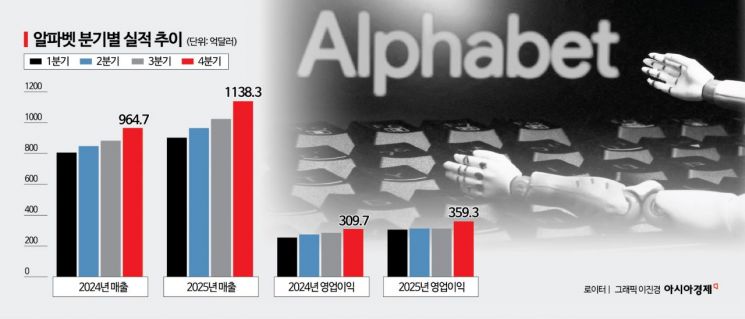
As Alphabet, Google's parent company, has reported quarterly results that beat market expectations, analysts say that continued investment in artificial intelligence (AI) is firmly establishing itself as the company's core real growth engine. Google is boosting its revenue by integrating AI across all of its business segments - advertising, platforms, and cloud - with its AI model Gemini at the forefront.
Alphabet announced on the 4th (local time) that its revenue for the fourth quarter of last year (October to December 2025) came to 113.83 billion dollars, an 18% increase from the same period a year earlier. Operating profit rose 16% to 35.9 billion dollars, and net profit jumped 30% to 34.5 billion dollars. Annual revenue exceeded 400 billion dollars for the first time in the company’s history. All of these figures are far above market expectations.
Double-digit growth in advertising and YouTube... Cloud division up 48% on AI demand
By business segment, revenue from the core search and advertising division grew 17% to 63.1 billion dollars, while YouTube advertising revenue increased 9% to 11.4 billion dollars. In particular, the cloud division, driven by growing demand for AI model training and operation, saw its revenue surge 48% to 17.7 billion dollars.
The AI model Gemini has become the key driver of growth. Sundar Pichai, Alphabet and Google CEO, said of the fourth-quarter results, "Gemini 3 has become a key milestone in our growth and we have built strong momentum," adding, "The monthly active users (MAU) of the Gemini app have grown to more than 750 million."
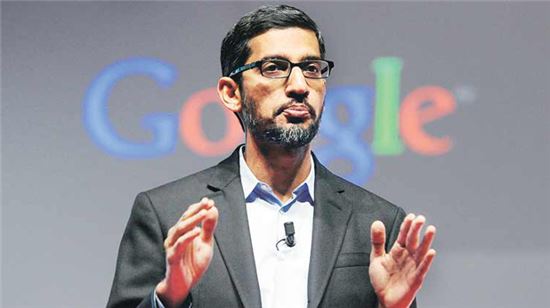 Pichai Sundar, Google CEO. Photo by AP Yonhap
Gemini is rapidly catching up with ChatGPT. Sam Altman, OpenAI CEO, recently issued an internal code red after witnessing Gemini’s fierce pursuit and ordered that all capabilities be focused on ChatGPT.
Apple’s decision last month to adopt Gemini instead of its own model is boosting Google’s valuation. While Apple has restricted AI spending and earned the stigma of being an "AI latecomer," Google, Meta, Amazon, Microsoft (MS) and others have been pouring massive budgets into AI development competition. Now that Google has joined hands with Apple, which has 2.5 billion active devices worldwide, it has secured a foothold to reach a much larger user base. Pichai said, "Gemini is becoming the AI engine for some of the most successful software companies in the world."
Capital expenditures up to 185 billion dollars... Profitability challenge versus investment
Alphabet expects this year’s capital expenditures to be between 175 billion and 185 billion dollars. This far exceeds the market consensus of 152.6 billion dollars. Newly appointed Chief Financial Officer (CFO) Anat Ashkenazi explained, "These funds will be used to expand Google DeepMind’s AI computing capabilities, respond to cloud customer demand, and invest in other new business strategies."
Google plans to continue massive investments to expand its AI infrastructure, including data centers, graphics processing units (GPUs), and tensor processing units (TPUs). With Meta saying it will increase this year’s capital expenditures by 73% to between 115 billion and 135 billion dollars (approximately 167 trillion to 197 trillion won), and Microsoft (MS) having announced record quarterly capital expenditures, Google has effectively jumped into the AI investment race in earnest. Some forecasts suggest that major big tech companies will pour more than 500 billion dollars (around 730 trillion won) into AI this year.
Some observers said, "As large cloud companies spend enormous amounts on building infrastructure, it is true that investors are becoming increasingly concerned about the returns from AI investments," and added, "This year they face the task of proving whether past investments will translate into profits." Despite the strong results, Alphabet’s Class A common stock at one point fell as much as 7% in after-hours trading, as concerns over the investment burden weighed on the share price.
© The Asia Business Daily(www.asiae.co.kr). All rights reserved.
![Clutching a Stolen Dior Bag, Saying "I Hate Being Poor but Real"... The Grotesque Con of a "Human Knockoff" [Slate]](https://cwcontent.asiae.co.kr/asiaresize/183/2026021902243444107_1771435474.jpg)
















