Lenticular clouds form when terrain and weather conditions coincide
Last weekend, clouds with a unique shape resembling a UFO appeared in the skies over the Yeongbuk region of Gangwon Province, drawing attention.
According to Yonhap News Agency on the 4th, on the afternoon of January 31, flat and smooth clouds shaped like UFOs were observed in the skies over the Yeongbuk region, including Sokcho City and Yangyang County in Gangwon Province. At the time, the sky was clear with hardly any other clouds, and only the clouds in question were floating in the airspace near Seoraksan National Park.
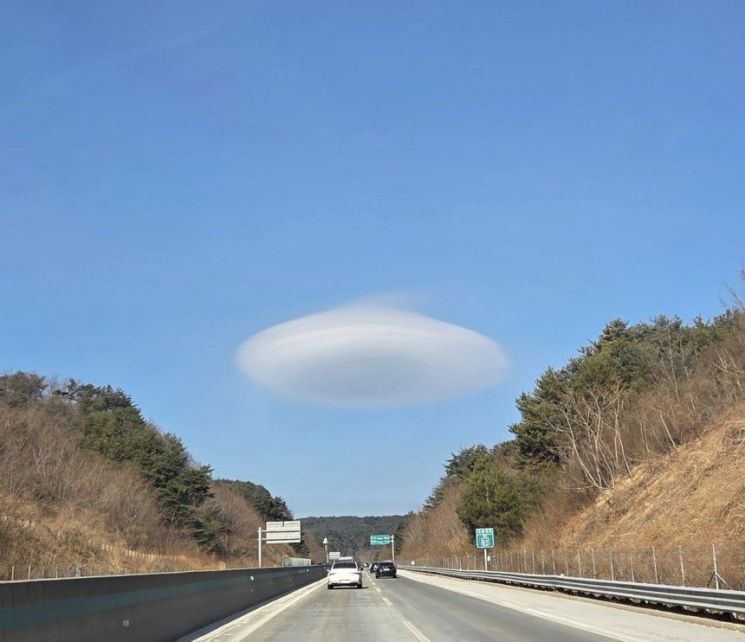
These clouds are "lenticular clouds," which appear locally only at specific points under clear weather conditions. Lenticular clouds form when mountainous terrain such as Seoraksan and particular weather conditions coincide.
When airflow crossing a mountain range intensifies, cold and fast winds pass vertically over the mountains, causing the air to oscillate up and down like waves. At points where the air rises, the temperature drops and water vapor condenses to form clouds, while in descending sections the clouds dissipate. This creates a structure in which clouds are sustained only at specific altitudes and locations. As this phenomenon repeats, clouds form only along a fixed plane above the mountain range, their edges remain undisturbed, and they take on a smooth shape as if cut with a knife.
Because of this, lenticular clouds are characterized by their unique appearance resembling a saucer or a UFO. Their shape does not change significantly even in strong air currents, and they can sometimes appear in multiple stacked layers. However, they do not usually persist for long periods, which adds to their mysterious impression.
Kong Sangmin, forecast analyst at the Korea Meteorological Administration, said, "When the air is stable and strong winds blow over a mountain, the air can be lifted and cooled, forming saucer-shaped lenticular clouds," adding that "they are the result of terrain and weather conditions occurring simultaneously." Lenticular clouds often do not accompany rain or snow, so they can appear locally even when the overall weather is clear. In addition, because they are heavily influenced by terrain, they are observed relatively frequently in the Yeongbuk region located between the East Coast and Seoraksan, as well as in the Jeju area near Hallasan.
Despite their mysterious appearance, they pose a threat to aircraft operations
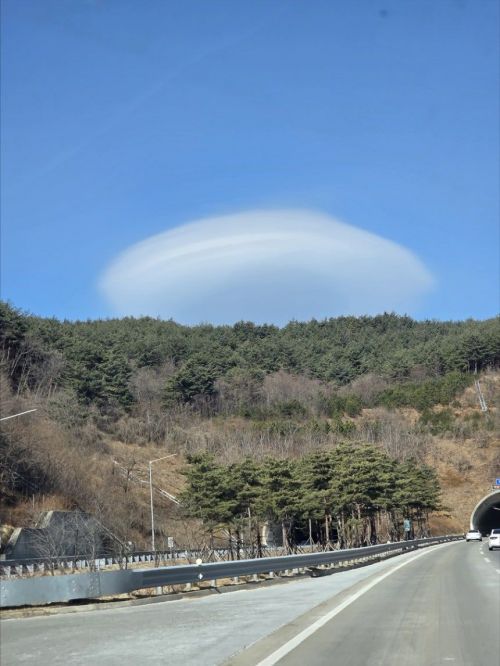
However, despite their mysterious appearance, lenticular clouds can pose a threat to aviation safety. Near the atmospheric inversion layer where lenticular clouds form, strong winds crossing mountains generate mountain waves, and these mountain waves in turn create severe turbulence that can endanger aircraft operations.
In fact, in 1966, BOAC Flight 911 from Narita Airport in Tokyo, Japan to Kai Tak Airport in Hong Kong suddenly crashed near Mount Fuji, killing all 124 passengers and crew on board. An investigation found that lenticular clouds had been observed in weather satellite images about 30 minutes before the accident, and concluded that the aircraft encountered severe turbulence caused by mountain waves, leading to the crash.
© The Asia Business Daily(www.asiae.co.kr). All rights reserved.