"Supporting Victims Through Lowest-Price Bidding? It Makes No Sense"
Eleven Existing Victims and Sixteen New Reports Left Unattended
Film Organizations and Sexual Violence Relief Center Sign "Joint Agreement"
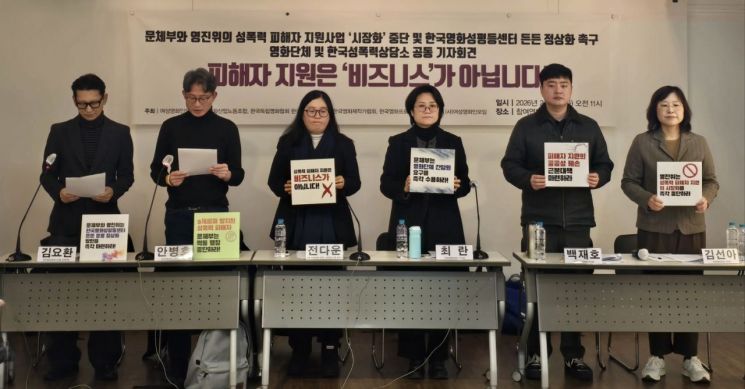
The film industry has pushed back against the government's plan to overhaul its support program for victims of sexual violence, declaring that "protecting victims is not a business." As the Ministry of Culture, Sports and Tourism and the Korean Film Council shifted victim support work to a competitive bidding system, critics argue that the public nature and expertise of the program have been undermined.
Film organizations including Women in Film Korea, the Korea Sexual Violence Relief Center, and the Korean Film Workers' Union held a press conference on the 3rd at Neutinamoo Hall in the People’s Solidarity for Participatory Democracy building in Jongno-gu, Seoul, calling for an end to the "marketization" of the sexual violence victim support program and for the normalization of the Korean Film Gender Equality Center Ddeunddeun. They criticized the Korean Film Council for halting public support for Ddeunddeun on May 20 last year and allowing an "administrative vacuum" in victim protection to continue for nine months.
The situation began when the Korean Film Council moved away from the existing designated consignment model and sought to introduce competitive bidding via the Public Procurement Service. The organizations stressed that "it makes no sense to run sexual violence victim support work, which requires a high level of expertise and trust, based on 'lowest-price bidding' or 'one-year short-term contracts'."
Paek Jongmin, a director of the Association of Korean Independent Film & Video, demanded that the stability of the system be ensured, saying, "A system that has lost trust can no longer function as a safety net." Choi Ran, deputy director of the Korea Sexual Violence Relief Center, also voiced concern that "if the support program is transferred to a for-profit corporation, it could shift away from victim protection and be distorted into 'market logic' centered on legal disputes, potentially causing secondary harm."
The consequences of this administrative vacuum are falling squarely on the victims. According to Women in Film Korea, even after the support was cut off, there are still eleven existing victims in the program, and sixteen new counseling and reporting cases were received by the end of last year. However, due to budget shortages, medical and psychological counseling and legal support are restricted, leaving some victims to pay medical expenses out of pocket. Although the Korean Film Council temporarily provided about 2.5 months’ worth of funding following criticism during the National Assembly audit, there is still no continuous protection plan in place.
With government support cut off, the film community has started to devise its own countermeasures. On this day, Women in Film Korea signed a work agreement with the Korea Sexual Violence Relief Center and decided to jointly provide legal and medical support to victims until the end of April. In addition, it announced the creation of its own safety net by signing a joint agreement with related organizations such as the Tripartite Film Industry Council for the stable operation of Ddeunddeun.
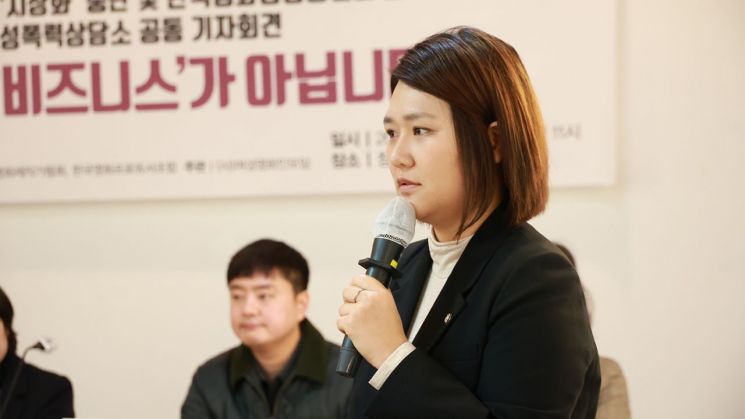
Assembly member Son Sol, who attended the press conference, stated, "The current vacuum is the result of the Ministry of Culture, Sports and Tourism, the responsible ministry, standing by and doing nothing," adding, "We will hold them accountable at the National Assembly level." The participating organizations presented four key demands, including the immediate halt to the marketization of victim support programs, a clear declaration of the principles of public interest and non-profit operation, and the acceptance by the Ministry of Culture, Sports and Tourism of an official roundtable with the film industry, urging the government to take a more forward-looking stance.
© The Asia Business Daily(www.asiae.co.kr). All rights reserved.