IARC/WHO study on cancer risk factors
"Reducing smoking, alcohol use, and infections can help prevent cancer"
"Tailored strategies needed that reflect gender- and region-specific patterns"
A new study has found that about 40% of all new cancer cases worldwide each year are related to "modifiable risk factors" such as smoking, infections, and alcohol consumption.

Research team analyzes links between factors such as smoking, alcohol use, BMI and cancer incidence
According to Yonhap News on February 4, the team led by Dr. Hannah Finke at the International Agency for Research on Cancer (IARC/WHO) of the World Health Organization reported in a paper published in the prestigious medical journal Nature Medicine that "among the 18.7 million new cancer patients with 36 types of cancer worldwide in 2022, the causes of about 7.1 million cases were found to be associated with modifiable risk factors."
Cancer is one of the leading causes of illness and death, and its burden varies by region. This is because populations are exposed to different modifiable risk factors, which include behavioral, environmental, infectious, and occupational factors. In this study, the research team used data from the global cancer statistics database GLOBOCAN, established by IARC, to estimate the global and country-specific (185 countries) cancer burden for 36 types of cancer that can be attributed to 30 modifiable risk factors.
Taking into account the latency period until cancer develops, the team combined the 2022 cancer incidence data (185 countries, 36 cancer types) with data on the prevalence of exposure to risk factors from 10 years earlier. They then calculated the associations between each risk factor and cancer incidence, taking into consideration that some risk factors can occur simultaneously. The 30 modifiable risk factors included smoking, alcohol consumption, high body mass index (BMI), physical inactivity, insufficient breastfeeding, air pollution, ultraviolet radiation, nine infectious agents, and 13 types of occupational exposure.
For men, smoking is the greatest risk... for women, infections such as HPV
The analysis showed that, among the 18.7 million new cancer patients, the causes of 2.79 million women (29.7%) and 4.3 million men (45.4%), totaling 7.1 million people (37.8%), were associated with modifiable risk factors. Smoking accounted for the largest share at 15.1%, followed by infections (10.2%) and alcohol consumption (3.2%).
In particular, for lung cancer, stomach cancer, and cervical cancer, cases caused by such modifiable factors accounted for nearly half of all cases. Among women, infectious factors such as human papillomavirus (HPV) and Helicobacter pylori accounted for 11.5% of all cancers, while among men, smoking (23.1%) emerged as the largest risk factor.
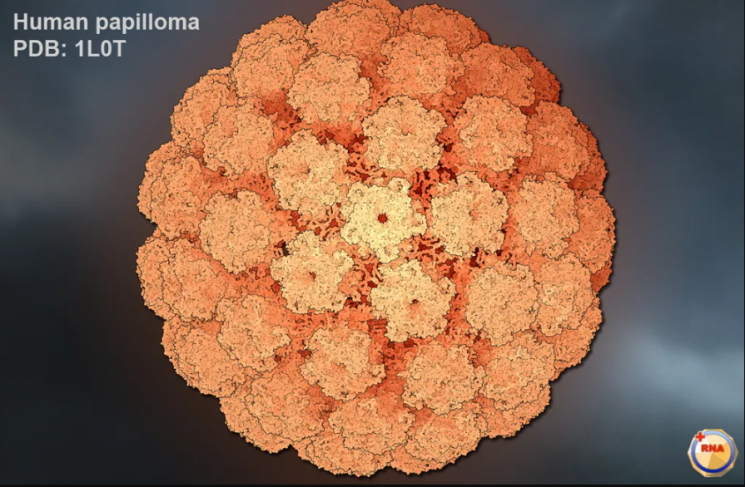 Image of human papillomavirus (HPV) to aid understanding of the article. Molecular Virology Laboratory, University of Wisconsin, USA
There were also regional differences. For women, the proportion of cancers attributable to modifiable factors was high in sub-Saharan Africa at 38.2%, but was 24.6% in North Africa and West Asia. In addition, 57.2% of cancer cases among men in East Asia were due to modifiable risk factors, compared with 28.1% among men in Latin America and the Caribbean, showing a large gap.
The research team stated, "Reducing smoking, infections, and alcohol consumption remains essential for cancer prevention," adding, "Understanding the relationship between the global cancer burden and modifiable risk factors can help each country plan prevention programs tailored to its own circumstances." They also projected, "If current trends continue, new cancer cases are expected to increase by 50% by 2040," and stressed that "reducing exposure to modifiable risk factors is one of the most effective and sustainable ways to prevent cancer."
They added, "National policies should be tailored strategies that take into account regional disease patterns and the prevalence of risk factors, such as strengthening tobacco control and expanding vaccination and screening programs," and emphasized that "approaches that reflect gender-specific characteristics, including broader HPV vaccination coverage and preventive services, are also essential."
© The Asia Business Daily(www.asiae.co.kr). All rights reserved.