President Lee Presides Over Cabinet Meeting on the 3rd
Following Ministry's Report on "Promoting Life-Sustaining Treatment Plans"
Lee: "Dying at Home Will Likely Cost Less"
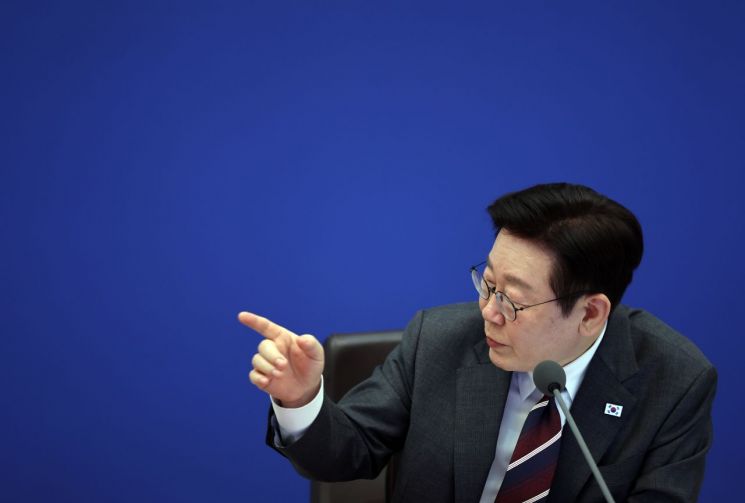 President Lee Jaemyung is speaking at a cabinet meeting held at the Blue House on the 3rd. Yonhap News
On the 3rd, President Lee Jaemyung ordered a review of related measures regarding the withdrawal of life-sustaining treatment, saying, "It would be good to have incentives."
President Lee made these remarks in the afternoon at a Cabinet meeting after receiving a report from Minister of Health and Welfare Jung Eun-kyeong on measures to promote the use of life-sustaining treatment plans.
President Lee said, "Not providing life-sustaining treatment and allowing patients to die at home does require manpower and costs," but added, "Not providing life-sustaining treatment and allowing patients to die at home will require far less manpower and costs."
He went on to say, "Then it is right to invest boldly. Please proceed that way."
President Lee had also asked during a Ministry of Health and Welfare work briefing in December last year, "If we do not provide life-sustaining treatment, costs are reduced; are you considering compensation or incentives?"
The Ministry of Health and Welfare plans to expand the timing for drawing up advance directives on life-sustaining treatment from the current "terminal stage" to "the point at which the terminal stage is anticipated." By moving this timing forward, the ministry aims to encourage patients and medical staff to decide earlier on whether to withdraw life-sustaining treatment.
The ministry also plans to expand the period during which the withholding or withdrawal of life-sustaining treatment is allowed, which is currently limited to the dying phase, and to increase the number of institutions authorized to provide life-sustaining treatment.
Minister Jung explained, "Once a decision is made not to receive life-sustaining treatment, there must be proper end-of-life care until death, but at present there is a shortage of institutions that provide end-of-life care," adding, "We intend to focus on expanding end-of-life care infrastructure so that people can experience a proper end of life."
© The Asia Business Daily(www.asiae.co.kr). All rights reserved.