Paid Access for About 12 Hours a Day, from Morning Until Night
A paid admission system has been introduced for viewing the Trevi Fountain in Rome, Italy. As more popular tourist attractions have begun charging fees in response to complaints from nearby residents, the Trevi Fountain has also started collecting a 2-euro ticket fee (about 3,400 won). The Trevi Fountain is famous for the belief that throwing in two coins will make you fall in love, and three coins will lead to marriage.
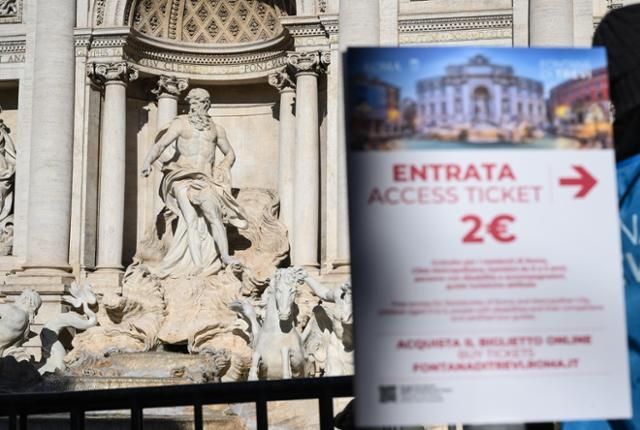 On the 2nd, when an admission fee began to be charged at the Trevi Fountain in Rome, Italy, a sign in front of the fountain was posted instructing visitors to pay an admission fee of 2 euros. EPA, Yonhap News
The Guardian reported on the bustling scene on the 2nd (local time), when admission fees began to be charged to visitors to the Trevi Fountain. The newspaper wrote, "Most people were happy to pay the fee in cash or via contactless payment machines," but added, "Some refused to pay, saying that the fountain should be for everyone, and walked away from it."
The fee must be paid by visitors who are not residents of the city of Rome when they attempt to go down the steps to reach the area directly in front of the fountain, which is located below street level. Because the purpose is to disperse crowds and improve management, the fee is only charged during peak visiting hours: from 11:30 a.m. to 10:00 p.m. on weekdays, and from 9:00 a.m. to 10:00 p.m. on weekends.
 On the 2nd (local time), when entrance fees began to be charged at Rome's Trevi Fountain, a tourist paid the fee and then approached the fountain to take a photo. Photo by EPA Yonhap News
Completed in 1762, the Trevi Fountain has long been one of Rome's most famous tourist attractions, open to all. At its center, the god of the ocean, Oceanus, stands atop a chariot, flanked on both sides by the sea god Triton guarding him. It was designated a UNESCO World Heritage Site in 1980. Most tourists who visit sit with their backs to the fountain and toss coins over their left shoulder as a ritual, and the value of the coins collected from the bottom of the fountain over the course of a year amounts to 1.6 million euros (about 2.7 billion won, as of 2023).
The problem is that excessive numbers of tourists have made maintenance and repairs difficult. Alessandro Onorato, Rome’s tourism councilor, told The Guardian, "Until just a year ago, there were uncontrollable crowds at the Trevi Fountain, and some people were even jumping into the basin, so the situation was a mess." In the end, after reviewing several measures such as an advance reservation system in 2024, the city authorities decided to introduce a ticket system.
The number of visitors to the Trevi Fountain last year is reported to have exceeded 10 million. The city of Rome expects annual admission revenue of 6.5 million euros (about 11.1 billion won), which will be reinvested in the maintenance and management of historical sites in Rome. Mayor Roberto Gualtieri told Euronews that in 2025 alone, more than 10 million tourists visited the fountain and that during the peak season, as many as 70,000 people visited in a single day.
Not only the Trevi Fountain, but also many historic tourist sites across Italy have recently adopted similar fee systems. The Pantheon in Rome has been charging a 5-euro admission fee since 2023. The courtyard in Verona made famous by Shakespeare’s "Romeo and Juliet" has been charging 12 euros per adult since December last year. Venice, starting in 2024, began imposing a 5-euro entry tax on day-trip visitors during the peak season.
© The Asia Business Daily(www.asiae.co.kr). All rights reserved.